Going From 'Is That Art?' to Artistic Meaning

     I don’t remember when I first heard the sentence “Anything can be a work of art.” It must have been over thirty-five years ago, when I was first developing an open curiosity about contemporary art, particularly in its then-newly emergent genres of performance, video, and installation. One of the works that I saw repeatedly around 1980 at the Berkeley Art Museum was Robert Smithson’s ‘Mirror Displacements’, the exhibition of which I recall consisted of several distinct piles of sand or dirt, each supporting a small, rectangular, vertical mirror. Something of its supporting pile was reflected in each mirror. What does this work mean? At that time I knew nothing of Smithson’s thought, in particular his conception of a work of art as a ‘dialectic of site and non-site’, a conception that the work was meant to embody. But attaching the thought that anything can be a work of art to ‘Mirror Displacements’ seemed to begin the process of reflective understanding: well, if anything can be a work of art, then mirrors stuck in piles of dirt can be one. But since not all piles of dirt with mirrors are works of art, what further is required for this use of these materials to result in an artwork? How does one pass from ‘can’ to ‘is’?

smithson mirror displacement.jpg

    There is I think a standard answer to this question, and one given in the second great axiom of contemporary art: “Something is a work of art if someone says it is a work of art.” In its most common iteration, the ‘someone’ is specified narrowly as an ‘artist’, or sometimes more broadly as a member of something called ‘the artworld’, which includes at least the studios, galleries, museums, and art history departments of the world. A moment’s reflection suggests that the first sentence expresses an implication of the axiomatic second sentence, since the range of things that someone can declare to be a work of art is unrestricted. The standard exempla of the second sentence are the readymades of Marcel Duchamp, or perhaps the work of Robert Rauschenberg declaring “This is a portrait of Iris Clert if I say so,” although the Rauschenberg piece at least does not declare itself to be a work of art.

raush iris clert.jpg

     A striking feature of this cluster of intuitions, perceptions, and thoughts is that it centers on the question of status of individual artifacts. If there is any urgency motivating this cluster, it seems to be generated by anxiety about classification: one is confronted by some non-standard instance of a putative work of art, and one wants to know whether it really is an artwork. Why should that matter? Well, presumably because an artifact’s being (judged) a work of art is way of singling it out for special attention, and so inclusion within special places that foster attention to particular artifacts, which with regard to the visual arts in modern life means inclusion and exhibition in galleries and museums. A second striking feature of this cluster is that axioms within it are silent about what sort of special attention artworks merit, and what it means for such attention to be rewarded. As a start one might say very roughly that what rewards such attention is something like ‘artistic meaning’. If so, then the coarse structure of a theory of art would consist of two unconnected parts: a theory of art-status oriented towards answering the question ‘What makes an artifact a work of art?’; and a theory of artistic meaning oriented towards answering questions like “What sort of meanings are distinctive of artworks?” and “How do artworks acquire distinctively artistic kinds of meaning?” It’s not obvious how on this picture one could begin to develop a theory of artistic meaning; the conceptually prior theory of art-status offers no guidance.

      What alternative might there be to a two-part account? Perhaps the beginning of wisdom in these matters is to begin with the second part, and treat art status as simply a vaguely defined point on spectrum of artistic meaning. I’ll try to explicate this obscure thought in future posts, but consider now the account of artistic meaningfulness offered art theorist Gottfried Semper back in the middle of the 19th century. Semper started from the question of how materials take on meaning in the process of creating artworks. First, they take on meaning because they are so to speak elaborated artifacts. The particular kind of elaboration that is most distinctive of works of art comes from the way in which artifacts become richly self-informative about how they are made. So, for a extremely simple example, motifs are might be added to a pot made on a wheel that evoke the process of spinning, as in the sense of torsion in Minoan pottery.

Kamares Jug.jpg

     Or something of the sense of seriality, of repeated elements emerging into view and submerging from view, might show up in decoration, as in the stupefying textiles of the Andean civilization of the Paracas.

       The second major way in Semper’s account in which materials gain meaning in their artistic uses is through metaphor. Again, some extremely simple, and also extremely common, ways in which this takes place in the visual arts globally is through the metaphorical treatment of a pot as a woman’s body, as again in a very early Minoan pot depicting a goddess.

goddess of myrtos.jpg

      On this line of investigation, one begins with immersion in some of the world’s artistic traditions, and comes to recognize instances of artistic meaning ‘at full stretch’, that is, where artworks attain a high-degree of meaningfulness. These works are in turn treated as exemplary instances of art. This solves the problem of determining art’s extension, one of the problems that plagues the standard two-part approach—non-exemplary artworks have the status of works of art as a matter of the degree to which they share the kinds of artistic meaningfulness seen in the exemplary works--, and treats art-status as determined by and derivative of artistic meaningfulness.

     In the next blog post I’ll consider the insoluble problems in one of the most influential accounts of art of the past half-century, the philosophical account of art proposed by Arthur Danto.

Merce Cunningham and Robert Rauschenberg at LACMA--A Kind of Failure?

     One of the central events in the mid-twentieth century arts was the forging of a new poetics by the composer/inventor John Cage, the dancer/choreographer Merce Cunningham, and the visual artist Robert Rauschenberg. To my mind this poetics has not been well characterized in the literature on the arts. One early and dismissive view was that it amounted to ‘neo-Dadaism’, presumably because of its seemingly anarchic quality and its use of materials that were not traditional vehicles of artistic expression. Another view was that it was an ‘aesthetics of chance’. This seemed to capture something central to Cage’s work, which starting in the late 1940’s involved methods of chance composition, and some of Cunningham’s choreography, which used chance to choose the order of poses and positions of the dancers. And Cunningham’s pieces were only united with their music at the actual performance, so at any moment the juxtaposition of music and dance was unforeseen by either artist, and so in a sense a matter of chance. Yet chance played no prominent part of Rauschenberg’s artistic process, and Cage and Rauschenberg both insisted that they were operating with a shared sensibility and poetics.

rauschenberg canyon j.jpg

     The most secure route into this poetics is, I think, through considering what each artist vehemently rejected: the fundamentally Romantic model of the work of art as primarily an expression of the artist’s mind, in particular of the artist’s mental states, attitudes, moods, and emotions. Each experienced this model as oppressive in limiting the choice of materials and handling to precisely those and only those that expressed the artist’s taste. Why is the expression of taste objectionable? Perhaps the answer for this poetics is the formative and ineliminable role of the past. Taste is the present and summative achievement of a sensibility originating perhaps in early childhood, and presumably for most of us no later than early adulthood. When the composer finds herself drawn to a certain sequence of seventh chords, the dancer to a certain fluid sweep of the arm, the painter to a certain scumbling in the background, and each puts something of those into her new work, there is a sense in which the past dominates the present; that taste that was (necessarily) formed prior to the act of making selects the elements and starts to position them within the work so that they will bear certain meanings (and not others). If this is right, then what this poetics rejects is not exactly ‘self-expression’, though this is the terminology used both by critics and the artists themselves, but rather a particular model of the self in art, that is, one wherein the self that is being expressed is treated, for the purposes of making art, as fixed prior to the act of making.

cunningham rainforest j.jpg

       What Cage, Cunningham, and Rauschenberg shared was an ambition and an attitude towards artistic meaning. The ambition was a sort of ‘letting-be’: let sounds be sounds (and not vehicles for expression and elements of structure); let movements be movements (and not vehicles for the expression of some mysterious and otherwise unavailable interiority); let things be themselves (and not bearers of extra-artistic meaning or compositional elements). This poetics is given its greatest exemplifications in celebrated works from the late 1940’s through the 1960’s such as Cage’s Sonatas and Interludes for Prepared Piano and String Quartet no. 1, Cunningham’s Winterbranch and RainForest, and Rauschenberg’s ‘Canyon’ and ‘Monogram’. My recent trip to the Los Angeles County Museum of Art to see the exhibition of Cunningham’s works entitled ‘Clouds and Screens’ and Rauschenberg’s (literally) ‘The ¼ Mile or 2 Furlong’ piece raises a question: when and why does this poetics falter?

rauschenberg 1:4 mile j.jpg

     Many viewers have noted a decline in interest in Rauschenberg’s work around 1964, and such viewers (including myself) face the prospect of 1040 or so feet of later Rauschenberg with some trepidation. Rauschenberg said that the distance between his house and his studio determined the physical expanse of the piece; so it was part of his attempt to ‘blur the boundaries’ between art (the studio) and life (the house). Also, Rauschenberg suggested that the one sure effect of viewing the piece was that by the end the viewer would not remember her thoughts at the beginning. So the sheer expanse does something to fulfill the constitutive aim of the poetics: it eliminates the possibility of a synoptic grasp of the work. Who can so much as remember it all, much less organize, analyze, and understand it all? But one might think that this is a rather desperately literal-minded way of fulfilling the poetics.

cunnningham:Brown j.jpg

     The exhibition of Cunningham’s work falls into three parts. In the entrance are some of the floating silver balloons that Warhol designed as part of the staging of ‘RainForest’. To the left are eccentrically placed and irregularly showing projections of two films of Cunningham dancing: a solo performance of Changeling (1957; filmed 1958) and a duet with Carolyn Brown of Night Wandering (1957; filmed 1964). To the right is a room containing 19 screens and projectors showing bits of performances of Cunningham’s company. The brief sequences are seemingly unconnected, except that occasionally there is a countdown of numbers (‘9 . . .8 . . .7’) on some screens, and less frequently a simultaneous such countdown on all the screens. This surely is meant to exemplify Cunningham’s and Cage’s practice of treating a fixed temporal expanse as the sole element shared by the otherwise uncoordinated sounds and movements in a performance. Cunningham himself had introduced the practice of staging ‘Events’ consisting in part of combined excerpts from different pieces. But this too seemed to me a failure. Why? The excerpts are all quite brief, so nothing of the sense of a sustained performance is evoked. Perhaps part of what made Cunningham’s work so compelling was the sense of conveyed in every performance of a difficult activity sustained. Seeing such an activity perhaps induces in the mind of the viewer the sense that the artist is engaged in a serious activity, though one without clear analogues in everyday life. And so one trusts the artist. I watched the performance of Night Wandering four times; in Cunningham and Brown one has artists one can trust.

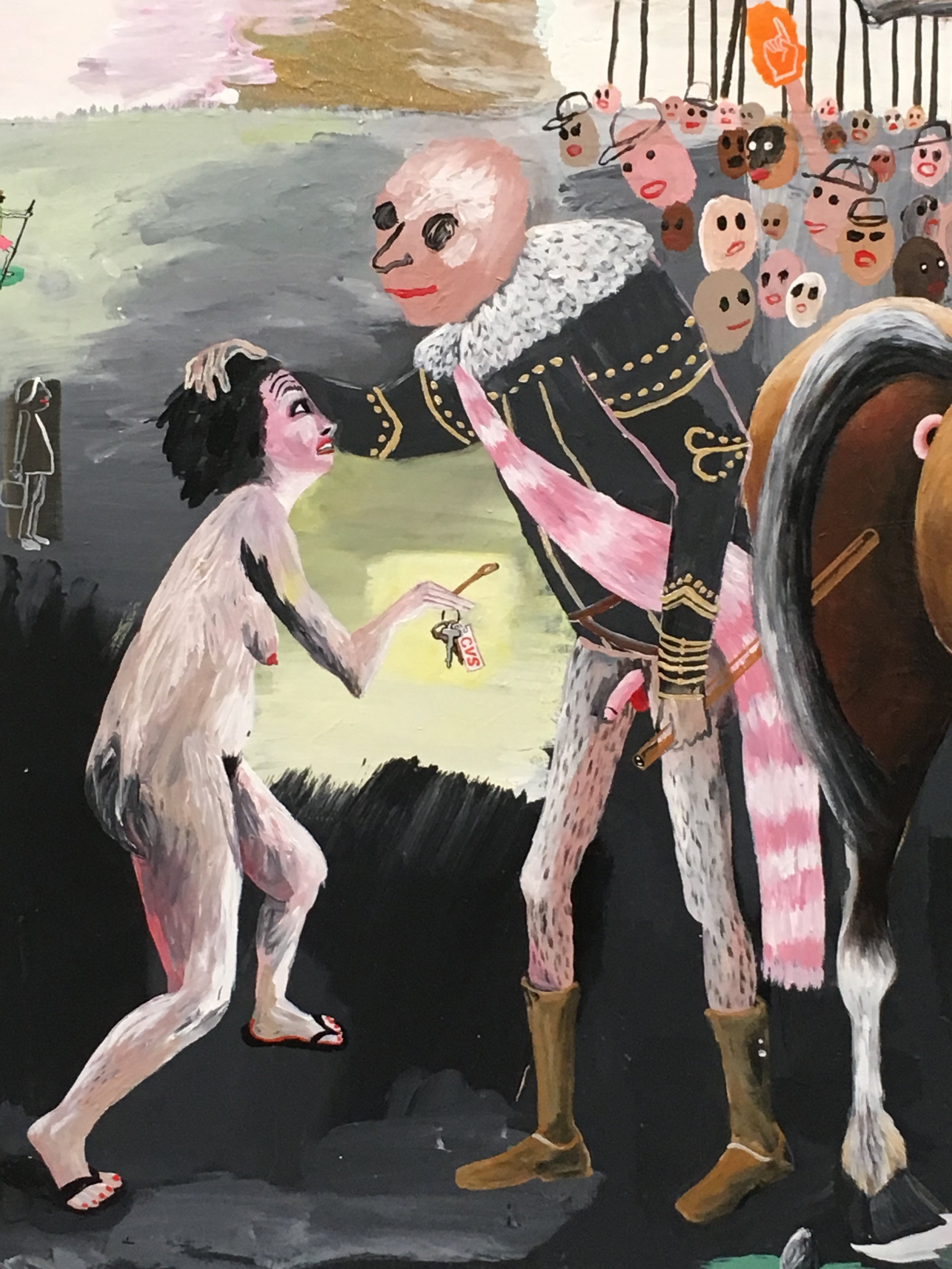
Cate White's Keys to the City

It’s a rare work of contemporary art that demands of the viewer any knowledge of art history. Much of contemporary art requires only that its viewer utter the shibboleth ‘anything can be a work of art’, a thought secreted a century ago by the work of someone named something like ‘Marcel Duchamp’. Then just walk in and look, armed with nothing but curiosity and a camera for the selfies. It was not always so. At the beginning of the project of modern art in the 1860’s Édouard Manet’s Déjeuner sur l’Herbe and Olympia required the viewer to register the distance between what was before her eyes and the relevant works of the school of Giorgione, while at its end the appreciation of the fecundity and piquancy of Picasso’s variations on the works of Delacroix and Velázquez presupposes a steady awareness of the models, indeed the sense that Picasso’s virtuosity is partially in the service of re-vivifying the masters. So it’s a surprise that one of the Bay Area’s possibly greatest and surely most interesting artists, the painter Cate White, has attempted a demonstration piece, one summarizing her artistic practice as a piece of her life, and closely modeled upon Velázquez’s The Surrender of Breda (1634-45). The resultant Keys to the City (2016), currently on display at the Yerba Buena Center for the Arts, is the most richly engaging work of visual art I’ve seen from a Bay Area artist in the past decade.

velazquez the surrender of breda.jpg

Velázquez’s painting is tribute to the sweetness of character, the gentleness and mercy of the Spanish general Ambrogio Spinola. In 1625 the Spanish forces under Spinola forced the surrender of the besieged Dutch town of Breda. The defenders were allowed to leave unmolested and honored. Velázquez depicts the moment when the Dutch commander Justin von Nassau hands Spinola the key to the city. Some Dutch soldiers stand disorganized on the left, while Spanish advisers, mostly older than the Dutch, stand about on the right. Few on either side seem to observe the commanders. The Dutch commander offers the key with his right hand, while slightly bowing and cocking his head to the left. Spinola counters by bending slightly and placing his right hand on Justin’s arm. Their eyes meet and form an axle about which their bodies dance courteously. The two commanders’ horses stand nearby on either side. On the right a long line of the Spaniards’ vertical pikes striate the sky, which mostly is thick with horizontal layers of clouds, themselves crossed by diagonals of smoke. Velázquez spares the viewer a vision of eirenic gods that would infest a similar such painting by his master Rubens.

Keys to the City retains and revises all of Velázquez’s major elements and compositional arrangements. The central figures are shifted to the right, with the painter White replacing the loser and offering her key chain to a cartoonish military goon in the winner’s position. The rightward shift both de-emphasizes the transfer of the keys and opens up more space on the left for White’s ‘army’, a coterie of White’s friends and loves. The winning goon is a hairy-legged mannequin, or perhaps balloon man, whose empty eyes and slight, fixed smile suggest a post-apocalyptic world so emptied that humanity is barely a memory. His protruding penis is a spigot, a Vienna sausage, a hanging thing never touched by eroticism or violence. White stoops and cringes before the man-thing. Behind their leader, the victorious soldiers are likewise balloon heads. Over against them and visually dominating the picture are some five dozen losers, suggestive of a great motley of isolates whose various actions and passions have given them faces freed, if nothing else, from worldy ambitions. At the highest point of the losing army, a naked woman leans back as if supported by the edge of the painting, and displays a banana dick while mumbling into a microphone “sorry 4 not giving a shit.” Neither side pays much attention to the central figures, nor to each other. What used to be humanity—spontaneity, unguarded curiosity, eroticism—is preserved in the animals; unlike in Velázquez, the two horses turn towards each other and, uniquely in the painting, their gazes, one coy and the other crazed, meet.

White Keys's Central Figures.JPG
velazquez breda central figs.jpg

The painting certainly induces an open-ended exploration and interrogation. Questions arise at every level, from the identity of the individual losers to White’s overall purposes. Two large questions in particular demand preliminary responses for the issue of White’s purposes to gain any determinacy: What city, and what keys? And what meaning arises from her choice and use of this particular Velázquez?

One answer to the first question is perhaps surprising but, it seems to me, irresistible. The small handful of keys, along with the CVS tag on the chain, are those of our dismal everydayness, surely including the house, the studio, and the car. The city, though, can be nothing physical; the members of the losing army do not know each other, have no unifying purpose, and surely live here and there, any place they can afford that allows them to escape the constant attentions of the government, corporations, and the worldly ambitious. All that unites the losers is their varied relationships to White. Those relationships mark out the spectrum of contemporary loves. A ‘city’ made up of kinds of attention, desires, and loves, and which is not of this world evokes Augustine’s account of the two cities, the City of Man and the City of God. Only the former is physical, but both are ‘cities’ as embodiments of different kinds of love, the one carnal, the other spiritual. 

But what could the keys to one of these cities mean to the people of the other? In Velázquez the city remains the same as the keys are transferred; the Breda of the Dutch is the very same as that of the Spanish. But the passage between Augustine’s cities is inscrutable: the two cities are unknown to each other, and passage requires spiritual conversion or degradation that God distributes for His own unknowable purposes. What could White’s keys mean to the winning goon and his happy minions? Perhaps this is part of the meaning that the use of the Veláquez has for White: entrance into the city of loves requires an abandonment of the sort of moral certainties and gentility to which Velázquez gives a supreme expression. And this would explain another feature not yet discussed: instead of the dense layering of clouds in Breda’s sky, White’s city re-enchants the inaugural love, as an aerial mother holding her infant bestows a beneficent backwards glance to the losing side as she approaches the winners. Don’t follow leaders; watch the horses.