At a dinner party I attended on New Year’s Eve, the question arose: What good things happened in 2025? The response was muted, unsurprisingly given the year of political reaction of a ferocity unknown in our lifetimes, as well as the terminal diagnoses and deaths of long-time friends that drain so much of the color from the lives of those of us over the age of 65. The long deafening silence was punctuated with mutters of ‘nothing big, maybe some small things’. One great small thing was the publication of the philosopher Richard Wollheim’s hitherto scattered writings on art, that is, those that were not included in his four books of the philosophy of art that treated the general philosophy of art, the artistic practice of painting, and two volumes of essays addressing various issues, especially in representation, expression, and style. Oxford University Press promises two further volumes of uncollected writings, on political philosophy (just published) and philosophy of mind, with a further promised volume from the NYRB Press of Wollheim’s occasional writings on art edited by Wollheim’s son Bruno Wollheim. Though I’ve had xeroxes of most of this uncollected material for the past twenty years, re-reading the pieces consecutively in the new volume has re-vivified and intensified my sense of Wollheim as the greatest philosopher of art of the second half of the twentieth-century. The volume does contain a couple of dozen or so pages of previously unpublished material embedded within three ‘Lectures’ entitled ‘Pictorial Form and Pictorial Organization’ and that comprise the sole instance of Wollheim’s developed conception of the nature of pictorial organization in artistic pictures. At $140 the volume is a pearl of great price, though one perhaps out of reach of some of my friends. The price is high, but the intellectual interest of Wollheim on pictorial organization is vastly greater, and so for my friends in this blog post I’ll try first to summarize Wollheim’s late thoughts, and in the next post contextualize and reflect upon this important contribution to the philosophy of art.
The three sections (Wollheim calls them ‘lectures’) comprising ‘Pictorial Form and Pictorial Organization’ take up over fifty pages. Almost all of the first lecture, and much of the third lecture, were previously published in two lectures and an essay from 1995 to 2002 (the editors have helpfully included the material that Wollheim deleted from the earlier publications). The second lecture consists of the new material, and which, together with a few pages from the first and third lectures, gives Wollheim’s positive and hitherto unavailable account. The rest of the material is largely given over to an analysis of and criticism of varieties of formalism. The second lecture is evidently incomplete, with blanks indicating places where specific references were to be included, and minor inconsistencies. The ordering of the lectures is also uncertain, as the end of the third lecture seems to be in part an introduction and transition to the second. Here I’ll set aside Wollheim’s account of meaning in artistic painting, which is stated summarily in an included piece entitled ‘On the Question ‘Why is Painting an Art?’’(1984) and developed at great length in his Painting as an Art (1987), and also pass over the criticisms of formalism, so as to present concisely Wollheim’s positive conception of pictorial organization in artistic painting. In barest outline, Wollheim argues as follows: 1. (Artistic) Paintings are organized artifacts, made with some degree of organization in mind, and made in such a way that a viewer is likewise aware to some degree of the organization (p.4). 2. Pictorial organization is scalar, that is, it is not an all-or-nothing phenomenon, but rather is always a matter of more or less, and/or better or worse organization (p. 59). 3. There are three grades of pictorial organization: (a) that which arises from the painter wishing to find a place for everything she wishes to include in the painting; (b) that which exhibits values that “can only be elucidated by reference to organization itself”, such as the values of “order, harmony, symmetry, proportion, balance, [and/or] tension of opposites” (p. 24, and similarly at p. 61); (c) that which arises from the painter’s attempt to realize “some end internal to what the artist hopes to achieve in, or through, his painting” (p. 25).
Wollheim stresses that some paintings are “brilliantly organized” (ibid) at the third grade without exhibiting any of the second kind of organization, which he calls ‘good’ organization; to demonstrate this near the end of the first lecture turns to Jacob van Ruisdael’s ‘[Landscape with the Ruins of] The Castle of Egmont’ (1650-55):
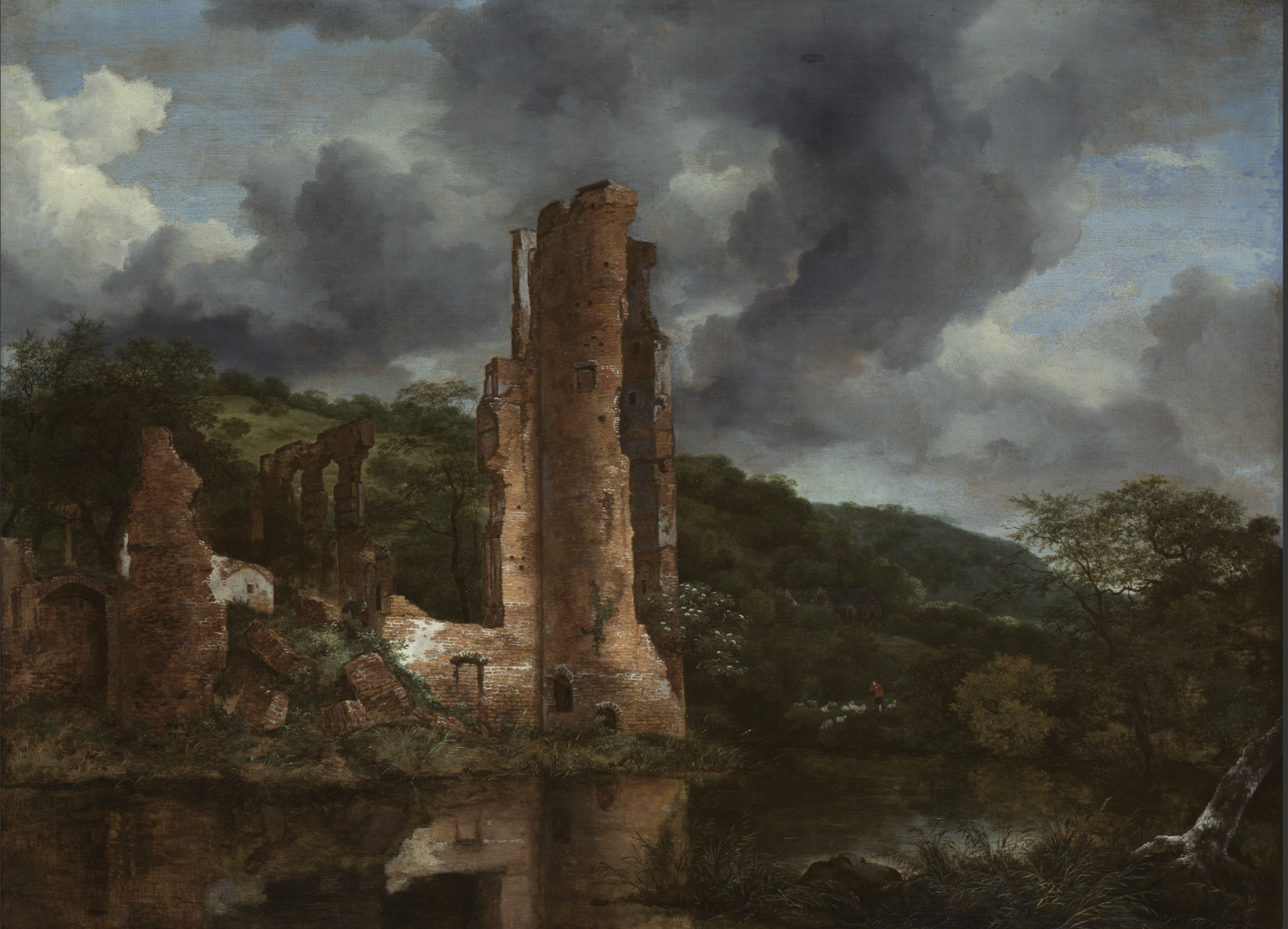
At first glance one sees both that the painting is organized, and also that the painting appears ‘lopsided’, with everything of immediate interest rendered on the left half of the canvas. Consequently we the viewers “seem driven either to re-evaluiate the painting or to use our eyes to see what might justify the grave asymmetry”. We then notice that on the right-hand side is “a small jewelled scene consisting of a timbered cottage, sheep, a shepherd, flowers, and a pool whose surface is patterned with dark mysterious reflections”. We, like Ruisdael, will come to “accept the revelation that small things can be as interesting as big things, and that uninteresting things can be as poignant as interesting things” (p. 26). It is this revelation, and the sense that we have found this for ourselves, that justifies and rewards the violation of ‘good’ organization. Artistic organization is after an experience of revelation beyond what the easy virtues of symmetry and harmony can convey. Thus understanding pictorial organization in artistic painting requires some sense of what the painter aims to achieve. Pictorial organization is nothing that can be conveyed or understood through merely formal accounts that abstract from or set aside the painter’s aims.
The second lecture aims to show how three great artistic painters, Jacob van Ruisdael, Claude Monet, and Nicholas Poussin organized some of their central paintings. He devotes by far the most attention to Ruisdael, so I’ll restrict my summary to the great 17th-century Dutch landscape painter. Since pictorial organization in the third degree cannot be determined without some sense of a painter’s aims, and for Wollheim the artistic painter’s aims are most reliably given through and understood in terms of the painter’s style and the central works exhibiting that style, Wollheim begins with the specification of the range and nature of Ruisdael’s stylistic achievement. Ruisdael was a prolific artist who produced highly accomplished works already in his late teens, and Wollheim considers Ruisdael’s mature style already in place by around 1650, that is, when Ruisdael was around the age of 22. Ruisdael’s core works were his large, horizontal landscapes full of vegetation (and so the core does not include Ruisdael’s seascapes and winter scenes) that convey a sense of richness and grandeur (pp. 30-1). Wollheim cites several examples of these core works, including the ‘Three Great Trees in a Mountainous Landscape with a River’ (late 1660s):
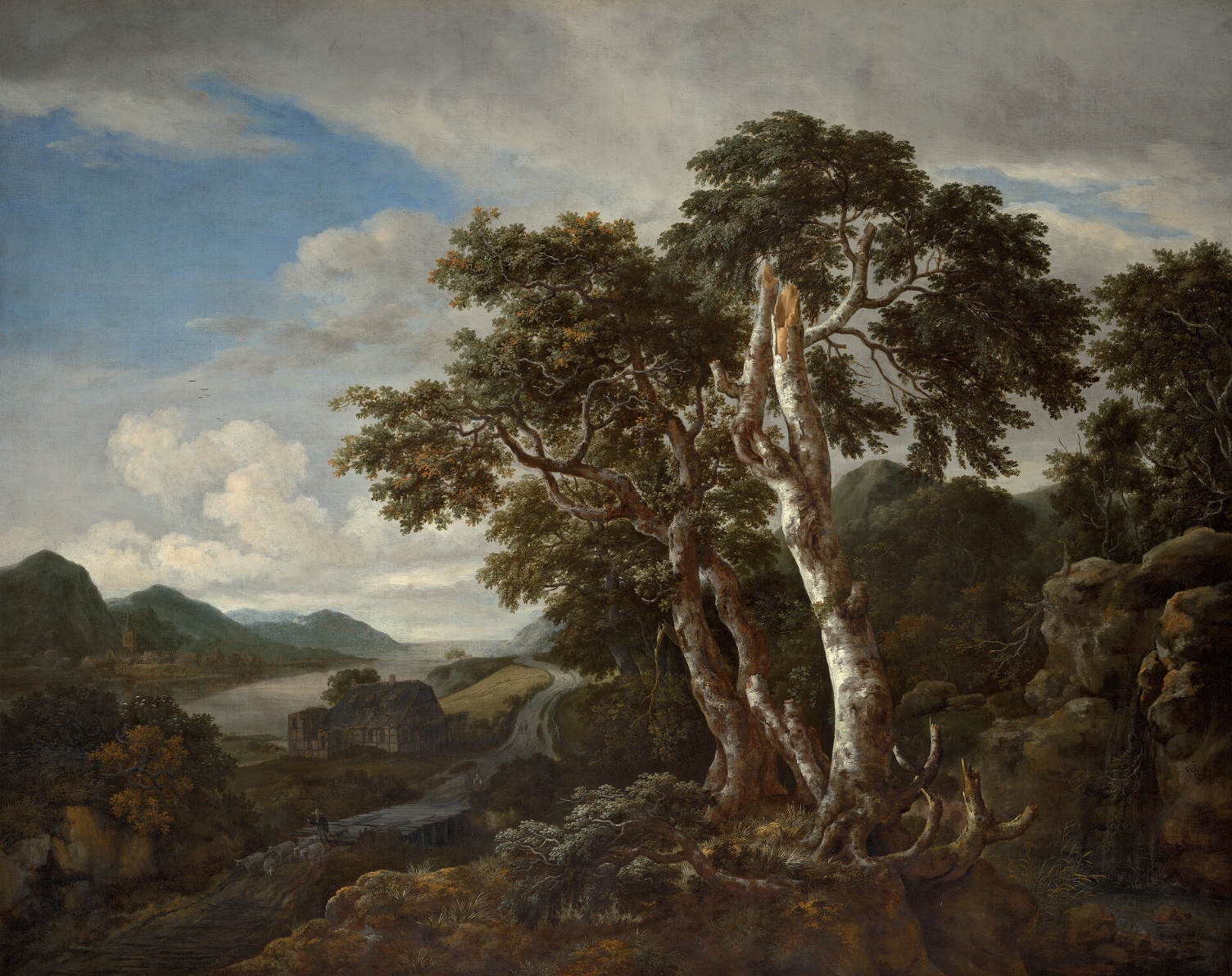
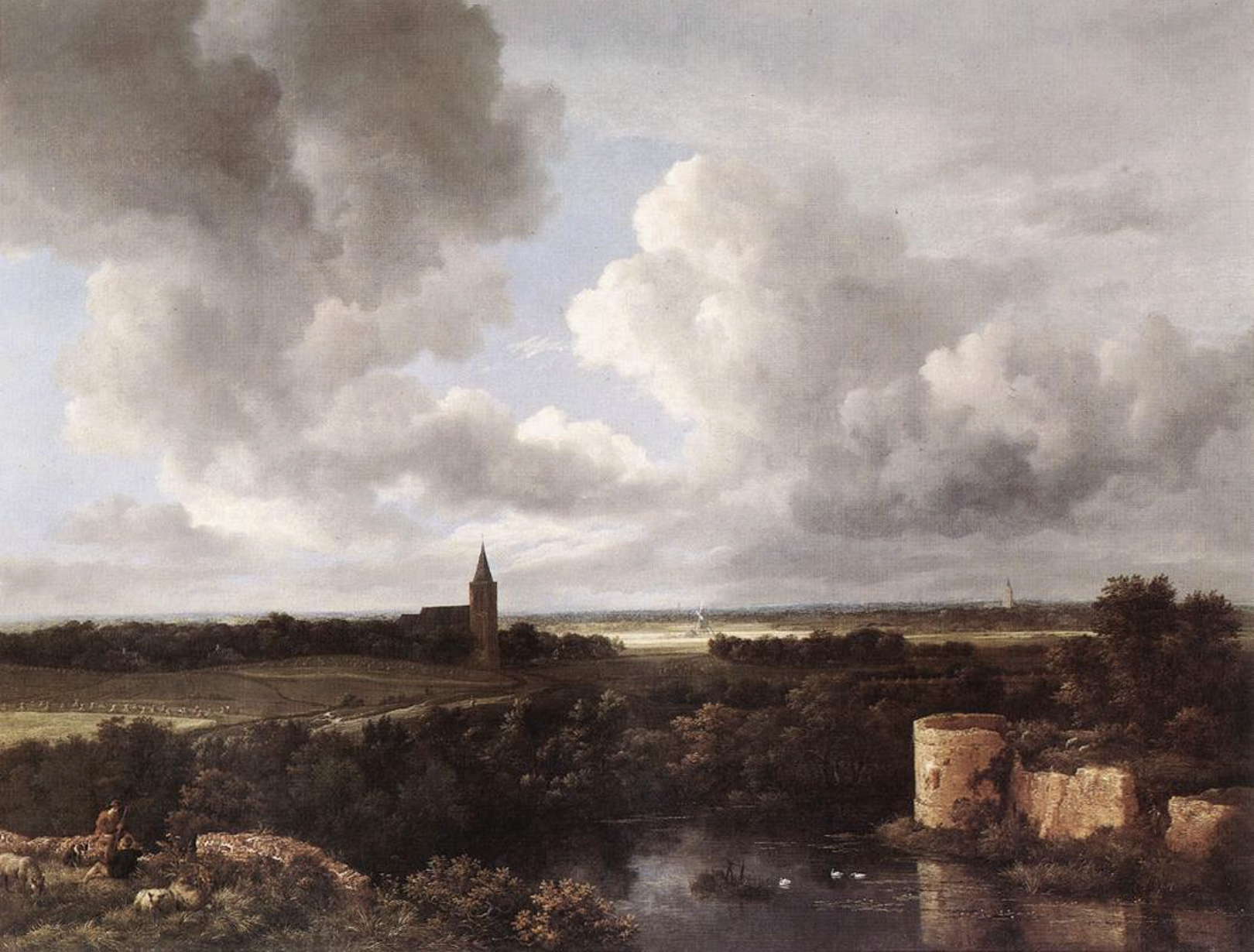
Pondering Ruisdael’s core works, Wollheim sees two principles at work that govern their pictorial organization. The microstructure is governed by a principle of ‘juxtaposition’, an “additive way of putting a painting together”, whereby Ruisdael “leave[s] the constituent elements more or less as they are, lying side by side, unadjusted” and then introduces micro-details, ‘spots’ of elements (trees, flowers, small cottages, lines of flax) that produce of the effect of balancing the element (p. 33). For Wollheim a masterpiece signally exhibiting the principle of juxtaposition is ‘A Landscape with a Ruined Castle and a Church’ (c. 1665):
The second principle, one which governs the macrostructure of Ruisdael’s core paintings, is that of ‘multiple entry’, an organization that can be seen at its simplest and most direct in ‘The Great Oak’ (1652):
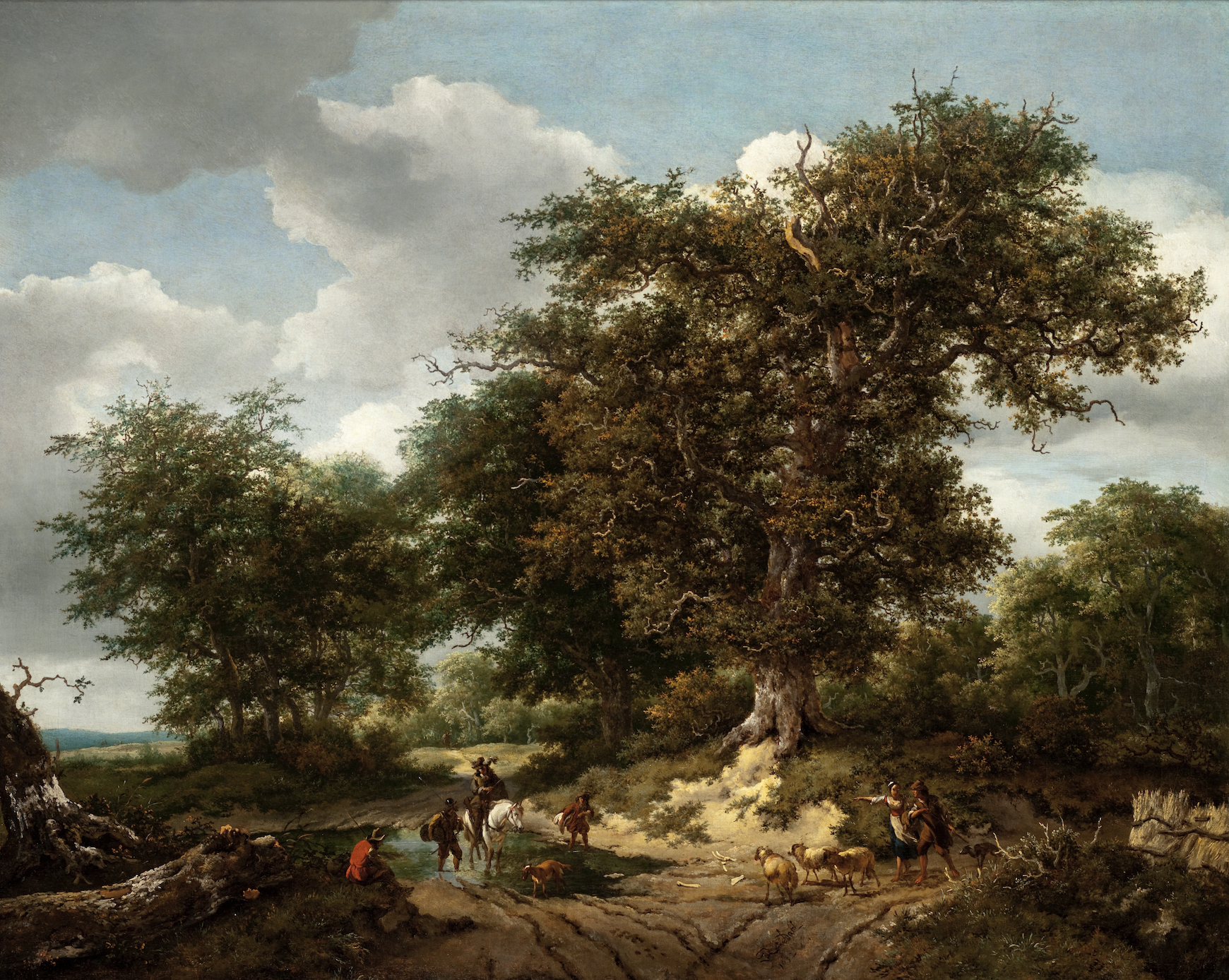
Wollheim goes on to analyze five other works by Ruisdael to show how the principle of multiple entry works in more complex examples, and then to show how Ruisdael combines the application of the two principles. Then he asks: What was Ruisdael attempting with his (non-verbal) formulation and application of the two principles? Wollheim suggests that “a central concern of Ruisdael’s was to construct his paintings [in such a way] that the eye would have real difficulty in encompassing them all at once’, and that this was ultimately in the service of “his desire to convey the overwhelming splendour and diversity of the divinely created world” (p. 42). Wollheim goes on to consider much more briefly a few works by Monet and Poussin.
If Wollheim is right, then it follows that the theoretical and interpretive aim to understand pictorial organization in artistic paintings cannot be realized through the identification of structural or compositional elements and their interrelations in abstraction from a prior consideration of what the painter is aiming to achieve. So most of the talk in the 20th century of composition, form, and pictorial structure is doomed to failure, or at least cannot be thought to achieve its aim unless it covertly presupposes a prior determination of the relevant artist’s aims and style. Not for the first time, I find myself compelled to agree with Wollheim, so in the second part I’ll try to provide some context from art history (especially the work of Meyer Schapiro) and from Wollheim’s own account of artistic meaning relieve the seeming arbitrariness of the sketch here of his views given here.
References and Works Consulted:
Rudolf Arnheim, The Power of the Center: A Study of Composition in the Visual Arts (1988)
John Barrell, The idea of Landscape and the Sense of Place 1730-1840: An Approach to the Poetry of John Clare (1972)
Robert Gordon and Andrew Forge, Monet (1983)
Thomas Puttfarken, The Discovery of Pictorial Composition: Theories of Visual Order in Painting 1400-1800 (2000)
Meyer Schapiro, ‘On Perfection, Coherence, and the Unity of Form and Content’, in Theory and Philosophy of Art: Style, Artist, and Society (1994)
--‘The Sculptures of Souillac’ (1939) and ‘The Romanesque Sculpture of Moissac I & II’ (1931), in Romanesque Art: Selected Papers (1977)
Seymour Slive, Jacob van Ruisdael: Master of Landscape (2005)
Virginia Spate, The Colour of Time: Claude Monet (1992)
E. John Walford, Jacob van Ruisdael and the Perception of Landscape (1991)
Richard Wollheim, ‘The Art Lesson’, in On Art and the Mind (1974)
--Art and Its Objects (2nd edition, 1980)
--Painting as an Art (1987)
--The Mind and Its Depths (1993)
--'On the Question ‘Why is Painting an Art?’’ and ‘Pictorial Form and Pictorial Organization’, in Uncollected Writings: Writings on Art (2025)