In my previous four blog posts I’ve summarized Philippe Descola’s recent magisterial contribution to the anthropology of figuration in visual artifacts, Forms of the Visible, and compared his treatment of two topics with those from earlier canonical anthropological texts. In this final post I’ll consider two further issues raised by the book: first, Descola’s anthropological account of contemporary visual art, and then consider the question of whether what Descola explores is not so much the anthropology of visible artifacts, but rather more specifically the anthropology of the world’s visual arts.
2. An anthropology of contemporary art? In a relatively short chapter, relative that is to his treatments of the four major visual ontologies of animism, totemism, analogism, and naturalism, Descola considers contemporary art. In order to bring out the distinctiveness of Descola’s interpretation, I’ll first briefly sketch what I take to be a standard understanding of contemporary visual art and its associated art worlds, as well as the indications of an account proposed by the anthropologist David Graeber in the past twenty years. I suggest that a standard account goes something like this: Contemporary visual art (usually referred to as just ‘contemporary art’) is a distinct period the world’s visual art that began around 1960 (give or take a decade). It emerges coevally with the collective sense that modernism and so modern art generally has exhausted its expressive resources. It’s orienting figure is Marcel Duchamp, who much earlier in the heyday of modern art produced a number of artworks that he called ‘readymades’, whose chief characteristic is that the work consisted of (a) an artifact chosen by Duchamp (that is, not something that he himself made), (b) the artifact is given a title (e.g. ‘In Advance of a Broken Arm’), (c) little or nothing is done to the artifact (if a little is done, e.g. painting a moustache on a reproduction of the Mona Lisa, it is an ‘altered’ readymade; if nothing is done, the readymade is ‘unaltered’), and (d) the artifact is declared a finished work of art, and under the right conditions is exhibited as such in the typical art world settings of galleries and museums. The upshot of the acceptance of the readymades as an orienting model for contemporary art is the adoption of a small set of ideologies stipulations, something like: ‘anyone can be an artist’ (that is to say, for example, that no special training or skill or social status is needed for someone to be considered an artist, and contemporary art is a global phenomenon, by no means restricted to ‘Western’ (North American and European) figures) and ‘art can be or be made of anything’ (so there are no special authorized materials required for artworks, nor any authorized ways of treating or elaborating those materials). Along with the traditional artforms of painting, sculpture, and drawing, contemporary art features new kinds of technological materials (such as video art and computer art), there are two novel super-genres in contemporary art, the installation (where the artist assembles a large number of materials, whether found or made and elaborated, into a distinctive spatial construction), and performance art (where paradigmatically the artist him- or herself performs a marked, untraditional action, usually requiring no special skills or training, and typically in front of an audience at a gallery museum, but also sometimes in non-art spaces and/or without an audience). If there is a central evaluative category for contemporary art (I’m inclined to think there is, but don’t know how to argue the point against an intelligent and unconvinced person), it would be something like ‘the interesting’(the artist Donald Judd proposed something like this in the mid-1960’s with the thought that ‘a work of art need only be interesting’). Among recent prominent anthropologists of art there is little treatment of Duchamp: most extensively, Alfred Gell treats Duchamp as having revealed the network of agencies that are part of the social making of art, where each artwork “is a place where agency ‘stops’ and assumes visible form” (Gell, p. 250), Néstor García Cancili similarly mentions Duchamp’s readymades as exposing the web of social roles wherein artworks are canonized (Garcíli Cancili, p. 153) briefly as an originator of the twentieth-century artistic aim of producing scandals with one’s artworks, and David Graeber does mention Duchamp in his account. I cannot see anything in the various accounts of the anthropologists inconsistent with the standard picture. Gell does not address contemporary art except tangentially, while García Cancili’s very interesting book seems to me much more a piece of cultural criticism than anthropology: his central claim is that contemporary art is related to its contexts to degree hitherto exampled in the arts, and that contemporary art “is the place of imminence--the place where we catch sight of things that are just at the point of occurring” (p. xiii). Graeber treats contemporary art as a continuation of modern art, itself an inheritance of the Romantic hope that everyone can be an artist, a hope that clashes with the constitutive feature of the art world, which is to create scarcity as value and value as scarcity, so that only a small set of the world’s imaginative artifacts will be treated as and so legitimized as artworks.
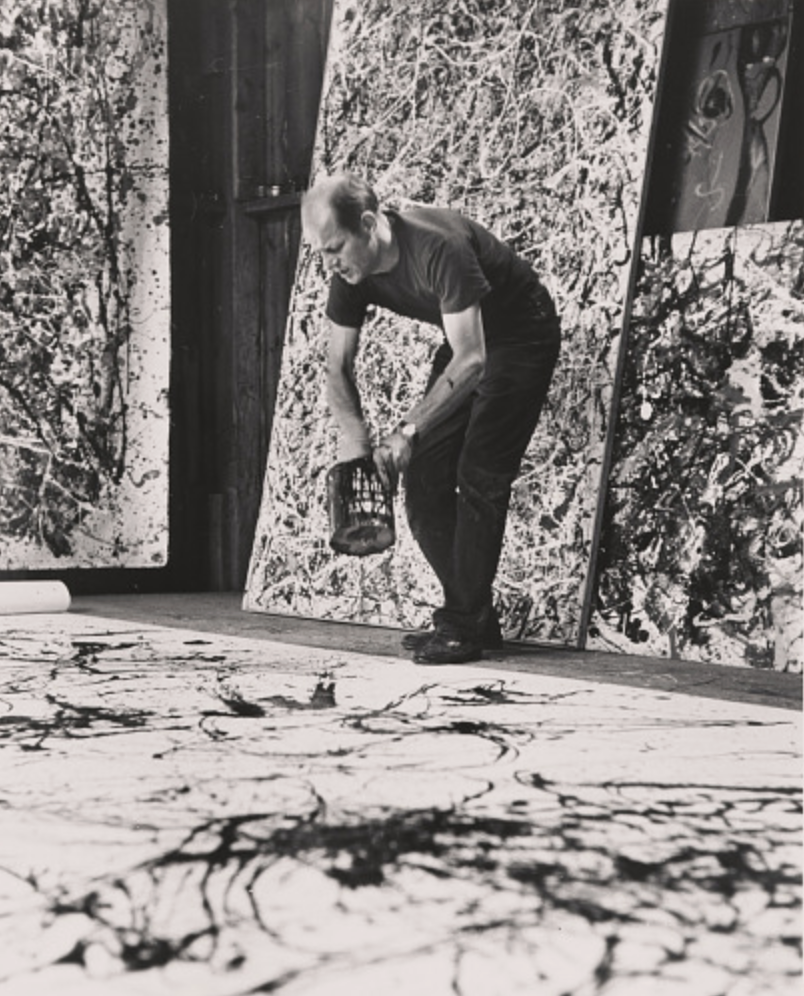
How does Descola’s account differ from those of his fellow anthropologists? Again, nothing in Descola’s analysis seems prima facie inconsistent with the standard view, and unsurprisingly he pursues the question of what if any visual ontologies are exhibited in contemporary art. His answer is tentative: He begins with the thought that “[s]tarting with Cézanne, and more decisively with the advent of Cubism, entire sectors of European art began to pull away from the iconographic canons of naturalism, anticipating in the field of figuration a probable crumbling of the principles on which that ontology was founded” (p. 452). What succeeds naturalism and its ontology is something that artists must take “from their own resources” (p. 453, quoting Jean Dubuffet. So under contemporary conditions, where no ontology is dominant in the arts, each artist will draw upon whatever they need to realize their expressive aims, including formal apparatuses that may be otherwise characteristic of one of the non-naturalist ontologies. For example, Jackson Pollock will seek to actualize a conception of an artwork that exhibits “a whole set of relations that allow the object to exist within an all-encompassing process” (p. 460), and so will use something like analogist figurations that have the power of fusing gesture with image and image with background (pp. 459-60).
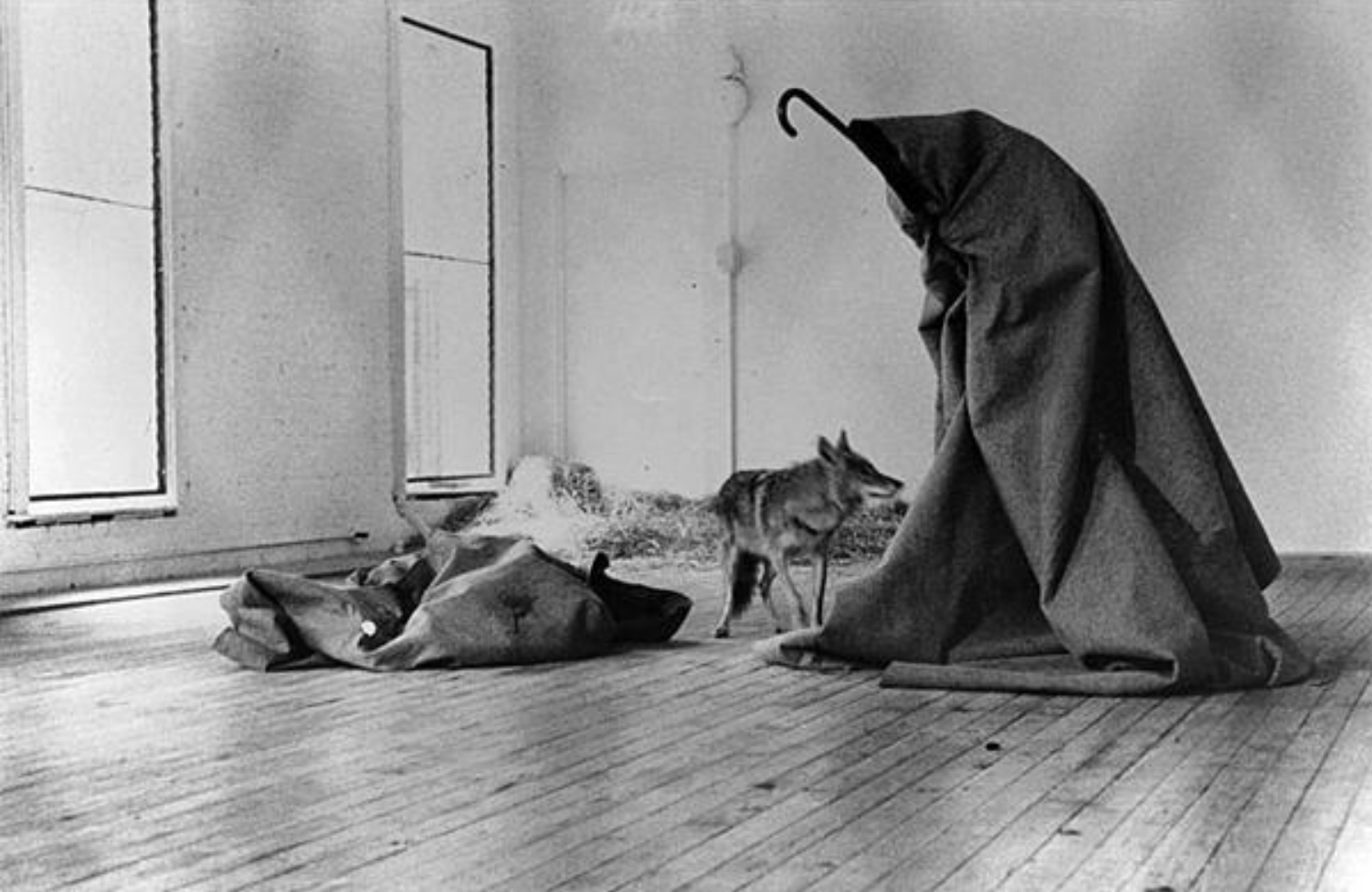
In his performance I Like America and America Likes Me (1974), Joseph Beuys will seek “to abolish the boundary between nature and culture that the colonizers . . . , seeking to restore the possibility of an interaction unfolding between two sensitive agents, or even to confuse the issue by questioning the ontological identities of the protagonists”. Descola asserts without elaboration that in realizing this aim Beuys “forcefully demonstrated [animism’s] constitutive principle” (p. 461).
It seems to me that with regard to contemporary art, Descola’s account plays a diminished, though not inconsiderable, role in the interpretation of artworks, diminished, that is, in relation to all of his other discussions of the world’s arts. In contemporary art, one starts one’s engagement and interpretation as it were with the artist’s aim, and then consults the relevant characteristics of a plausibly associated ontology in order to bring into focus the formal operations, whether overt or recessive, whose artistic role is to develop and enrich the particular artwork’s meaning. With the rest of the world’s art, one could start with recognition of the relevant culture’s leading ontology, and use that to place the artworks considered in the relevant conceptual framework. One might say that, with regard to contemporary art, not just the artist, but also the viewer, try to make something from their own resources.
3. But is it art?
I conclude with a brief reflection. Early on Descola insists that he is not discussing artworks, but rather figurations, in particular those that are embodied in the world’s visual artifacts. His reasoning is briefly presented, and it seems to me fairly typical. He says that figuration is “a universal impulse”, but “that does not make its products a unified category, and that is why philosophers of aesthetics as well as art historians have sought unsuccessfully to specify a transhistorical class of art objects on the sole basis of perceptual or symbolic properties that inhere in them” (p. 5; on p. 7 Descola credits Duchamp with showing that it was impossible to identify art objects on a perceptual basis). He asserts that likewise symbolic properties cannot play the role of identifying artifacts as artworks, and so the impossibility of such a project succeeding “is intrinsic to the very enterprise of classifying any artifact whatsoever as an art object” (p. 7).
Against this, I would suggest the following claims and observations: Descola has not considered other ways of picking out and identifying artworks, such as a recently fashionable ‘cluster’ account wherein one abandons the search for necessary and sufficient conditions for something being an artwork, but rather suggests that there are a range of characteristics exhibited by prototypical artworks, and we might loosely identify artworks as those artifacts which possess ‘most or all’ of such characteristics. Another suggestion, which I’ve tried to develop in some of my writings, is to suggest that, although there is no fixed transhistorical conceptual boundary between artworks and artifacts generally, but we might think that artworks are part of a spectrum of meaningfulness, with ordinary artifacts exhibiting a zero degree of artistic meaning, and paradigmatic artworks a maximal meaningfulness. It’s striking that Descola does not treat in the book what one might take as paradigmatic ordinary artifacts (this table, this laptop, this book), but rather always artifacts that are richly meaning-bearing and so readily treatable as embodying one or another of the four ontologies. One might think that Descola has willy-nilly produced his own serviceable definition of an artwork: a work of art is an artifact that is sufficiently elaborated so that it bears richly elaborated meanings, in particular those that embody some reigning visual ontology.
References and Works Consulted:
Néstor García Caclini, Art Beyond Itself: Anthropology for a Society Without a Story Line (2014)
Philippe Descola, Forms of the Visible: An Anthropology of Figuration (2025)
Alfred Gell, Art and Agency (1998)
David Graeber, ‘The Sadness of Post-workerism’, in Revolutions in Reverse: Essays on Politics, Violence, Art, and Imagination (2016)
--'Another Art World, Part 1: Art Communism and Artificial Scarcity (with Nika Dubrovsky)’, in The Ultimate Hidden Truth of the World . . . (2024)