In a recent blog post I sketched a theory of a kind of artistic meaning that I call ‘resonance’. On the conception I’m proposing, ‘resonance’ refers to a basic kind of meaningfulness that arises in generally in works of art. Such meaningfulness has two structural aspects: First, artistically resonant artifacts exhibit what I called following Ellen Dissanayake the character of having been ‘made special’; Dissanayake has recently replaced this term with ‘artification’, so that ‘artified’ artifacts stand out among and from other, more ordinary artifacts by virtue of a salience achieved through an indeterminate range of mechanisms including stylization, symbolic elaboration, and special placement. Other terms pointing to this distinctive meaningfulness might be ‘markedness’ or ‘presence’. Second, artistically resonant artifacts exhibit what the art writer and critic Adrian Stokes termed ‘the invitation in art’, an invitation embodied in the artifact for a recipient perceiver to enter into a state more attentive to materials, structures, and meanings of the artifact than is typically the case with other, ordinary artifacts, and to linger with the artifact and explore--in interactions, in perception, imagination, reflection, and/or contemplation-- its elements and their interrelations. On this conception resonance takes its place among other kinds of artistic meaningfulness such as representation and expression, but it is the most basic kind because one that is most intimately bound to the artistic efficacy of artifacts per se: much art lacks representation or expression, but none lacks resonance, on pain of not being a work of art at all. I have chosen the term ‘resonance’ in the attempt to evoke the ways in which meaningfulness in artworks seems non-finite and seems to spread: aspects of artworks mutually inform and inflect each other, the recipient experiences herself as affected by and corresponding to the work, and the meanings embodied in the work seem to generate open-ended correspondences between the prima facie internal aspects of the artifact and contexts outside the work, whether cultural, social, political, natural, or cosmic.
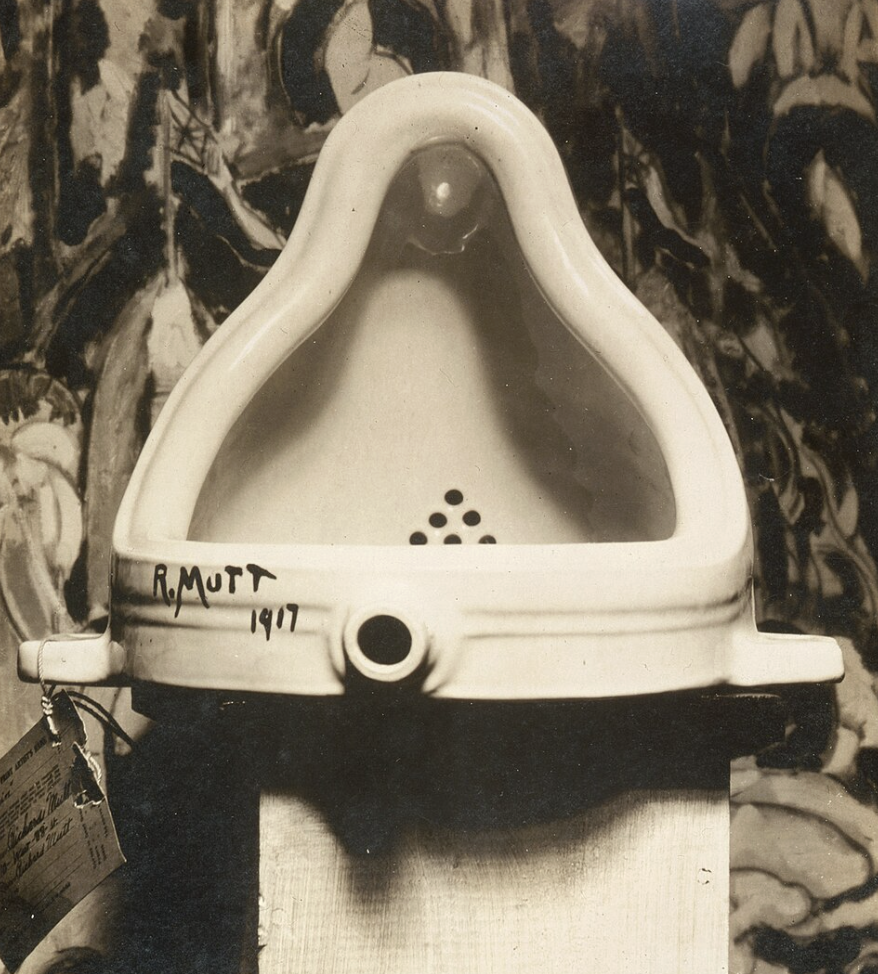
Here I’ll attempt to explicate further resonance as a kind of artistic meaning through consideration of some major works of contemporary art, and to use Richard Wollheim’s path-breaking article ‘Minimal Art’ as a methodological guide. In his article first published in 1965, Wollheim drew attention a prominent, though by no means dominant, type of twentieth-century visual art which seemed to possess what he called ‘minimal art-content’, either because the artwork was internally undifferentiated to an extreme degree, or what differentiation the piece possesses comes not from the manipulations of the artists’ hands, but from some non- or extra-artistic source such as nature or a factory (Wollheim, p. 101). His chief examples are Marcel Duchamp’s ‘Fountain’ (1917), where the differentiations of the artifact are those of shapes and volumes dictated by designers and engineers and produced in a factory,
And Ad Reinhardt’s ‘Untitled (Black)’, a near-monochrome that seems to show three dark areas dividing the canvas into equal thirds, with the central third lighter than identically colored areas flanking it, and a similarly sized band, midway in hue between the two colors of the vertical, and bisecting the canvas horizontally.
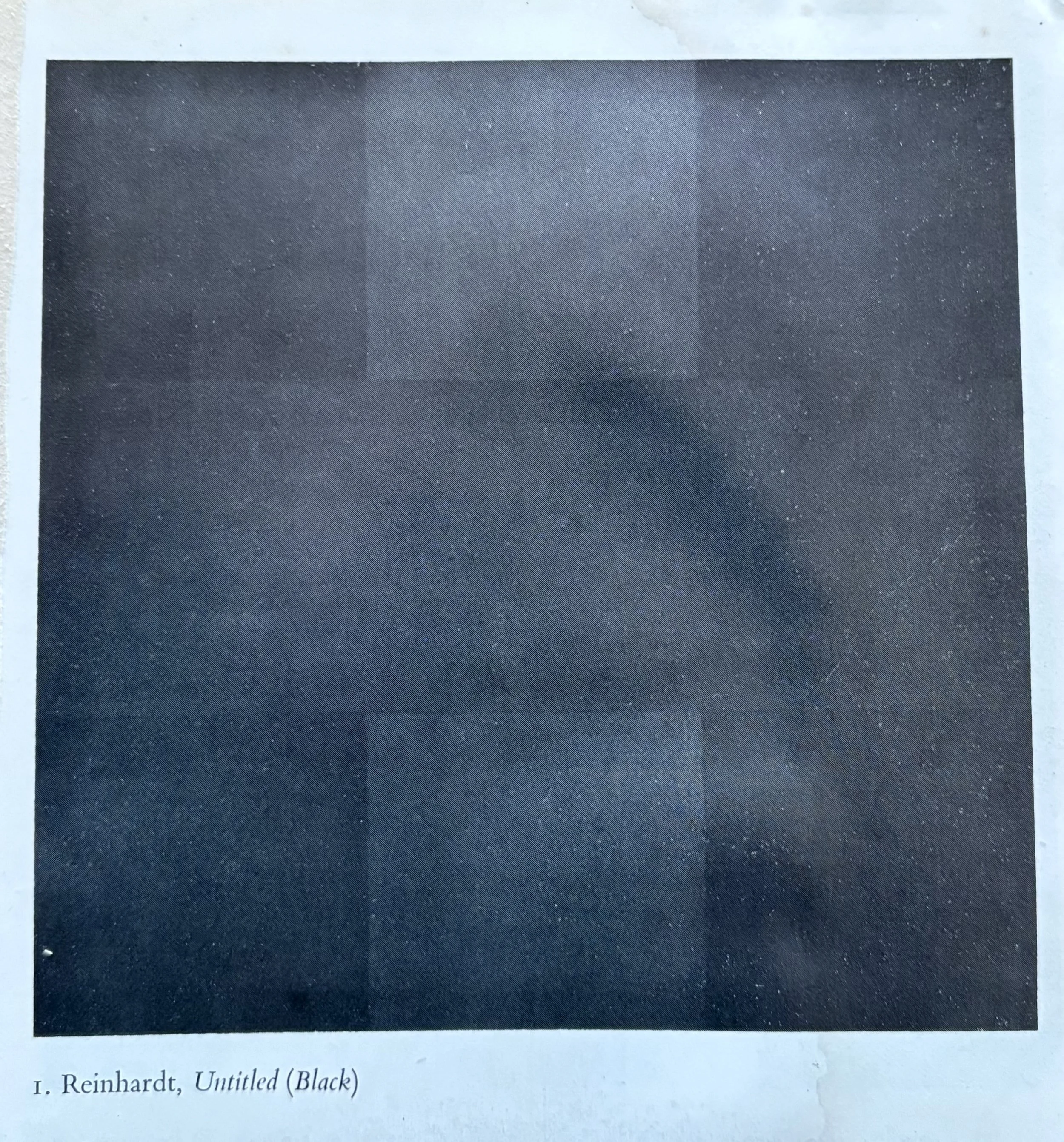
Wollheim accepts that both artifacts are indeed works of art and suggests that the resistance to their claim to such status stems from their failure “to evince what we have over the centuries come to regard as an essential ingredient of art: work, or manifest effort” (p. 106). So the challenge presented by those who reject the claim that these are works of art is to show in what sense of the term ‘work’ does these artifacts display the marks of artistic work. Wollheim’s answer is first that the Duchamp forces us to recognize that the artistic work consists of two phases: an initial phase modifying the medium (putting paint on canvas, hacking a stone, welding metal, etc.), and a second ‘phase’ where the artist decides “that the work has gone far enough” (p. 108)--it is finished. So the artistic work of Duchamp’s ‘Urinal’ consists not just (as it is usually understood) choosing the (non-artistic) urinal and declaring it an artwork (neither of these are intrinsic the artistic work), but rather in the decision ‘it’s finished’ (which is internal to the artistic process). So Duchamp has highlighted an aspect of the typical process of artistic making, and his extremism just consists in him eliminating every other aspect of the process and its typical manifestations. Reinhardt’s piece, Wollheim suggests, likewise highlights a typically unnoticed aspect of the artistic work, though one from the first phase: we are inclined to think of the first phase as wholly constructive, that is, it is a process wherein the artist alters the medium in the service of working something up, making it quantitatively greater (e.g. depositing pigment on the canvas) and/or more differentiated (hacking stone). What the Reinhardt reveals about artistic work is that the constructive process of making is simultaneously a process of unmaking or destruction, namely “the dismantling of some [prior] image which is fussier or more cluttered than the artist requires” (p. 109). The challenge to ‘minimal art’ as art is answered by showing ways in which the artworks are indeed the results of artistic working, and further they reveal something hitherto overlooked or under-appreciated about the nature of artistic work itself.
With Wollheim as a model, I turn to the consideration of two works of recent visual art by two prominent artists, where all the works exhibit the kind of ‘extremism’ noted by Wollheim and so characteristic of contemporary visual art. Again, by ‘extremism’ Wollheim (and I) mean works that seem to lack much of the kinds and density of differentiation of surface and/or shape that seem wholly characteristic of the world’s visual art. One of the works, Wolfgang Laib’s ‘The Five Mountains Not to Climb On’ (realized 1984 and 1990), seems at first to be something like pure presentations of monochrome color. The other work, David Nash’s ‘Birch Crack and Warp Column’ (1989), offers more differentiated surfaces, but not in one of the manners typical of visual artworks: a block of wood is alerted with nothing but rows of deep kerfs, the product of repetitive acts of sawing. Both these works lack representational and expressive content, do not seem to evoke or instantiate metaphors, and invoke no symbolic frameworks or systems (unlike, say, the use of circles and squares in Chinese art, which immediately symbolizes Heaven and Earth respectively).
Laibs’s piece shows five small cones of granular yellow pollen arranged in a line on a bare floor.
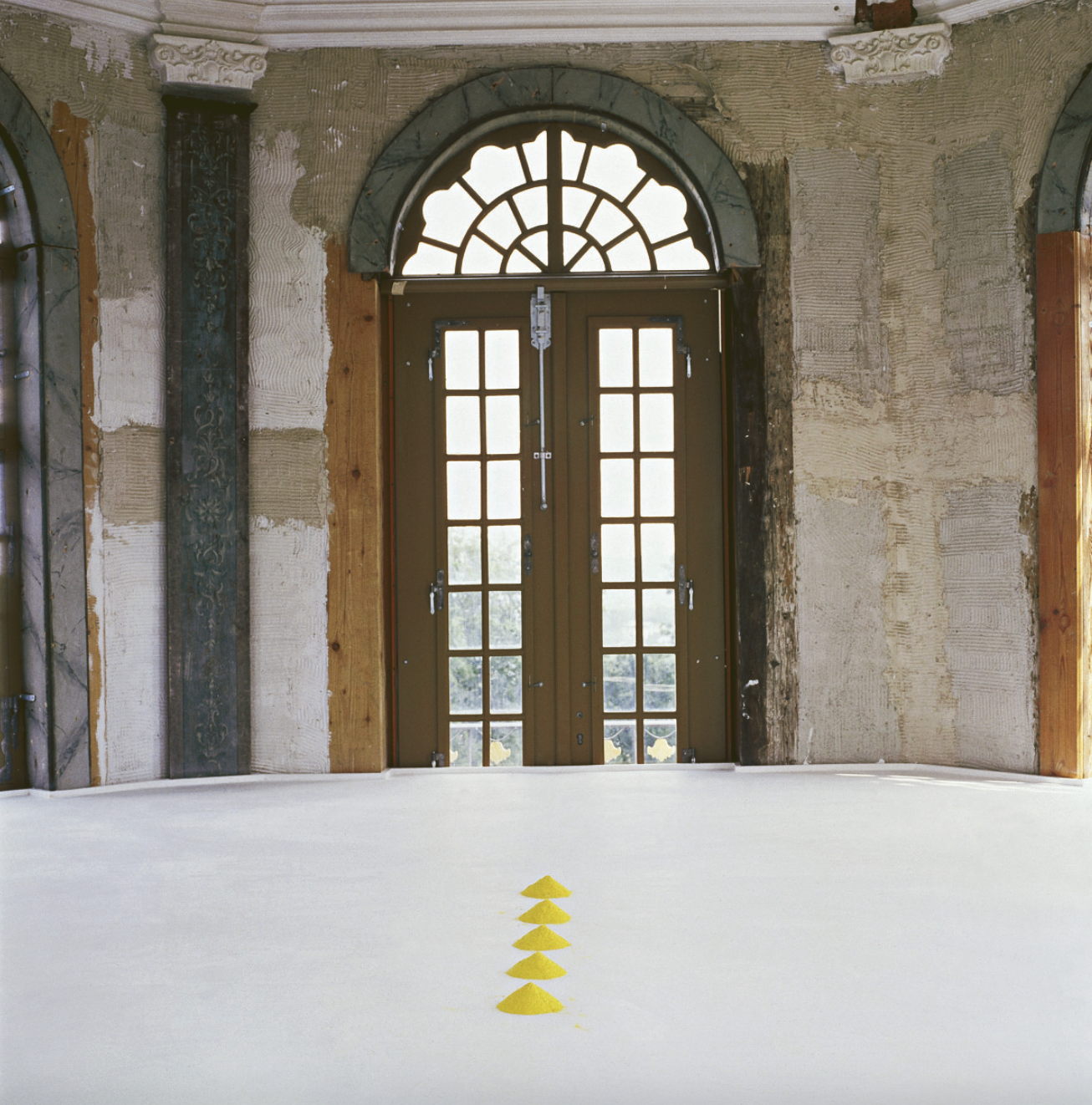
The pigment is identical throughout, that is, with no variation in hue, value, or saturation within or across the cones, and so strongly unifying each cone into an immediately grasped geometrical shape. The primary range of viewpoints are from head height from a medium distance. The intensity of the color in contrast to the drabness of the floor gives the piece an often-remarked hallucinatory quality, which is enhanced by viewing it from directly overhead, from which position the cones seem to float (I’ve experienced this every time I’ve seen Laib’s pollen pieces). One effect of Laib’s construction of the cones through repeated deposits of small amounts of pollen is to give the cones small, pervasive irregularities, visible upon close inspection and suggestive more of geological processes than standard artistic making.
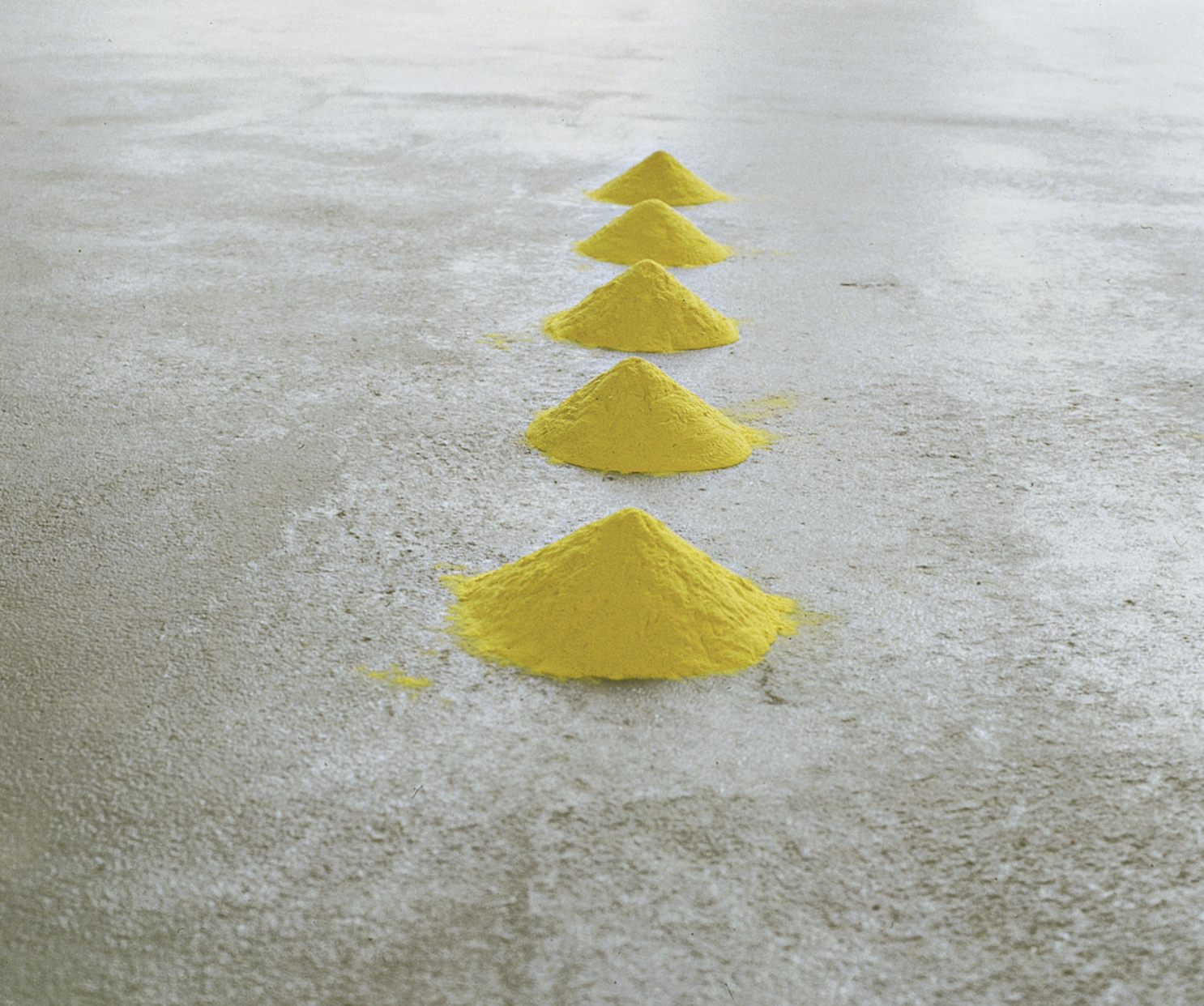
Each cone relates initially to the other cones as an element in a punctuated line whose termini are the outer two cones. As the viewer’s attention spreads to the placement, the floor is visually activated as both support for and an element alien to the cones. An atmosphere of contraries and dualisms is formed: the pure and the impure, the geometrically ordered and the prosaically disordered, figure and base, the vivid and the drab. Then the cones become peaks, as one imagines the floor cutting the visible cones are merely the peaks of from indeterminately large cones largely under the floor, or as a layer of clouds out of which mountains emerge. While the intensity of the hue visually anchors the basic and orienting presentation of presence and color, it also anchors further kinds of meaningfulness--figure and support, here and beyond, presence and absence, perception and imagination--, and all are set into play with each other endlessly. The elements ‘resonate’ with each other, that is, in the viewer’s act of attuned perception the elements enter into relationships with each other, and further ‘resonate’ with latent physical, conceptual, and cosmic contexts.
In contrast to Laib’s piece, Nash’s ‘Birch Crack and Warp Column’ is highly differentiated, though not primarily as a result of the artist’s repetitive sawn cuts.
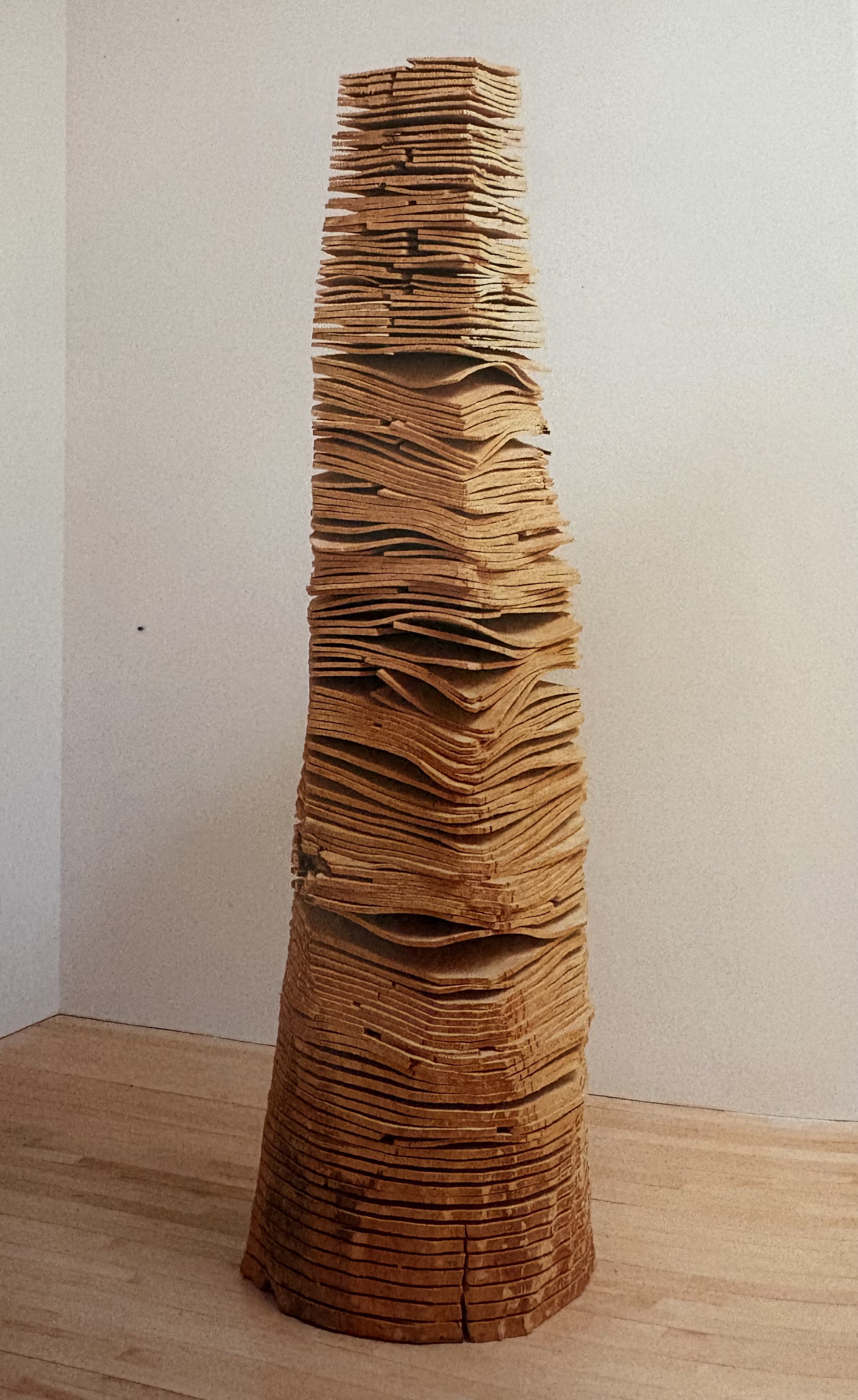
Rather, the richness of differentiation arises from two sources: the wood itself is nothing homogenous (unlike Laib’s pollen) but rather full of variety from the striations and grain of the wood; and the thin slices of wood resulting from parallel cutting twist and buckle. With regard to what is given to the viewer in perception, the artist’s action of sawing is a mechanism of releasing into manifestation the pre-existent differentiation of wood. And since the wood is organic, it is subject to temporal processes of expansion and contraction, twisting and buckling, and ultimately dissolution and destruction.
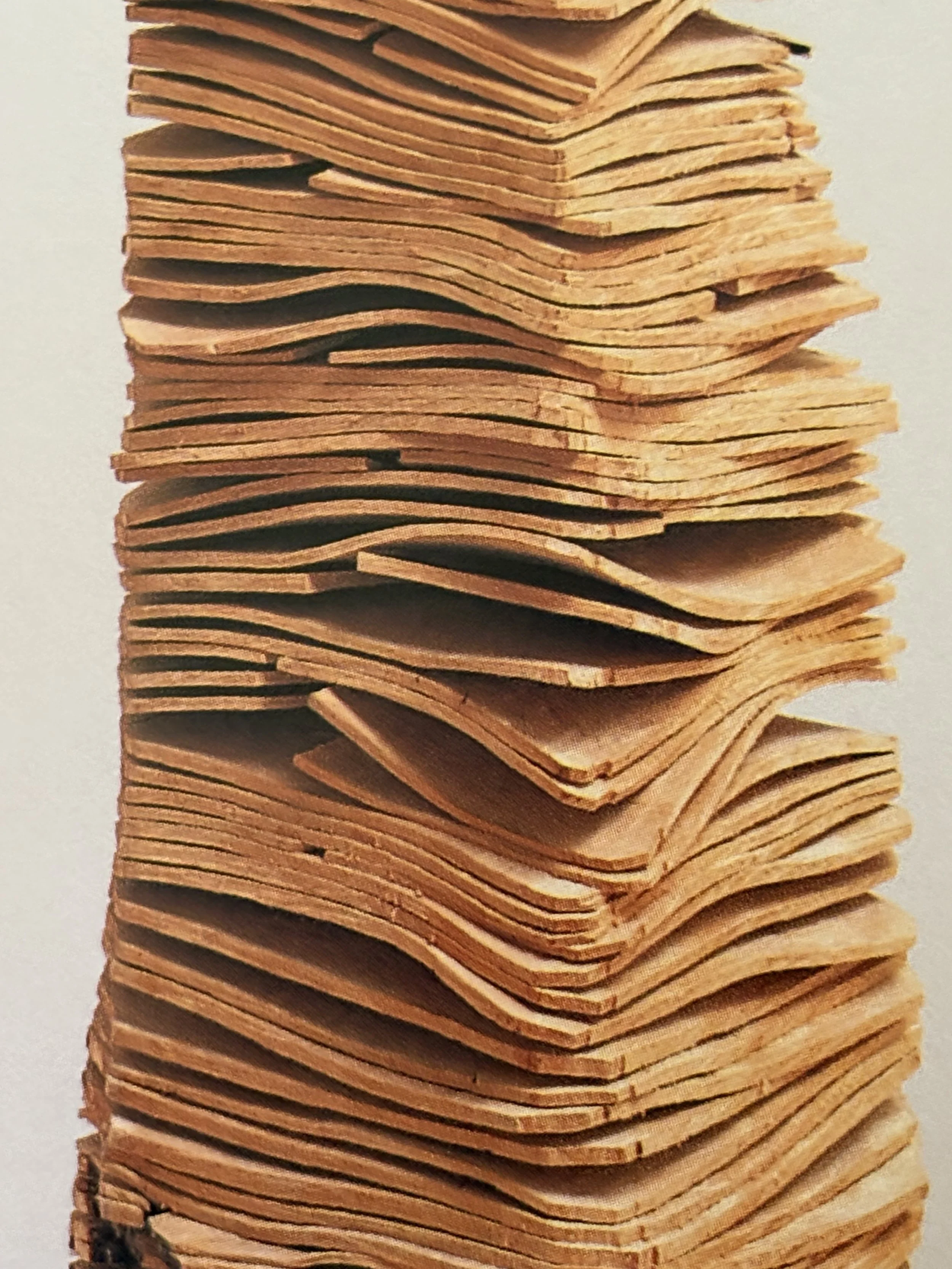
The piece is nothing finished, but rather bears within its appreciative, sufficiently imaginative perception its artistic origin in Nash’s cutting, and its ultimate decay. The piece ‘resonates’ primarily along its temporal dimensions: the work has a powerful presence, while indexing its coming-into-being and passing-away. And as likewise with Laib’s piece, the work embodies an invitation for imaginative perception that activates it artistically through a course of combined perception and imagination that induces the resonant play inner and outer, and the interlacing of present, past, and future.
We are now in a position to see how this sketch of resonance as an aspect of artistic meaning in ‘extremist’ recent art parallels Wollheim’s account of minimal art. Wollheim claimed that minimal art isolates aspects of artistic work in the service of revealing hitherto unnoticed or underappreciated aspects of such work. Similarly, the two extremist pieces considered here isolate resonance as a kind of artistic meaning, demonstrating how attuned artistic perception responds to the invitation in art to engaged in imaginative perception, which sets up the possibility of a sort of artistic liveness in artworks whereby elements of the work interact with and mutually inflect each other, the viewer follows the process imaginatively, and further contexts, indeterminate in range and number are invoked. Like minimal art, these extremist resonant works alter and deepen our understanding of character of the viewer’s appreciative involvement with visual artworks.
Bibliography:
Julian Andrews, The Sculpture of David Nash (1999)
Ellen Dissanayake, Homo Aestheticus (1992)
--‘Mark-Making as a Human Behavior’, in Darwin’s Bridge: Uniting the Humanities and Sciences (2016), ed. Carroll, McAdams, and Wilson
Klaus Ottmann, Wolfgang Laib: A Retrospective (2000)
Hartmut Rosa, Resonance (2019)
Adrian Stokes, The Invitation in Art (1965)
Richard Wollheim, ‘Minimal Art’ (published 1965), in On Art and the Mind (1974)