I have recently finished a short car tour of Colorado, initiated by the most precious of opportunities, that of seeing the show of the Argentinian artist Adrián Villar Rojas at the Aspen Museum of Art. Then after a couple of days in the Rocky Mountain National Park, I was fortunate to be able to visit the largest exhibition ever in North America of recent Australian Aboriginal art outside of Australia, ‘The Stars We Do Not See: Australian Indigenous Art’, at the Denver Art Museum. A free morning in Denver allowed a spontaneous return trip to the Clyfford Still Museum. The return drive, dominated by Jack London’s Martin Eden, Duane Allman’s solos, and signs urging me to ‘stop the communist’ and to vote for candidates endorsed by the current U.S. President, has induced a few thoughts about this great art.
For many years Australian Aboriginal art has been my favorite kind or sub-genre of contemporary art, and the exhibition helped me crystallize why. From among the many dozens of works shown, I was only familiar with two of the artists, Clifford Possum Tjapaltjarri and Emily Kame Kngwarreye, yet I cannot recall having seen a large show of such consistently high quality since the William Blake exhibition at the Getty Center in 2023; all but a few works struck me as meriting extended and repeated viewings. For purposes of a brief appreciation, I’ll let one work stand for the rest, Natalie Napangardi Watson’s ‘Wititji (Hair String)’ (1997).
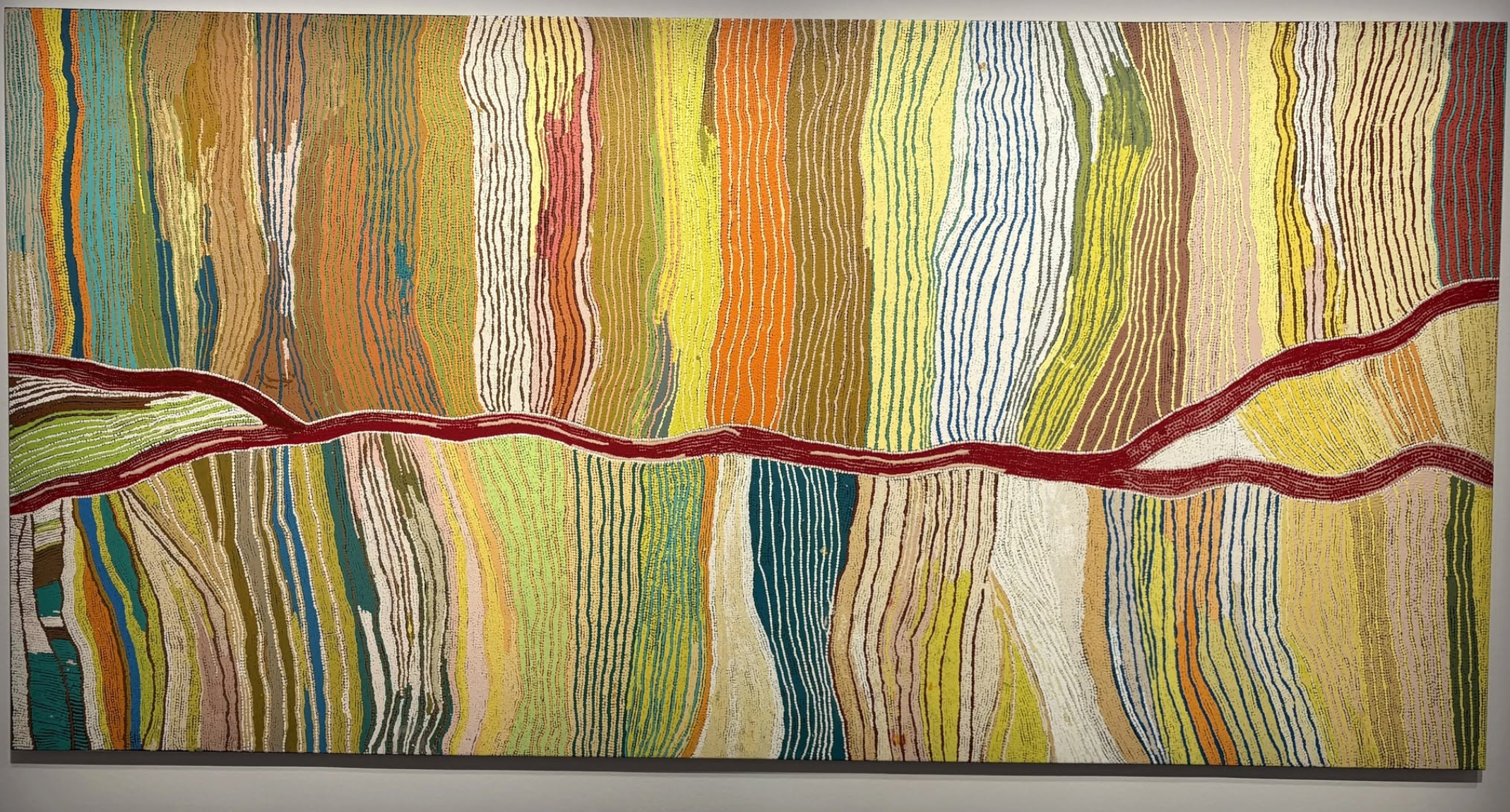
As is typical of such art, the painting depicts an incident in Dreamtime, the Aboriginal mythic time wherein various fabulous beings acted in ways that in many cases left traces in the landscape. According to the wall text, this painting depicts an incident where Ancestral women “gather for ceremonies at Mina Mina in northern Australia’s Tanami Desert, picking up digging sticks that emerged from the earth and traveling east. On their journey, they encountered an Ancestral lizard who cut their hair and spun it into fine strings for them.” The painting is further typical in that the artist stipulates the narrative content of the artwork, a content that would be otherwise visually unrecoverable even to those familiar with the story. The forking, roughly horizontal figuration evident represents and/or maps the path of the women, while the numerous colored patches above and below the path, most of which patches are articulated with several roughly vertical internal lines, represent the cut and spun hair. The actual depositing of the paint of the canvas is done throughout with the dotting technique familiar from the paintings of the Western desert groups, so that even small areas that seem to be areas of homogenous color show themselves on close inspection to be the result of densely placed, partially overlapping dots. What makes this piece, and with it this kind of art generally, so appealing and stand out so markedly in the contemporary visual art world with its pervasive ideologies inaugurated most notably by the ready-mades of Marcel Duchamp and the factory-like productions of Andy Warhol?
Reflection initially suggests five characteristics of this sort of art that, although individually present in countless contemporary artworks, taken collectively as the marks of a distinctive poetics seem to break with major ideologies and practices common across a great range of contemporary art. These five are: textural detail; the dance of the viewer; mapping; stipulative meaning of ancestral patterns and references; abandonment of the pictorial dynamics of horizons and gravity. First, textural detail:
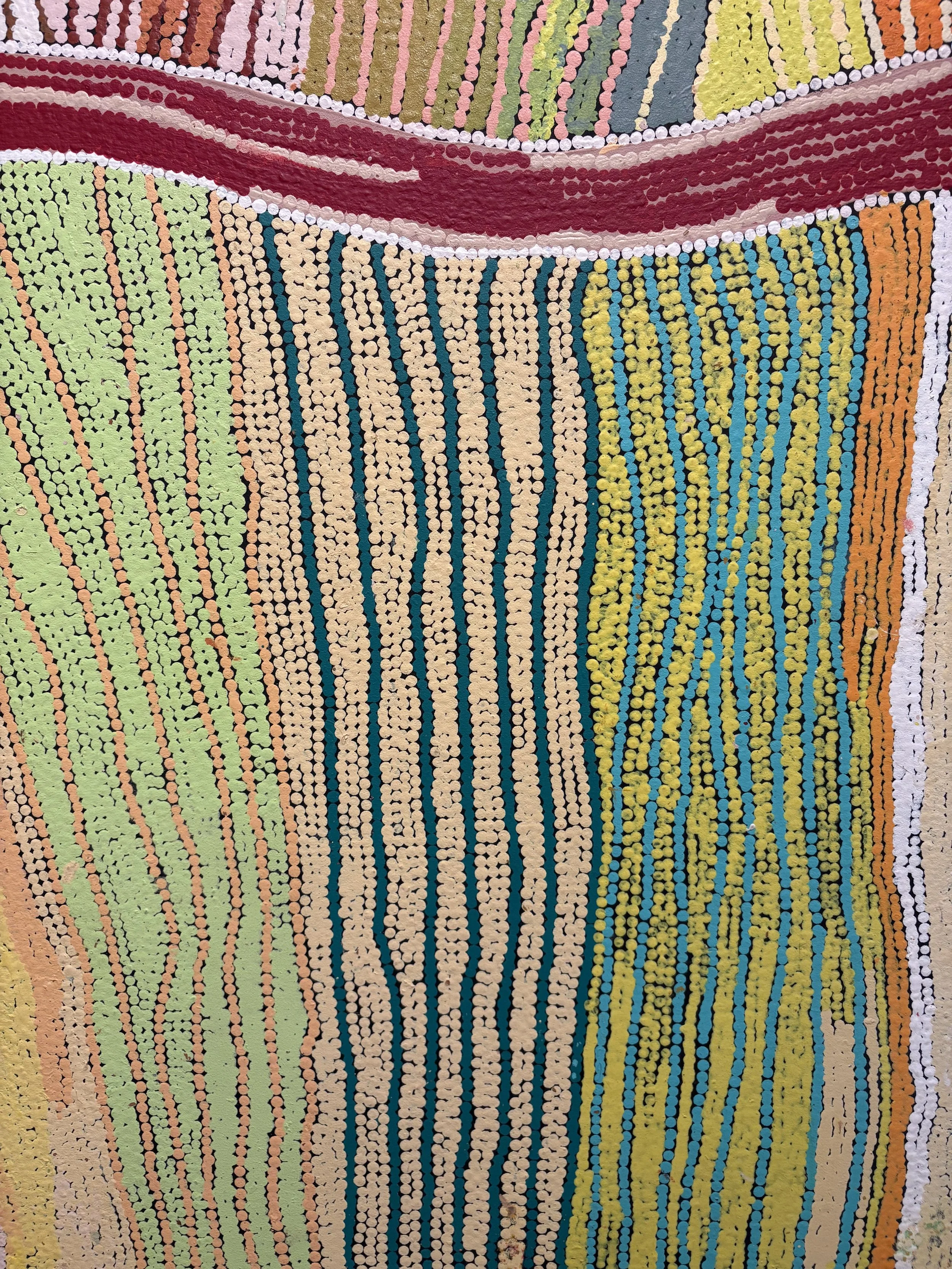
As well-known and noted above, these works are made with dottings of paint, and the deposits are kept distinct except in the densest areas. Correlatively, for the most part the dots are sufficiently dense that, although the support is visible between dots, it never achieves sufficient salience to become pictorially active (here I restrict myself to a formulation appropriate to Watson’s painting; this point would need re-formulation for the linear paintings on bark characteristic of the northern groups). The artists avoid any feel of geometric regularity in the lines and planes, with the spacing between and among dots always varying, however slightly. This rewards seemingly infinite exploration by the viewer, first of all at the micro-level of the dots, but also the higher level of the planes and lines formed, and then edges of the figures, and finally in their overall quality of giving a shimmering quality to the work as a whole. The second characteristic of inducing a physical, non-finite dance of the viewer is closely bound with the first characteristic, as the viewer is induced to move forwards and backwards to grasp visually the micro-elements of dots and their contribution to the pictorial dynamics higher level features of line and plane, and then to the work’s overall effect. But the dance seems to me to differ in two major ways from that typical of the canvases of the great European artists such as Titian. With much European art the viewer moves back and forth as if between two realms, the material realm of paint on canvas, and the virtual realm of the figure.
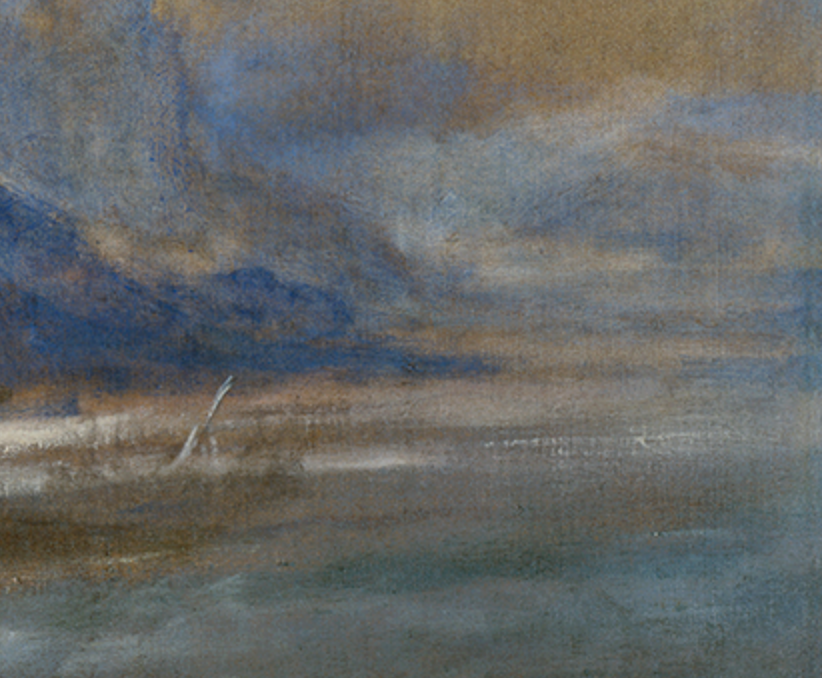
A particular pleasure for the viewer is the discovery of the distance where one realm switches to the other, and the figure seems to emerge as if by magic from the material.
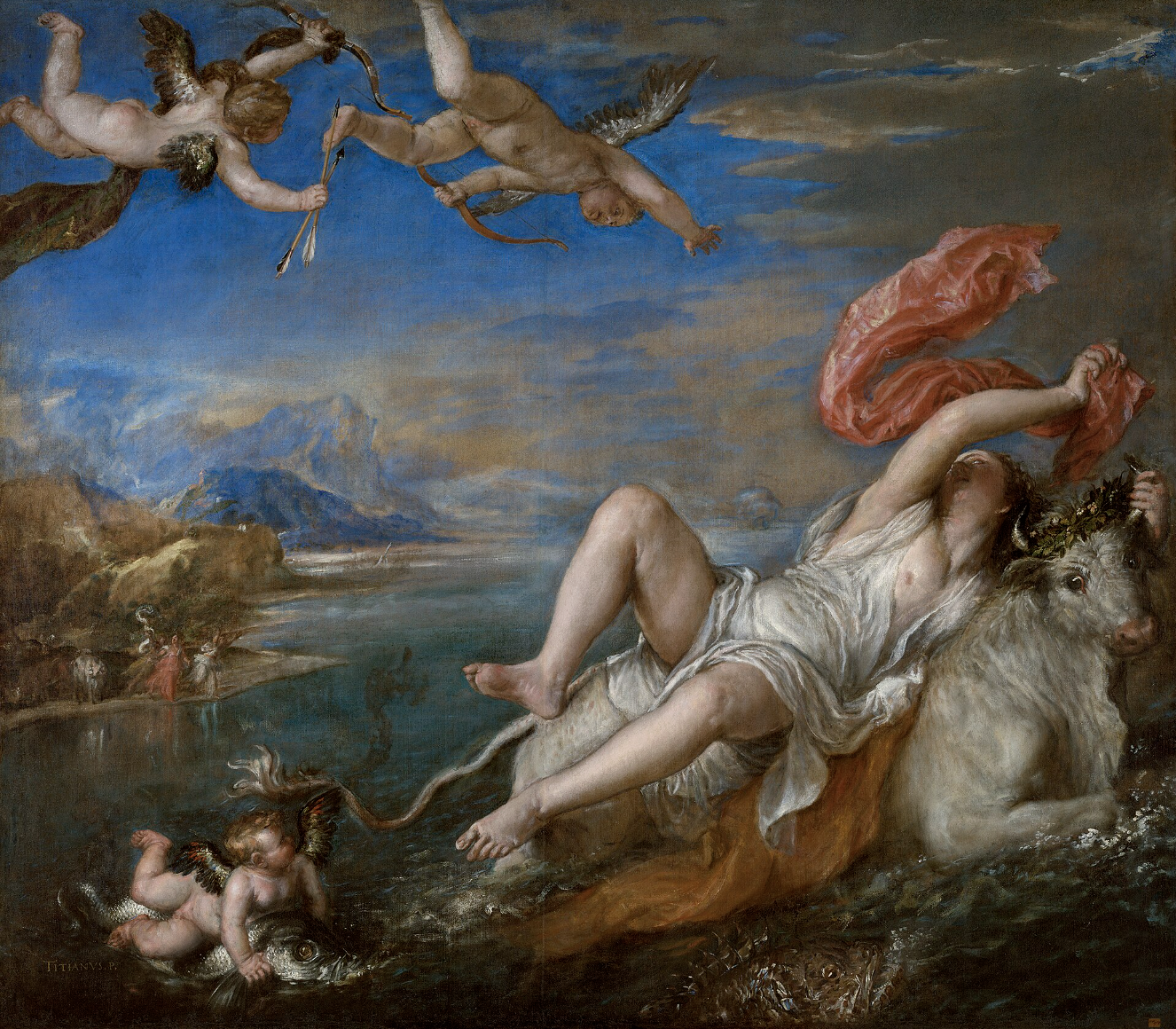
There is no such point the Aboriginal works, where one experiences by contrast a sense of nested levels governed by a guiding mythic narrative. This leads to the third characteristic, that for each work the artist stipulates the meaning of some story in Dreamtime. The artist treats the Dreamtime stories as fixed once and for all time, but also conceptualizes them as massively under-determining what will count as their visual expression. That is, the content is fixed as traditional, but it has no canonical visual representation. So the artist assumes a nearly unbounded freedom of expression, bounded only by a link between content and expression that she herself stipulates. This contrasts with most contemporary Conceptual art, where the artist stipulates both content and manner of expression.
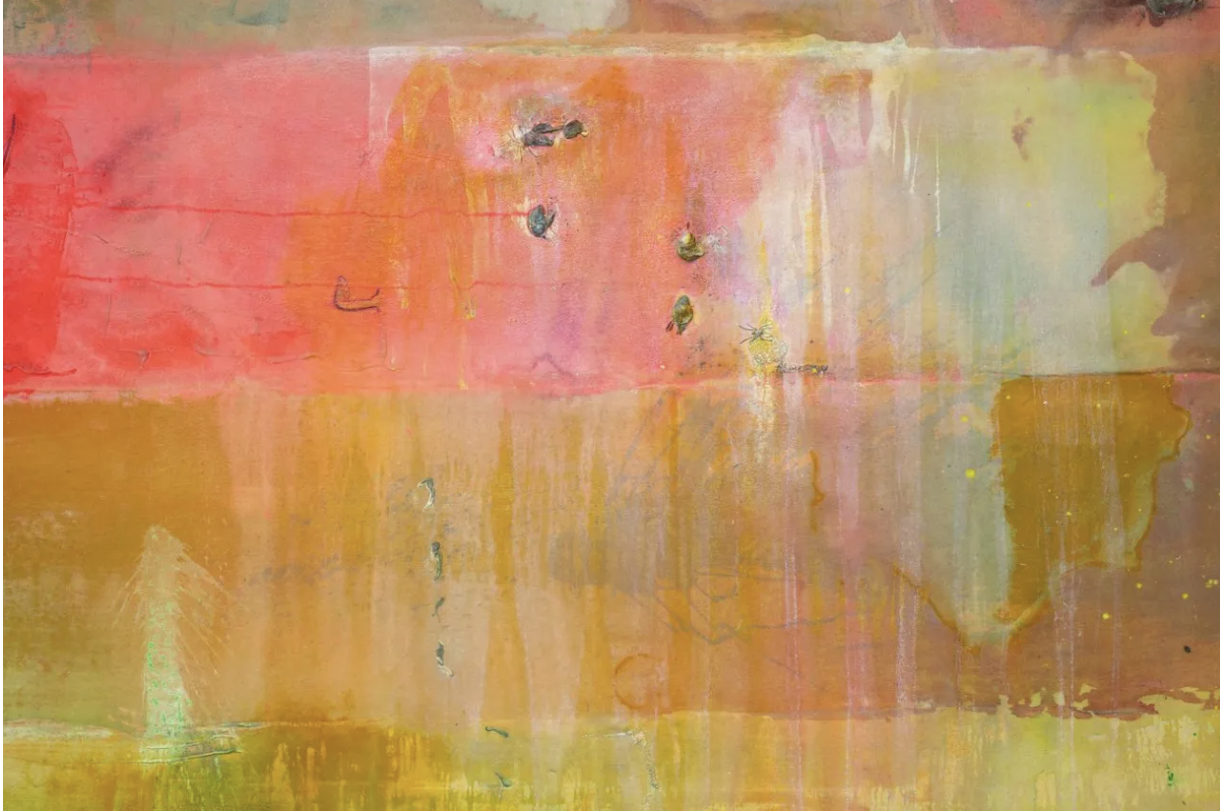
A fourth characteristic follows directly from the previous one, namely, that the artworks are maps of some landscapes and paths, and also typically with the sites of important events indicated. In Watson’s piece the forking red line indicates the path of the women through the desert. The mapping function indicates an implied viewpoint looking down upon the landscape from on high, and so further complicates the viewers’ dance in front of the picture with a constant awareness of an imaginative viewpoint along with the physical, shifting viewpoint. A final characteristic resonates to some degree with the mapping function, as unlike so much of late modern and contemporary abstract painting there is neither a sense of a horizon line (as here in a magnificent work by Frank Bowling)
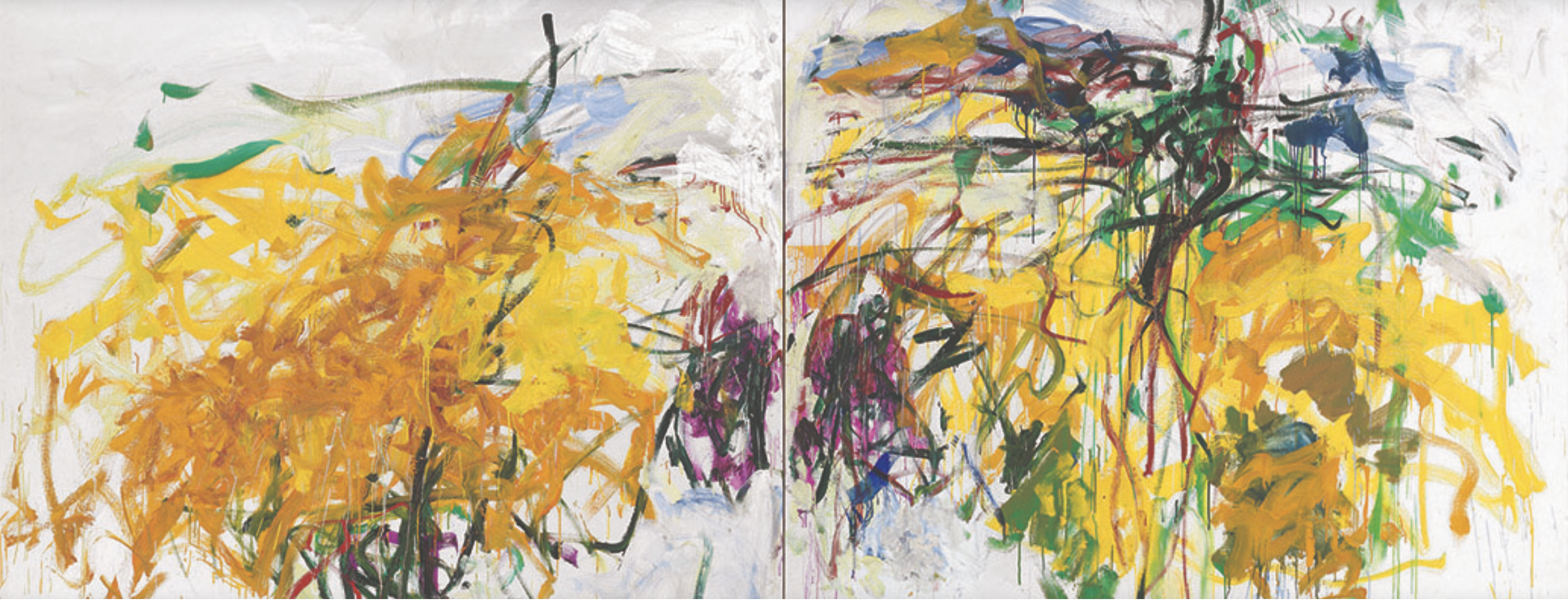
Or of the orientational effects of gravity (as given such striking expression in the works of Joan Mitchell).
Something of the constant effects of this collection of characteristics, so it seems to me, regularly places recent Australian Aboriginal painting among the finest works of contemporary art. Or does it point to something beyond contemporary art? I’ll consider this with regard to my next post on the work of Adrián Villar Rojas.