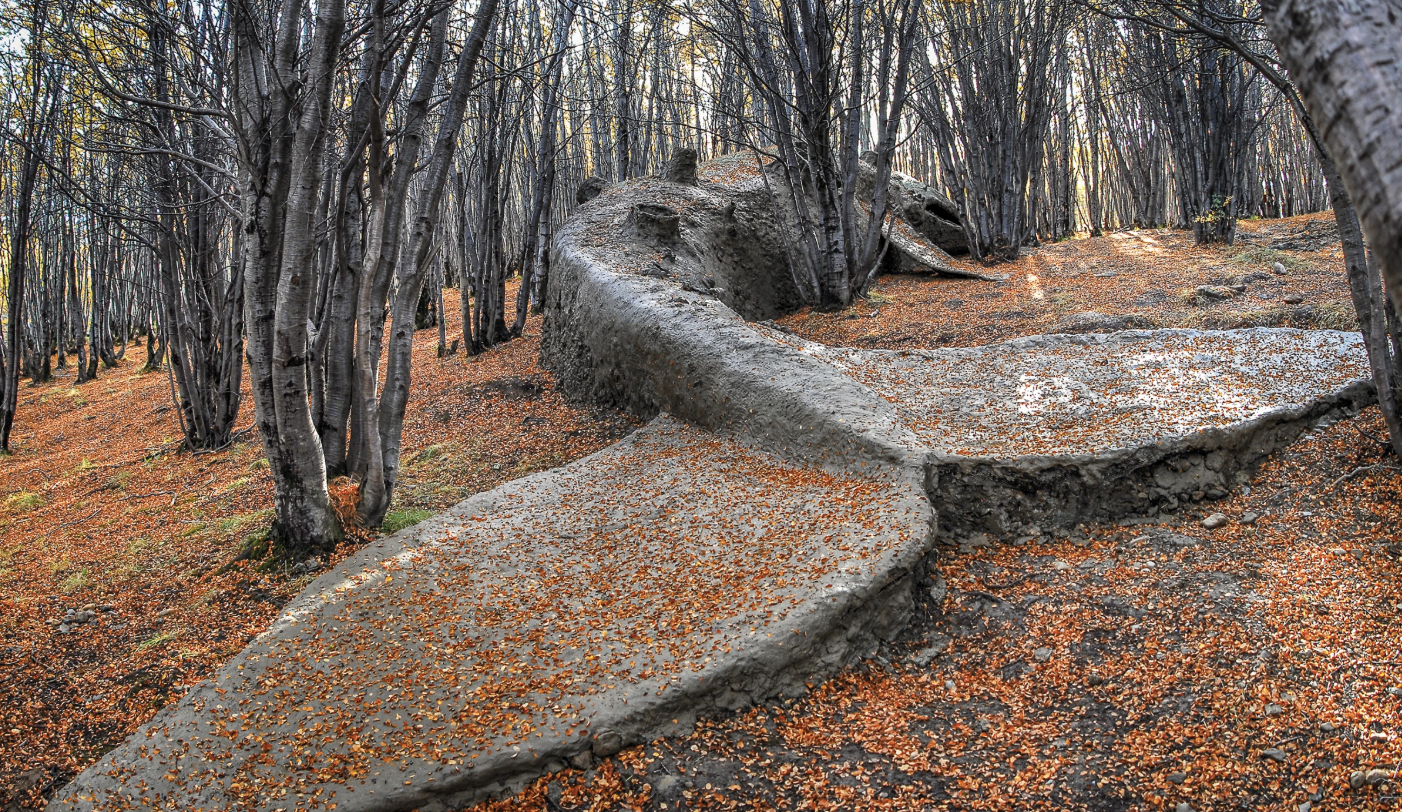
I continue my reflections on my recent art-tour of the great state of Colorado with a consideration of the Argentinian artist Adrián Villar Rojas’s ‘First Gods, Lost Animals’ at the Aspen Museum of Art. Learning of this exhibition early this year motivated the trip, as I had been hoping to see an exhibition by Rojas since first coming across his work about five years ago. Rojas first came to the world’s attention in 2009 (though not mine) with his sculpture of a whale set in a forest, ‘Mi Familia Muerta’.
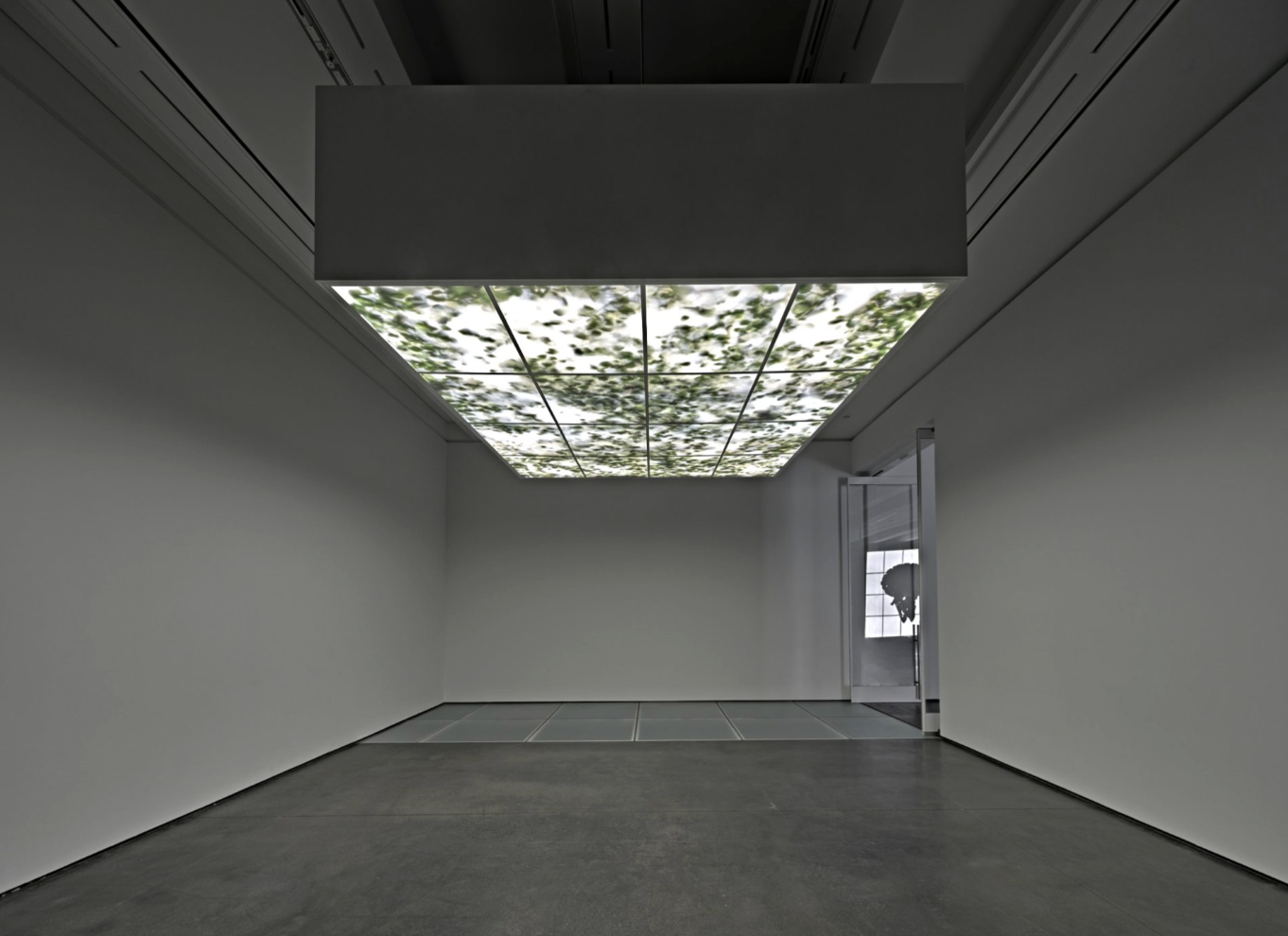
Since then he has created a unique body of art that arises from him and a team going to a site, usually a museum, and spending months making sculptural installations out of local materials. The current exhibition breaks with that practice in that the major pieces were fabricated elsewhere and shipped to Aspen, where it occupies the five rooms and a hallway comprising the Museum’s two lower stories. Two of the rooms display light boxes faced with grids and displaying back-lit leaves of ivy; one box is mounted on a wall, one on a ceiling.
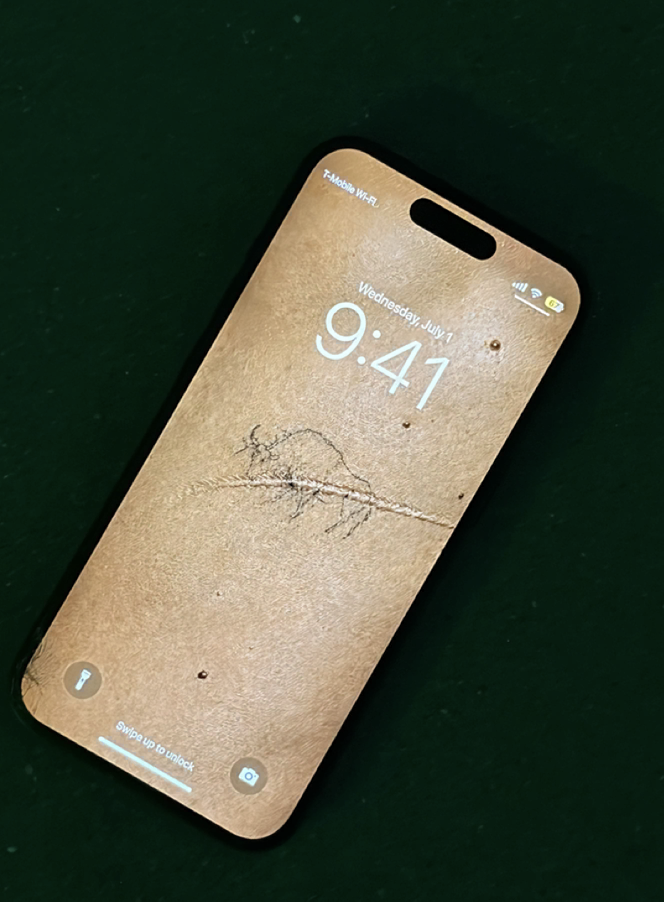
In a hallway a single iphone displaying a quasi-Paleolithic drawing is placed on the floor face-up.
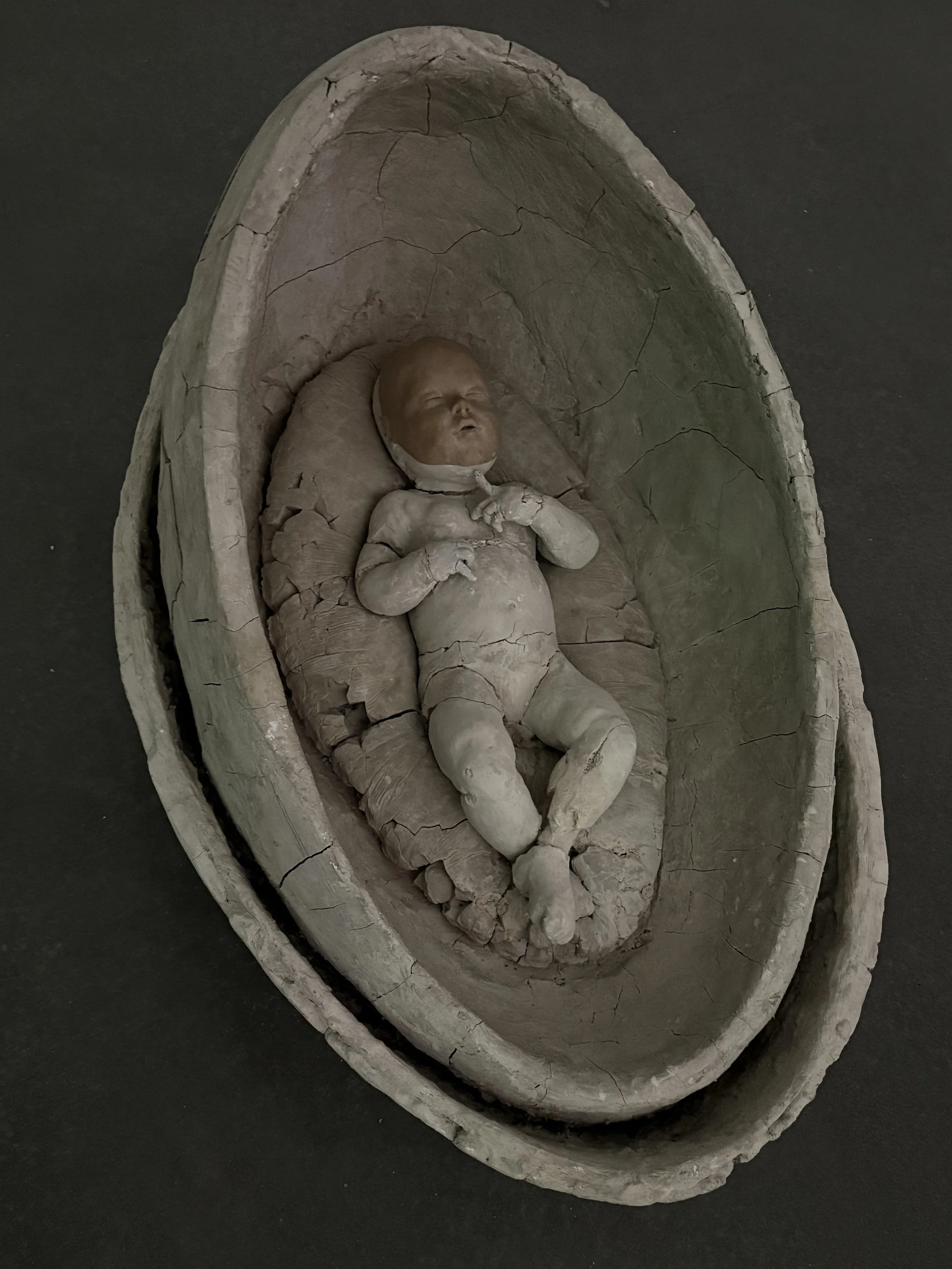
Another room contains an early piece by Rojas, ‘Return of the World XIX’ (2012), showing a plaster baby in nested oval clay cribs.
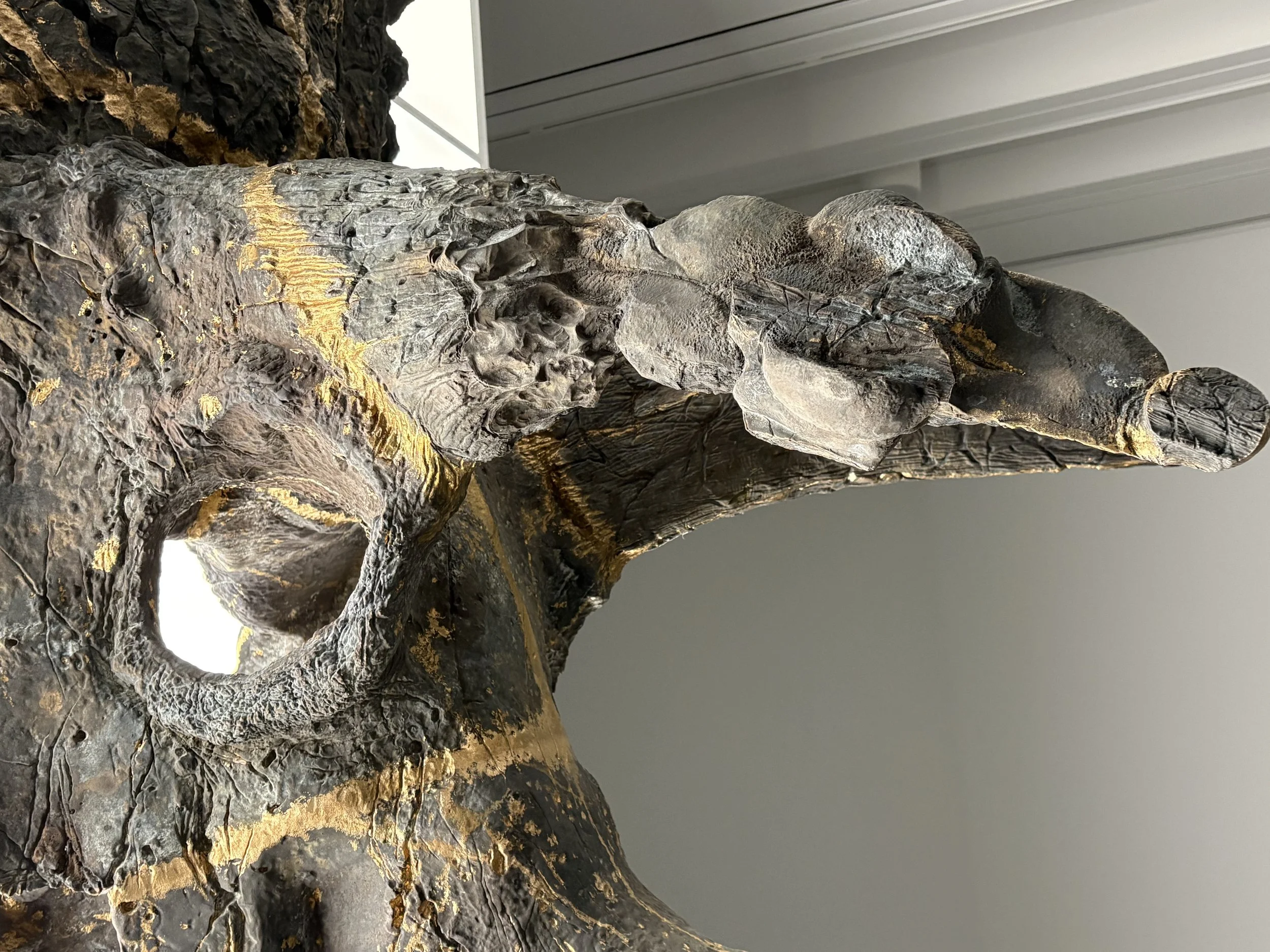
Another room is devoted to ‘Untitled (From the Series The Language of the Enemy)’ (2025), which consists of a life-sized bronze triceratops head,
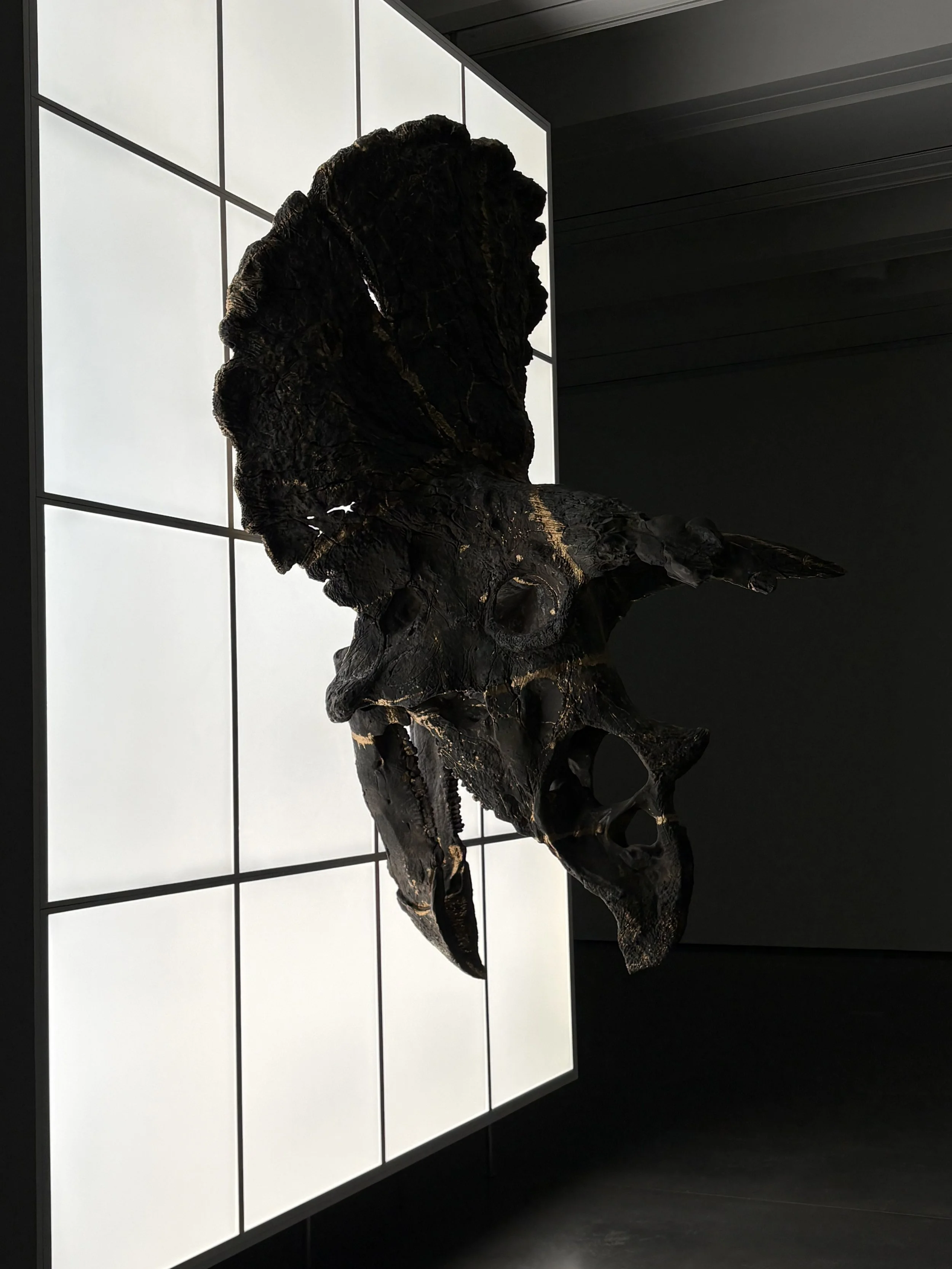
one of whose horns has been carved in manner evoking the Paleolithic sculpture usually referred as the Venus of Lespugue.
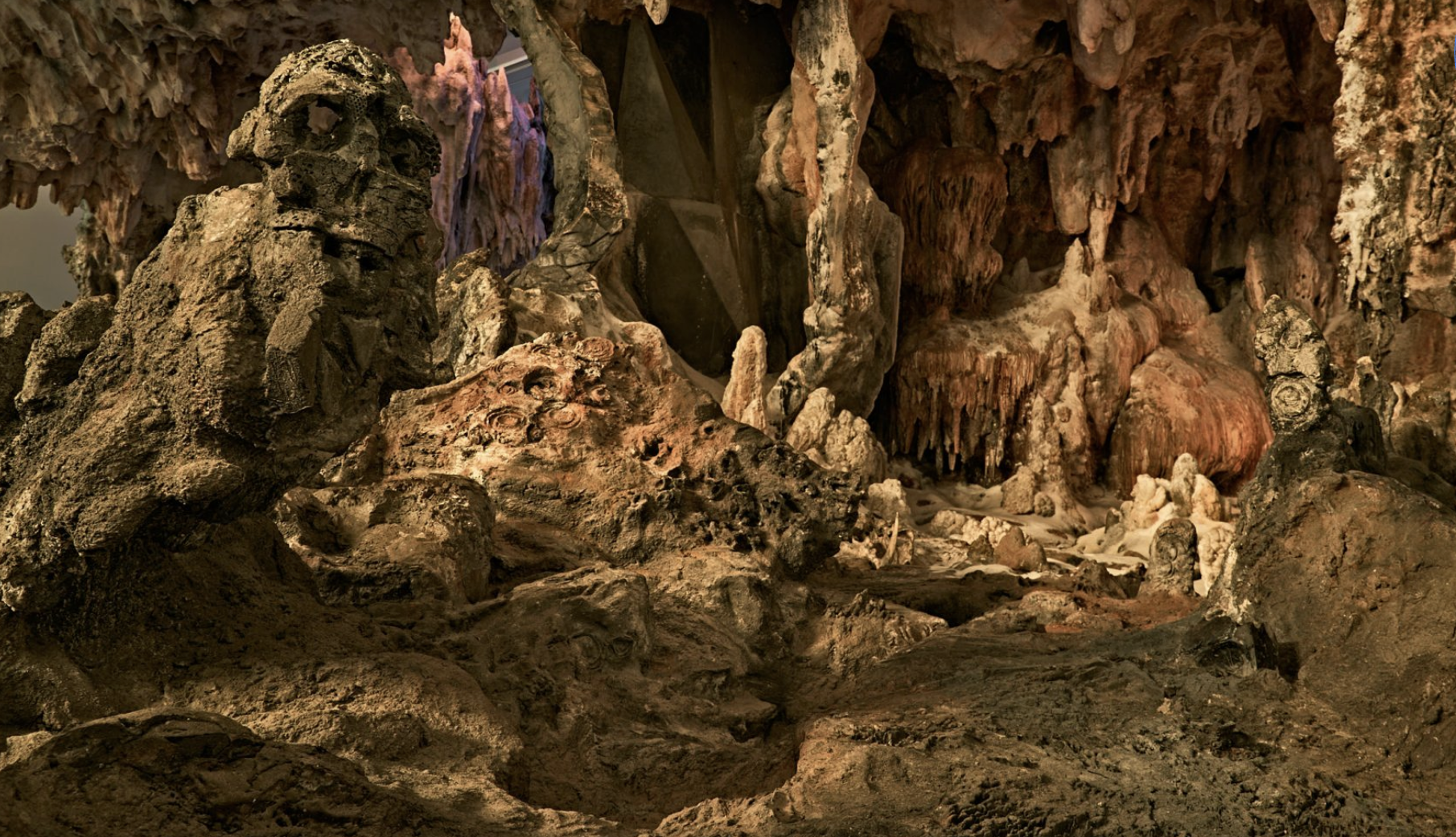
The largest and surely most stunning and enigmatic element is ‘First Gods, Lost Animals I, II, III’ (2026), which the catalogue describes as made of ‘layered composites of organic, inorganic, human, and machine-made matter’ and as slightly larger than 12’ x 33’ x 22.5’. The experience of encountering and visually exploring this piece cannot be well conveyed in photographs, as it offers no obviously summarizing vantage point and suggests an inexhaustible complexity of surface incident.
With Rojas and his collaborative works something new emerges in contemporary art. The general format and manner of presentation are of course familiar: a number of individual works in both traditional and non-traditional media are brought together in a single exhibition under some organizing idea. For purposes of a blog post I’ll try to bring out the startling originality of the exhibition with some consideration of Rojas’s explicit statements, and then let the artwork and the verbal statements interpret and refine each other. Three statements motivate the exhibition and indicate something of Rojas’s specific artistic conception therein. First, in the materials accompanying the exhibition, Rojas says that “Twenty-five years ago, I had--and still have--a difficult relationship with the post-Duchampian, post-readymade art field I found myself in. I had the feeling that it would only be a matter of time before art expanded toward every possible entity and experience, appropriating reality itself through concepts and language. Everything could eventually be claimed, absorbed, and reframed a part of the territory of art. I found that to be a fascinating cultural dead end, an exhaustion of a certain position”, and he goes on to liken this diagnosis to Jorge Luis Borges’s in ‘The Library of Babel’, wherein “every story has already been written, and that we are merely ghosts inhabiting the landscape”. Second, Rojas is paraphrased as saying that he is interested in ‘the conditions that make meaning possible’. Third, the materials used in ‘First Gods, Lost Animals I, II, III’, a mixture of clay and cement, provide “the possibility of speaking simultaneously about prehuman life on Earth and about a deeply human time”. The triceratops skull is said to imagine “a speculative, world-building moment: a transmission across time and a gift from a now-vanished branch of human ancestry to another, more specifically from Neanderthals to Homo sapiens”. Stated so summarily, each of these three points seems both obscure and evocative, inducing indeterminately whole worlds of thought, reflection, research, and interpretation from art history, the philosophy of art, the philosophy of language, and linguistics, with the third point invoking additionally archeology and human evolution; and each point prima facie requires a great deal of further explication to be intelligible.
One of many possible initial stabs of making Rojas’s three claims coherent and intelligible might go something like this: A central ideology of contemporary art stems from the broad acceptance of Marcel Duchamp’s readymades as both inaugural and paradigmatic instances of contemporary art. In such an ideology, the act of artistic creation consists in (i) the artist’s proposal of some idea (‘I’ll make a work about x”) and the choice of some object or artifact y as the vehicle of the idea, so artistic making consists fundamentally of proposal + choice, accompanied with seeming necessity by the claim that y is adequate as the vehicle of x. No restrictions are placed upon either x (any idea might become (part of) the content of a work of art) or y (anything might be the artistic vehicle of an idea). Accordingly, as contemporary art is made decade by decade, along with a kind of implicit yet powerful pressure on artists for originality in both ideas and vehicles, the idea of a limit point wherein every idea and every kind of material have been used in an art work, and so (contemporary) art comes to an end, at least as a cultural project demanding originality. (We supply a premise:) Art is the paradigm of full or maximally rich meaning, so the end of (contemporary) art is the end of (full) meaning. The working out of the Duchampian premises of contemporary art over the last hundred years puts us now at the end of art, perhaps in something like the philosopher Hegel’s sense that we’ll still have art in some minimal sense, but that art can no longer be a central cultural activity. (We supply a further claim:) In archeology and the study of human cultural evolution it has become customary to use the notion of ‘cultural modernity’, a state achieved Homo sapiens no later than 45,000 years ago wherein human beings had full language, rituals, probably some sort of religion, and the arts of dance, music, drawing, painting, and sculpture. In what is now Spain and southern France immigrant Homo sapiens would have encountered an indigenous population of Neanderthals, who had proto-arts of marking, likely had a kind of proto-language consisting of classifying ‘words’ and expressive markers of various kinds, and possibility had some sorts of rituals and burial practices (the evidence is ever-changing with new theories, new discoveries, and re-dating of earlier discoveries; see for example the books by Collins and Tomlinson in the bibliography below). There is no evidence to suggest that the Neanderthals had anything like array of arts of the Homo sapiens, and so we can say that the Neanderthals had no concept or practice of art. We might then, correlatively with our current imaginative stance at the end of art, imagine the non-artistic state of the Neanderthals and ask: What might the Neanderthals have contributed to the humans other than a negative example of the non-artistic? And most generally, since we occupy an imaginative viewpoint that is simultaneously pre- and post-artistic, the resultant artifact cannot be thought of as something (maximally) meaningful, but rather as something presenting the conditions of (maximal) meaning, out of which, under different conditions from cultural modernity through Duchamp, meaning might arise.--So Rojas’s agenda is set.
Let us turn now to what is surely the central piece in the exhibition, the massive ‘First Gods’. The essay accompanying the exhibition states that the piece is based upon photogrammetric scans (that is, imaging techniques used to produce three-dimensional models) of the caves of Lascaux and Chauvet, the two greatest sites of Paleolithic painting in France, and that Rojas has reproduced parts of the caves that mostly lack artworks. So these are parts of the cave that as it were are in the vicinity of art, marginal areas that must have been inspected in the Paleolithic and rejected as inappropriate. One’s initial impression is of large, irregular chunk of nature, and nothing about the piece suggests any particular path for exploration. With sustained viewing one notices indeterminately many signs of artifice: most commonly grids seemingly carved into stalagmites, sometimes suggestive of electrical boards, other times as decorations or gameboards.
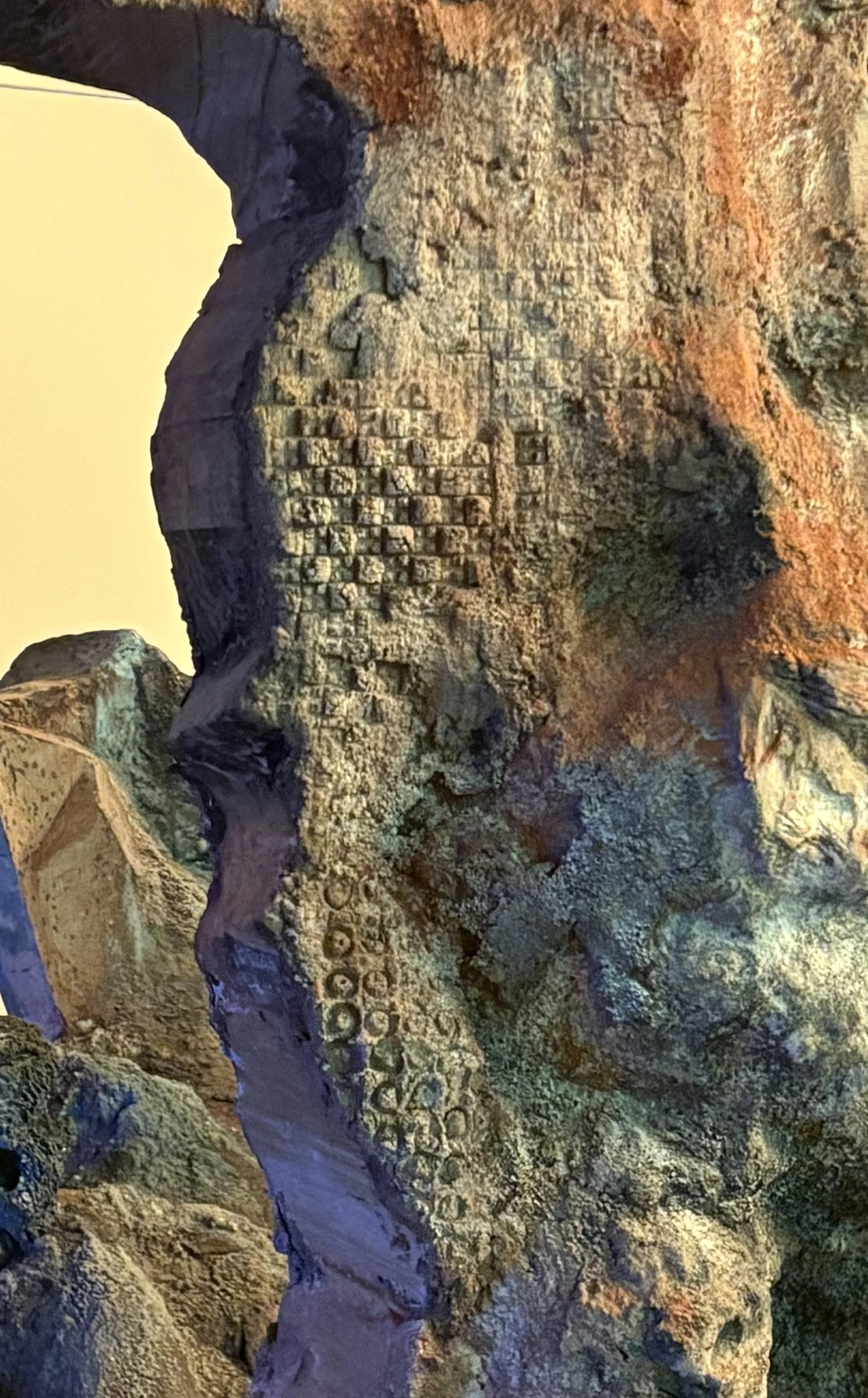
Scattered about are carved depressions of concentric circles.
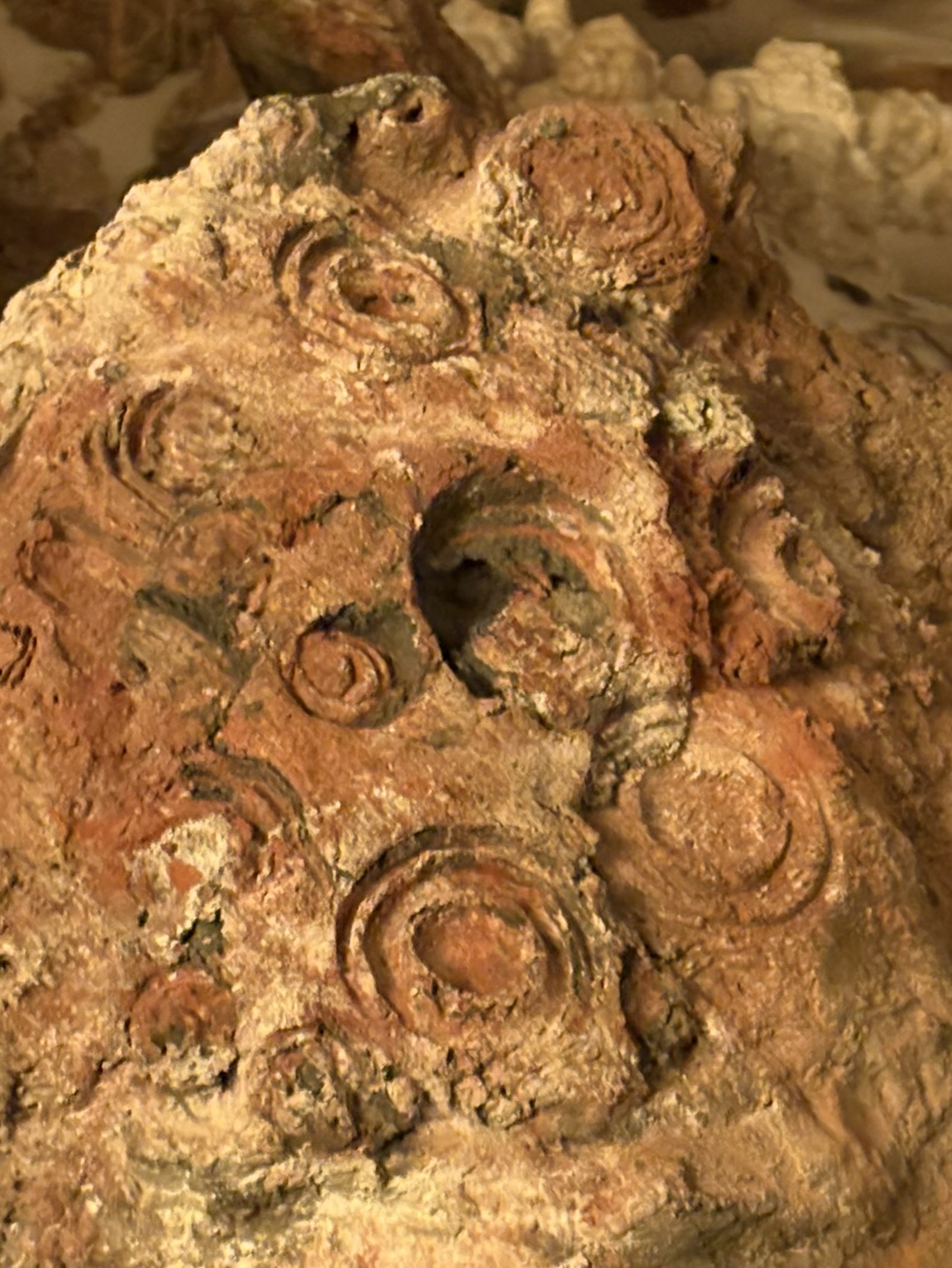
There are also many small stalactites and stalagmites that have been seemingly minimally carved to suggest profiles of animals, with many instances where one wonders whether one is seeing a carving or just result of natural processes.
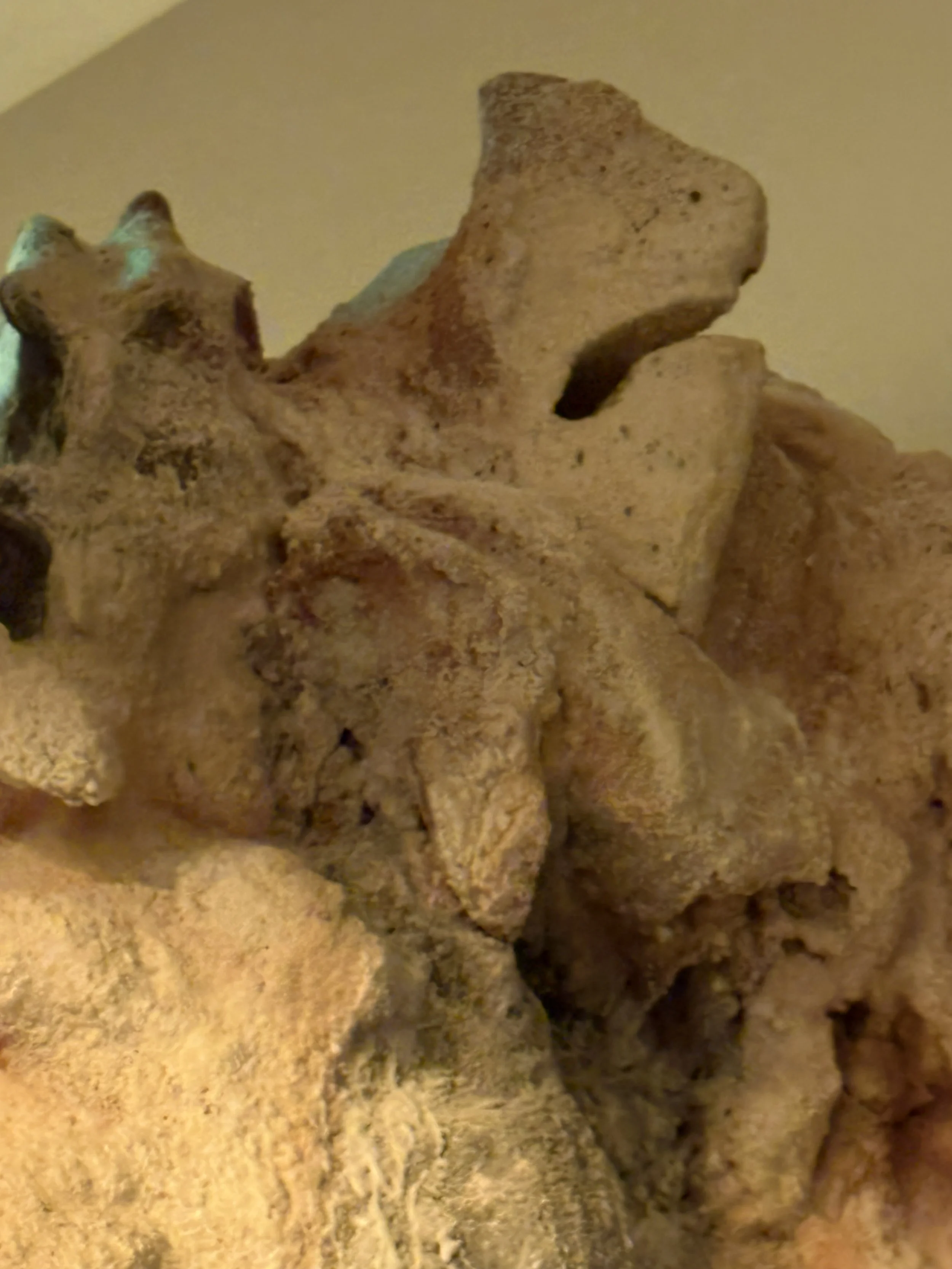
More dramatic is the lower part of the skull of what looks to be a saber-toothed tiger,and most dramatic of all a carved human, or at least hominin, skull, the sole figurative item.
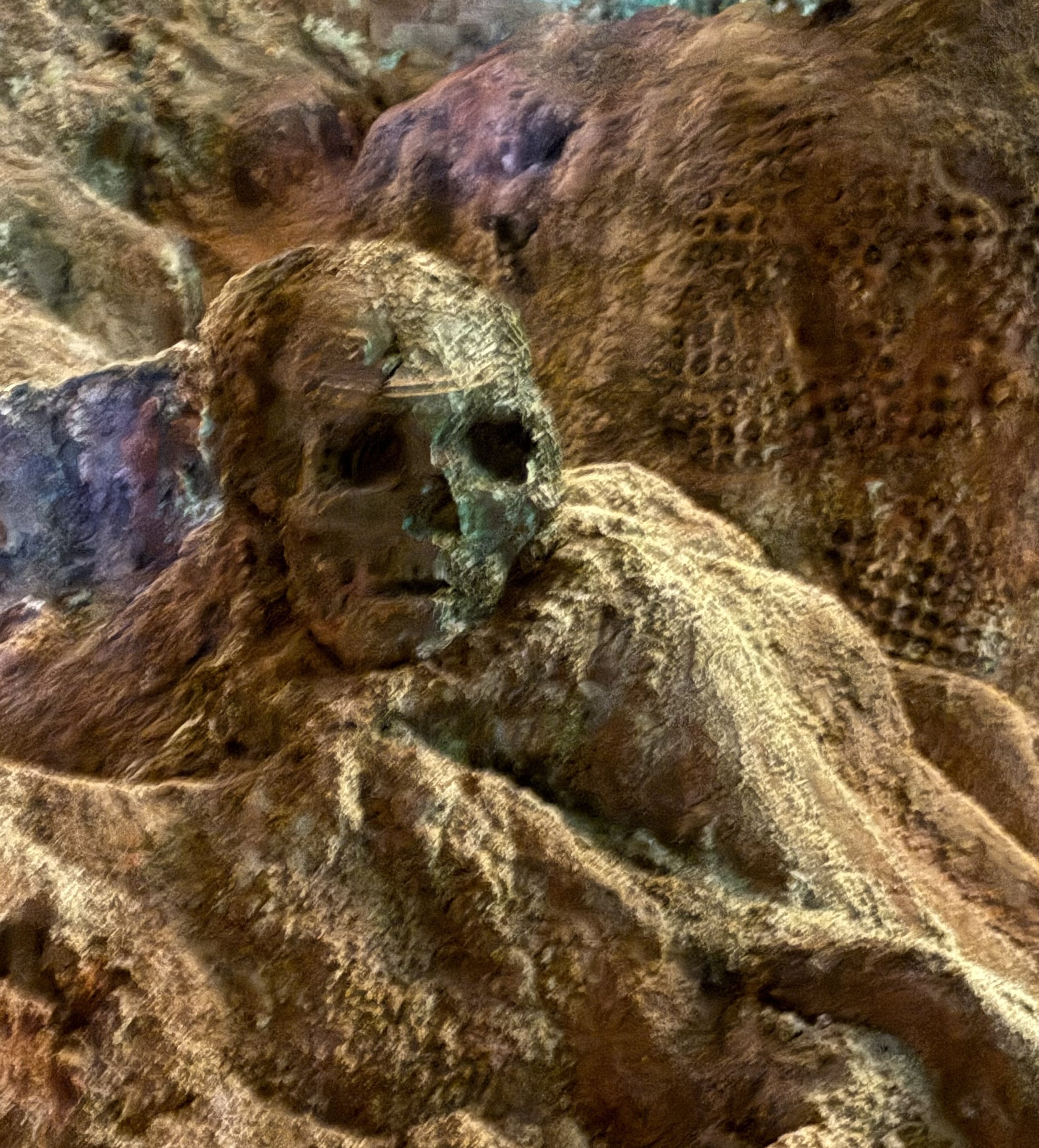
It seems to me that there are at least two overall effects of minutes and hours spent exploring ‘First Gods’. One is the sense that there is a basic level, one almost wants to say a fundamental ontological level, where the distinctions between nature and culture, what is given and what is made, the non-intentional and the intentional, all vanish in the face of a kind of materialized temporality of processes. Instead of the expected sense that the cave-like environs are settings of or backgrounds for artifice, design, and art, the hominin products are grasped as ephemeral knots of energy that are soon to dissipate into something indistinguishable from the sheerly material formations. Yet also at the same time everything seems the product of human artifice, as one carries the knowledge that what one sees is made, and where something like the distinction between the phenomenal distinction between the natural and the made reveals itself as the distinction between as it were unmarked and marked makings. Rojas’s use of relatively marginal and unmarked areas of Lascaux and Chauvet encourages the thought that much of what we see has been carefully scrutinized and then left untouched. What has been touched becomes meaningful, and meaning is both rare and ephemeral. As a pre-Socratic philosopher might put it in the spirit of Rojas, ‘All things are subject to the ordinance of time, things are come to be and pass away, all things are made, some things pass from non-meaning to meaning to non-meaning’. One is left with the powerful impression that some unemphatic and ineffable intention pervades everything. Like Nicolas Poussin, Rojas too could say ‘I have neglected nothing’.
What then might be the Neanderthals contribution to human art? The Neanderthals are thought to have evolved on the Eurasian landmass very roughly 400,000 years ago, with their cousins Homo sapiens emerging perhaps only 200-150,000 years ago. When human beings encountered Neanderthals first in the near East, and then much later in Europe, they encountered a much older type, better adapted to cold, but lacking art. Might the humans have sensed in the Neanderthals a way of living more durable than theirs? And we humans, after the end of art, and perhaps even more after the coming ecological catastrophes, might we then feel closer to our Neanderthal cousins than to our ancestors who cursed the earth with their fixed hierarchies, eco-cides, nuclear weapons, de-forestation, and vast patches and piles of technological trash?
A fantastic question arises: Is Adrián Villar Rojas the first great artist (or post-artist?) of the post-contemporary art? A more realistic thought is that his ‘First Gods, Lost Animals, I, II, III’ is among the very greatest artworks of our time.
Bibliography:
Anonymous, ‘Adrián Villar Rojas: First Gods, Lost Animals’ (statement accompanying the exhibition (2026))
Jorge Luis Borges, ‘The Library of Babel’ (1941), in Collected Fictions (1998)
Christopher Collins, Paleopoetics: The Evolution of the Preliterate Imagination (2013)
Gary Tomlinson, A Million Years of Music: The Emergence of Human Modernity (2015)
--Culture and the Course of Human Evolution (2018)
--The Machines of Evolution and the Scope of Meaning (2023)
Adrián Villar Rojas (in conversation with Álvaro Enrigue, ‘Historical Fictions, Future Myths’, Aspen Art Museum: Summer 2026