Having offered some accounts of and reflections on the work of Adrián Villar Rojas at the Aspen Art Museum and the large exhibition of recent Australian Aboriginal Art at the Denver Art Museum, I turn to a couple of reflections upon my visit to the Clyfford Still Museum in Denver. The Museum possesses the great bulk of Still’s work, as well as a very large archive of material related to Still. At any given time the Museum displays the course of Still’s work from his early figurative work,
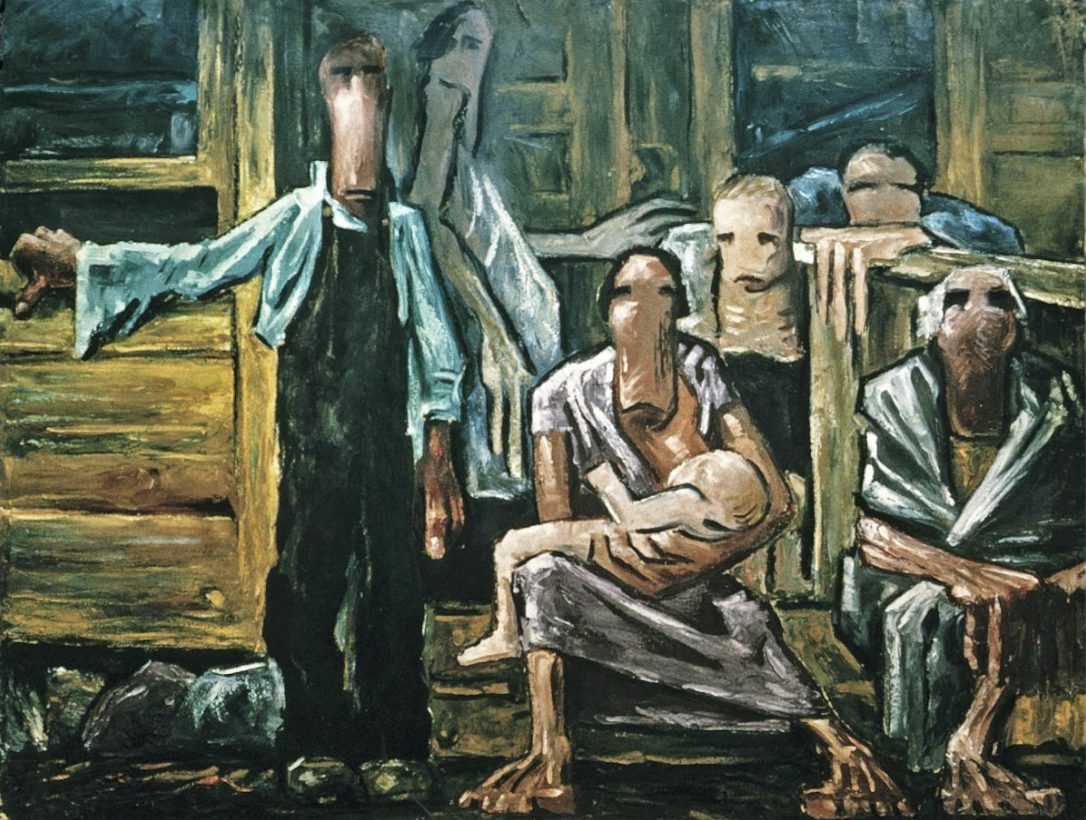
through his turn to abstraction in largely vertical formats,
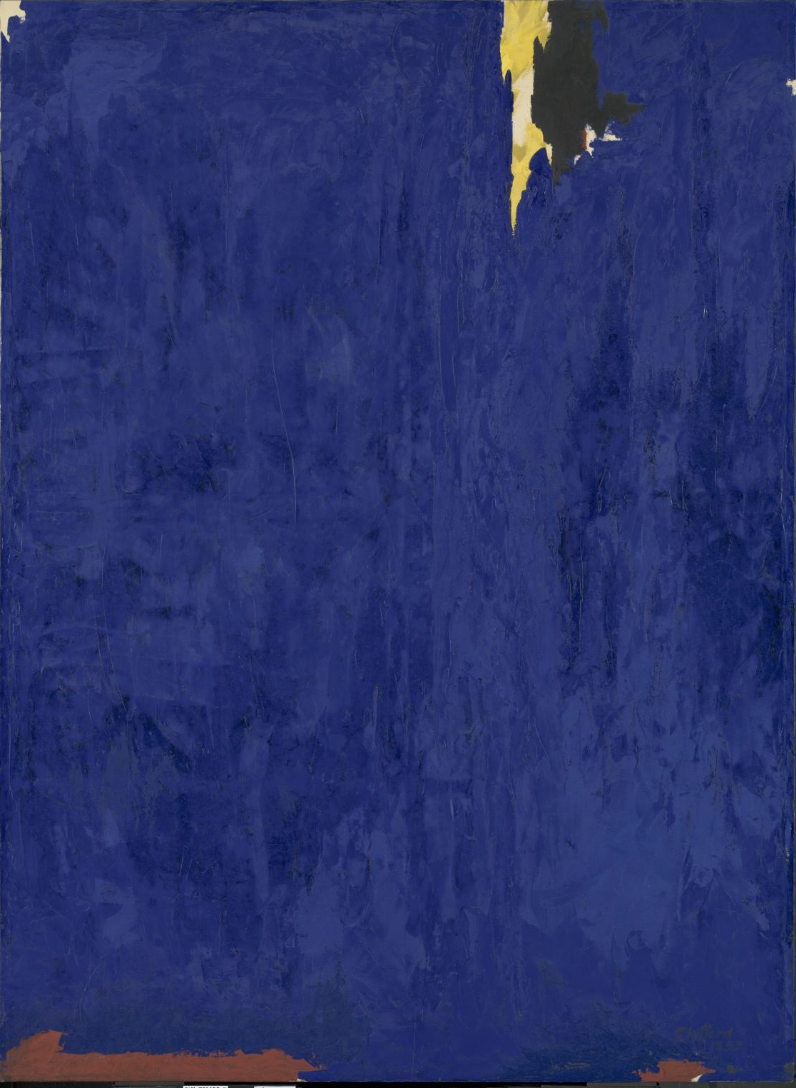
ending with his later work, which tends, in relation to the earlier abstracts, to expand vertically and introduce more ‘empty’ space or bare canvas;
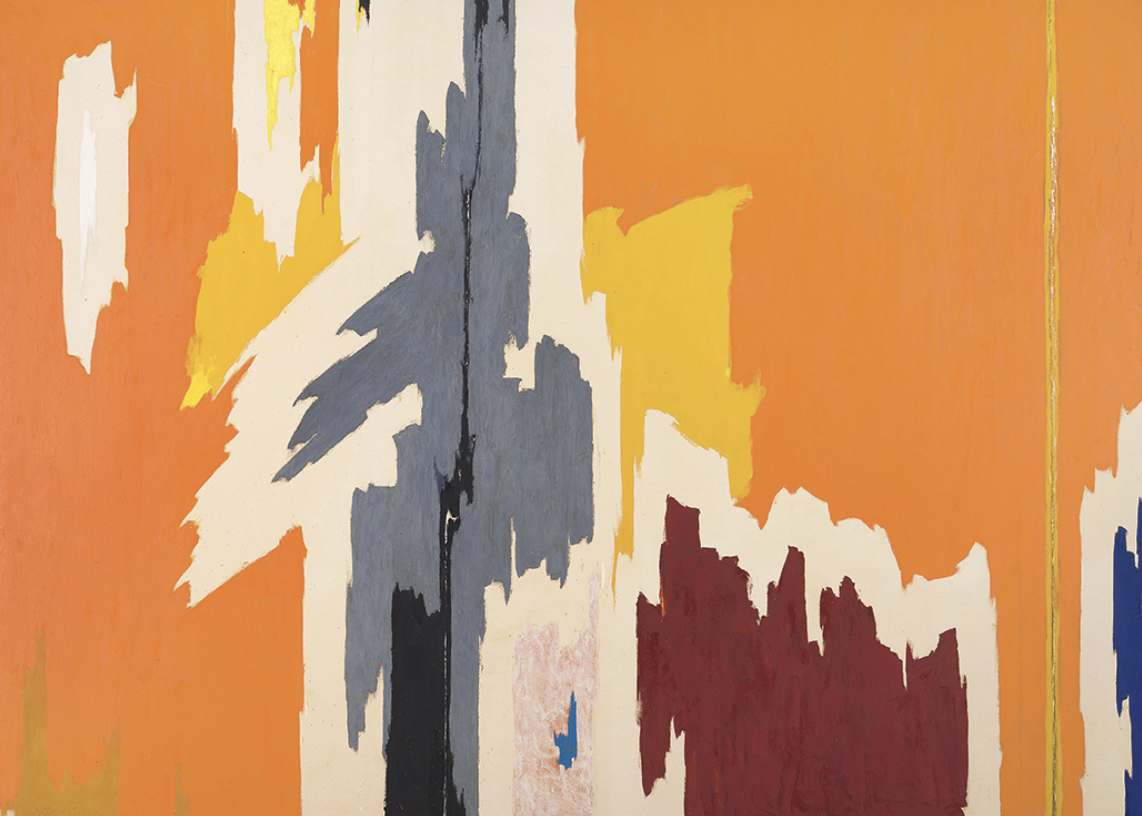
however, on account of the very large number of works in Still’s oeuvre, the museum regularly rotates the works. So for those of us who are infrequent visitors it is, like a Ross Dress For Less of the Arts, never the same place twice. I started looking at and studying Still’s abstracts around 1980, and have taught his work countless times as part of surveys of modern art. My kinds and degrees of understanding and appreciation of Still have been quite stable for decades, so here I restrict myself to two brief considerations: What is the role, if any, of decoration in Still’s work? And did Still inject into his work any resonances that might relieve the sense of otherwise unrelieved imperiousness?
1. Still as an anti-decorative artist.
Like many modern and especially late modern artists, Still’s mature style is partially structured by a cluster of rejections: there shall be no figuration, no traditional painterliness, no foreground/background relations, no volumetric shading, nothing suggestive of geometry, nothing distinctive of Cubism, etc. One notices that the rejected have differentially important to the art of painting, that is, some might be thought to be near-universal features of the world’s visual art (e.g. foreground/background relations), others of to be features of much of the world’s visual art (figuration), still others as prominent aspects of a major line of visual art (e.g. shading in Western art), and yet others relatively recent and local features of a tradition (e.g. Cubist space and formal structures). Still wrote a thesis on Cézanne and was vividly aware of the sense that Cubism arose from a kind of radicalization of Cézanne’s method of unsettling entrenched spatial and formal relations; for example, Cézanne characteristically renders a motif as if seen from multiple viewpoints (where, say, parts of a table are shown from a view more or less face-on, and other parts from a higher viewpoint, as if the table had been tilted in the process of painting it).
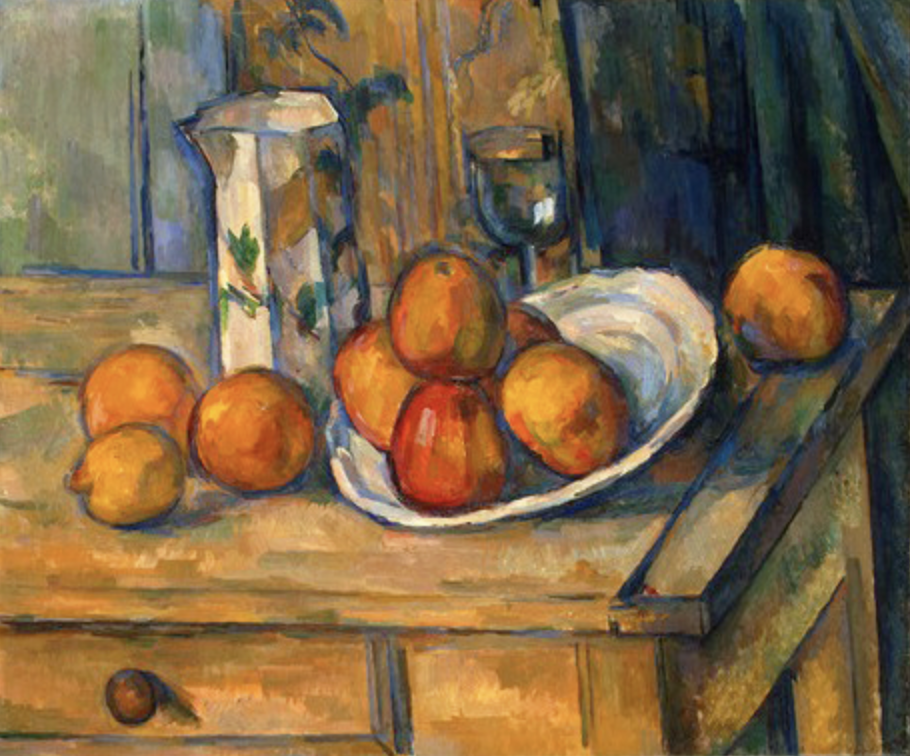
Then in Picasso’s and Braque’s early Cubist phase, the motif is built up from multiple small planes or facets, as if each micro-part of the motif were seen and rendered from a different viewpoint.
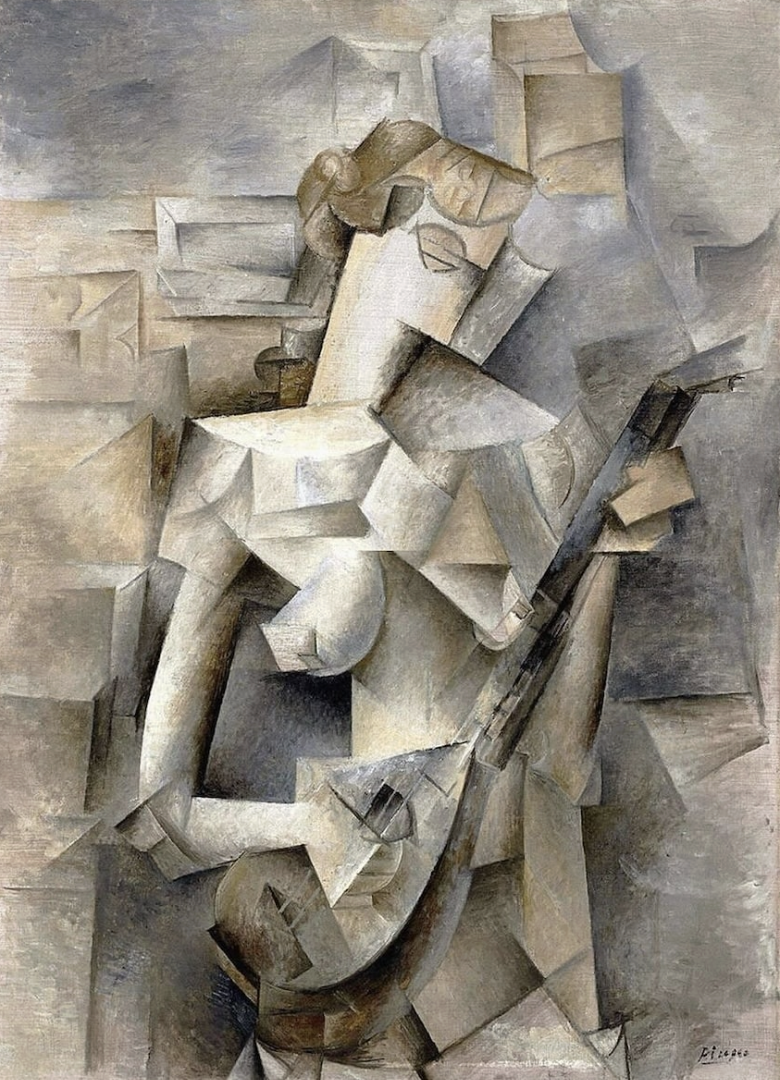
There is much to be said about this, but with regard to Still’s rejections I note two points. First, early Cubist works typically involve some determinate distinction between foreground and background, although sometimes a facet is left unclosed on one edge and so the motif seems to blend into the background. The background itself is only lightly structured, and the resultant effect is usually to as Cubism’s ‘shallow space’. Second, in much of Cézanne, and pretty much all of early Cubism there’s a pervasive rectilinearity in the rendering of motifs, with the effect (particularly powerful in Cézanne) of an unusually close connection between the motifs and the (rectilinear) edges of the canvas; the horizontals and verticals seem to echo the edge of the canvas within the canvas, and diagonals seem to provide an intricate architectural counter-point. With regard to these two points, Cubist shallow space and Cubist architectural rectilinearity, one could plausibly say that Still’s rejections are thoroughgoing; nothing of these two elemental devices of depictive meaningfulness survives in Still’s work.
But Cubism and its devices are only a small peninsula on the continent of the art of painting. Consider the following conceptual model of the basic elements of a typical picture in the practice of painting as an art: (a) Some element or small number of elements constitute the focus or foci of the painting; the rest of the painting is non-focal, and primarily background, although typically complicated with secondary or tertiary elements and details, such as recessive figures, houses in the background, a castle in the distance, etc. etc. (b) The picture has edges, which determine spatially and literally what is in the picture and what is not. (c) In a great many of the world’s artistic pictures the edges are decorated, either with decorations on a frame that surrounds the painting, or with painted decorations (typically paralleling the edges) that consist of schematic representations and/or geometric figures in simple patterns wherein elements are repeated, reversed, and/or flipped on their horizontal axis (see E. H. Gombrich’s The Sense of Order for the canonical presentation of this point).
Now these three features--foci; edges and inside/outside determination; decoration--are plainly much more entrenched in humanity’s practices of artistic painting than the characteristic stylistic features of Cubism, but it might also be thought that Still’s rejections extend to these more elemental characteristics. For example, Still’s particular use of and juxtaposition of ragged monochrome vertical planes eliminate the sense that some elements are focal, salient, and/or marked; the great size and, in the later works, the horizontal expansion greatly reduce the degree of awareness of the edges that a viewer might otherwise have with smaller works; and in turn the pictorial need for decoration fades with the elimination of the sense of an edge. Still’s attempt at radical rejection of these more basic characteristics might provide some support for his claim that his art is sui generis, free of influences, and generated wholly out of himself.
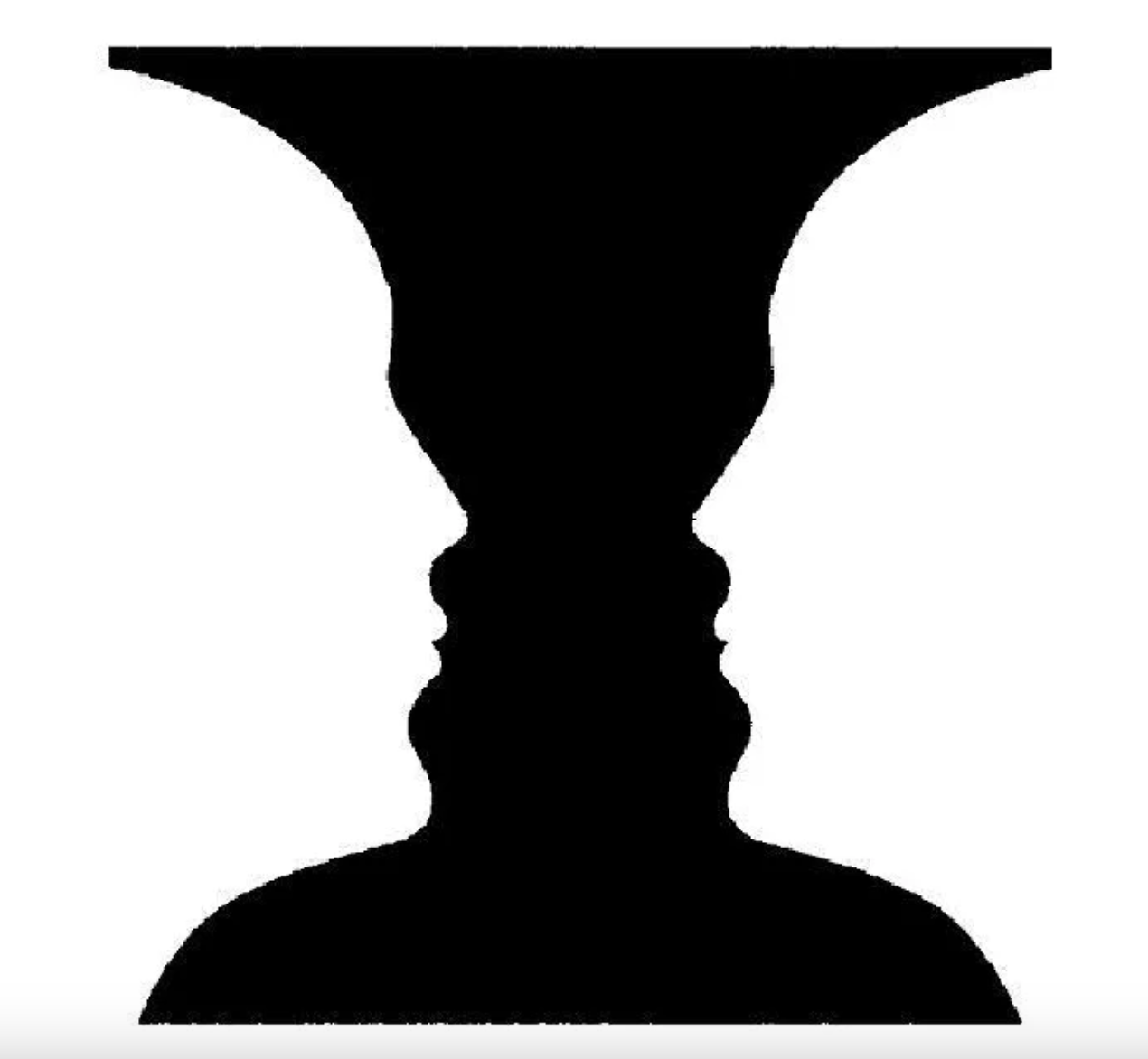
But can a kind of painting that aims to reject such basic features of pictorial art attain the kind of sublimity and large cultural ambitions at which Still aimed? In the previous paragraph I referred to the fading, but not the extinction, of the need for decoration. One prominent artistic mechanism of decorative arts is the interlocking of geometrical forms, which induces the sense of a two-dimensional plane wherein the viewer can see one interlocking form as figure and its counterpart as background, then at will shift to seeing what had been the background as figure. A simple and famous non-artistic instance of this is the profile/vase shift in the so-called Rubin’s vase image:
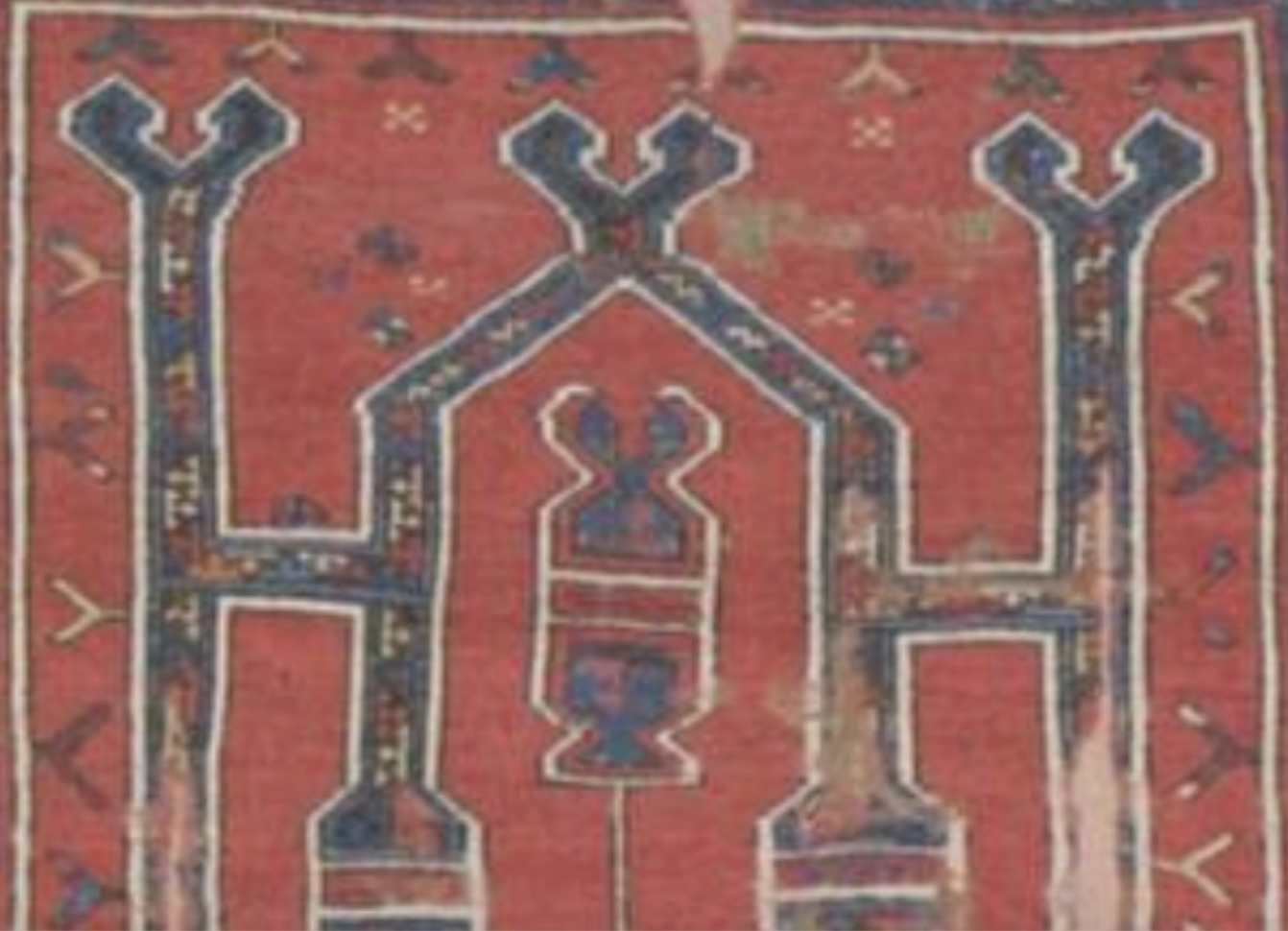
Christopher Alexander explored the artistic uses of this shift in a sustained and revelatory manner in his book on very early Turkish carpets, as instanced here:
In 1955 Clement Greenberg characterized Still’s typical treatment of shape as using “dead-leaf edges”, which in his later work is isolated and thematized, as here:
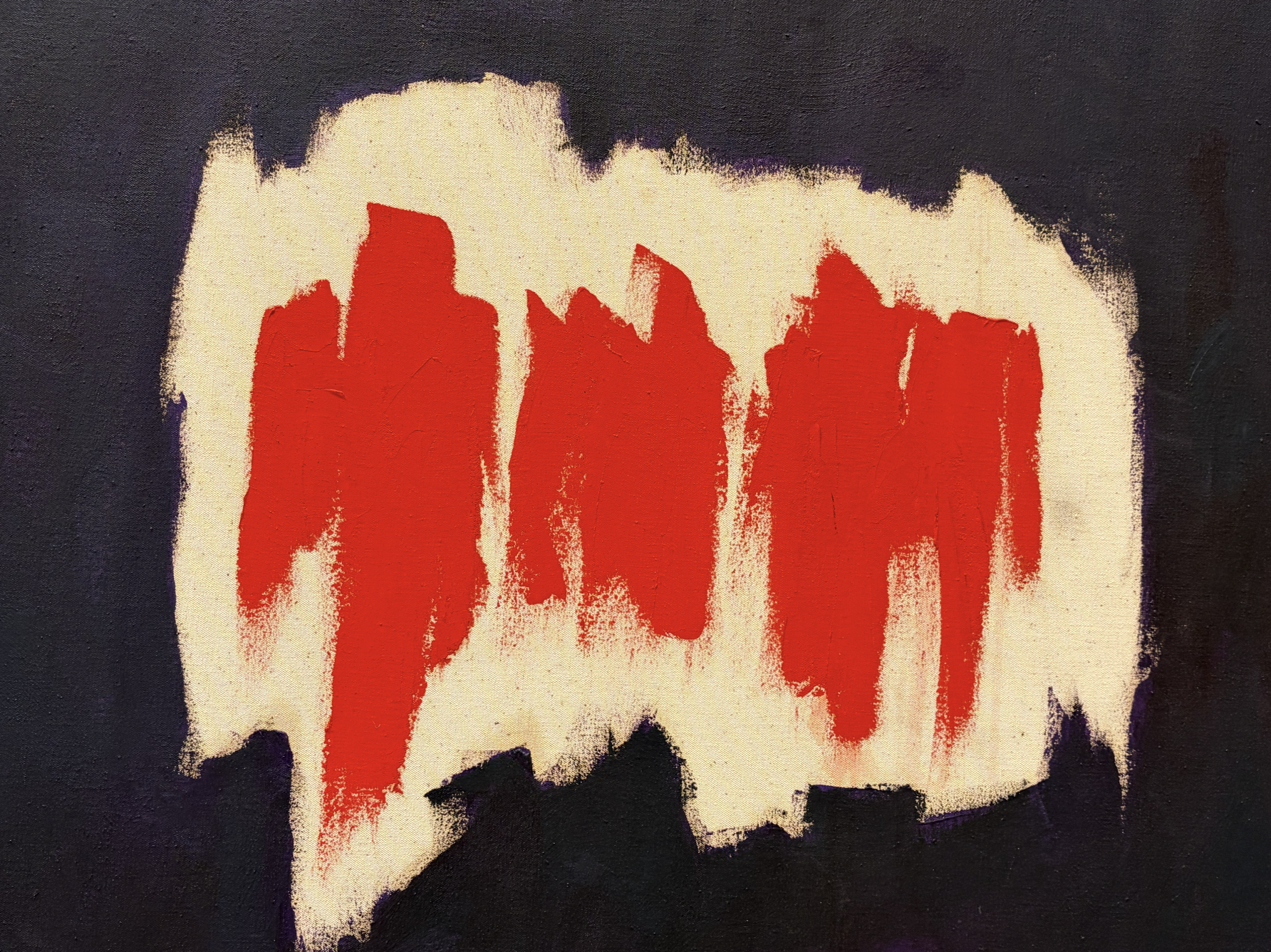
This example allows us to see how at least in part Still aimed to give his canvases a kind of visual vivacity through the interplay of echoing and reversing shapes, that is, through isolating an aspect of decoration and elevating it into a focal element of the painting’s content. Golding noted that one of the typical ways in which the great generation of early abstract artists--for him Mondrian, Malevich, and Kandinsky--moved from figurative to abstract art was as it were through an artistic and mental operation of isolating a detail and expanding it, ‘blowing it up’, and thereby arriving at something abstract (Golding, with particular reference to Still on p. 171). On that account, Still’s use of the dead-leaf edge both places him in tradition of the world’s artistic painting and in a modernist cohort of abstraction. Radicalism can never be wholly radical in its rejections.
2. Clyfford Still as Walt Whitman?
In 1955 the art critic Clement Greenberg gave an account of then recent American painting, comparing Still to Walt Whitman: “Still’s is the first really Whitmanesque kind of painting we had, not only because it makes large, loose gestures, or because it breaks the hold of value contrast as Whitman’s verse line broke the equally traditional hold of meter; but just as much because, as Whitman’s poetry assimilated, with varying success, large quantities of stale journalistic and oratorical prose, so Still’s painting is infused with that stale, prosaic kind of painting to which Barnett Newman gave the name “buckeye” . . . landscapes exclusively . . . piling dry paint” (Greenberg (1993), p. 230). In the later influential revision published in Art and Culture (1961), Greenberg characteristically pronounced some aspects of Still and Whitman as good, others bad: “Still’s uncompromising art has its own affinity with popular or bad taste. It is the first body I know of that asks to be Whitmanesque in the worst as well as the best sense, indulging as it does in loose and sweeping gestures, and defying certain conventions (like light and dark) in the same gauche way that Whitman defied meter. And just as Whitman’s verse assimilated to itself quantities of stale journalistic and oratorical prose, Still’s painting assimilates to itself some of the stalest and most prosaic painting of our time” (Greenberg (1961), p. 223). The comparison of Whitman and Still strikes me as illuminating, and perhaps more so than Greenberg would have imagined. But can we intelligibly distinguish the allegedly good qualities from the allegedly bad qualities in the arts when they seem fused in particular artworks?
I’ve long noted that almost every major critic of Whitman makes such a distinction, including some of my favorite writers on the arts such as D. H. Lawrence, C. L. R. James, and Gilles Deleuze. In Studies of Classic American Literature Lawrence praised Whitman as the seminal poet of ‘The Open Road’ while scorning the fabulist of the big fat ego that assimilated everything into itself. In an essay contrasting Whitman with his preferred Melville, James likewise criticized Whitman’s insistent attempts at assimilations, as evidenced in the poetry’s endless listings, and which he attributed to Whitman’s fundamental isolating individualism and consequent craving for contact. And in a short essay on Whitman Deleuze like Lawrence (of whom Deleuze was greatly appreciative) praises the poet of the Open Road, but thinks he goes wrong when he starts from a ‘European’ idea of organic totality into which he assimilates everything, dissolving the initial fragmentary character that Deleuze thinks is a fundamental feature of American culture, and fundamental contribution to experimental thought. Greenberg’s reference to Whitman’s best and worst qualities is certainly under-explicated, but he seems to think that the worst qualities are a certain sloppiness and lack of concern for detail, as well as a clumsiness (occasional? frequent?) in Whitman’s free verse.
Perhaps what lies behind Greenberg’s criticism, and certainly something that bothers many viewers about Still’s work, is the sense of the work controlled by a great, inflated, imperious ego, an artistic self-conception as a Promethean world-creator and law-giver. In Whitman’s poetry such a conception is at least partially off-set and alleviated through the poet’s self-conception as a worker among workers, a loafer among workers, and a fellow among fellows. By contrast one never senses in Still’s work any humility before things, submission to reality, or just letting-be (as Heidegger might put it) of phenomena.
But one aspect of Still’s elevated self-conception might still give us something salutary. Consider Wallace Stevens’s fragment:
In the far South the sun of autumn is passing
Like Walt Whitman walking along a ruddy shore.
He is singing and chanting the things that are part of him,
The worlds that were and will be, death and day.
Nothing is final, he chants. No man shall see the end.
His beard is of fire and his staff is a leaping flame.
John Golding has drawn attention to a particular stylistic feature in Still’s work that flickers in and out of his painting across decades: a thin, vertical, irregular line whose semantic source Golding identifies as a shaman’s wand. One sees the line, for example, in a most direct presentation work of 1945:
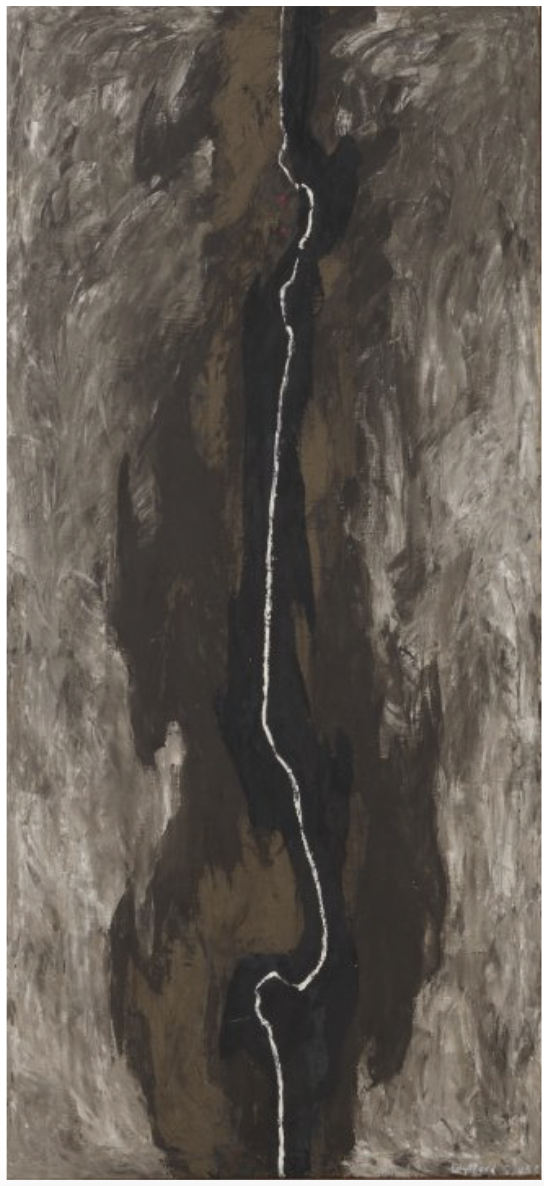
The line occasionally occurs in Still’s mature work as an inflection of one of the great otherwise monochromatic vertical areas, and occurs even in Still’s last works, such as this drawing from 1978:
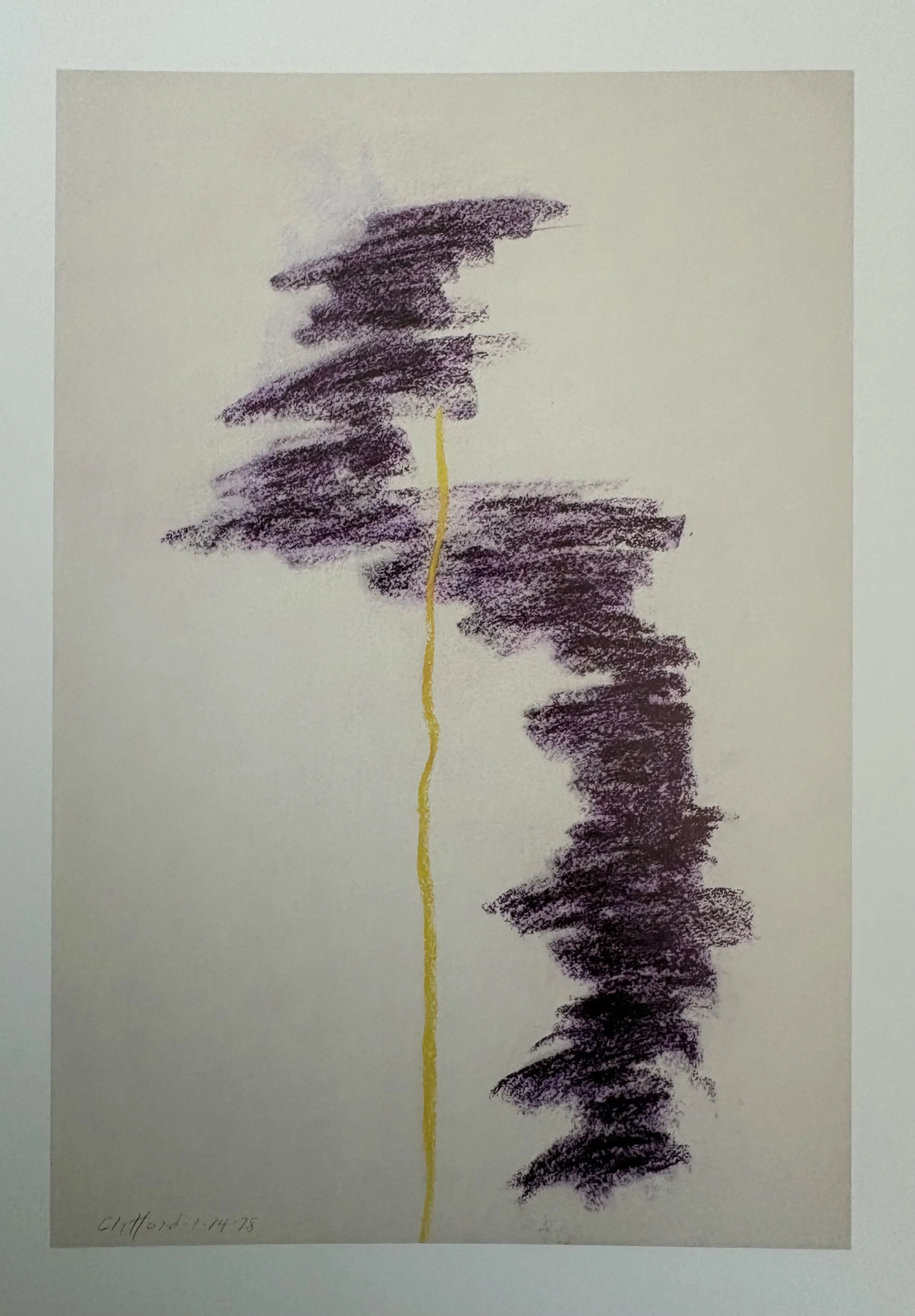
One might think that the motif of the shaman’s staff only exacerbates Still’s constitutional grandiosity. But the most striking feature of the line is its wavering and seeming uncertainty, an element of tenderness that Still’s oeuvre otherwise lacks. One thinks of the drips that Barnett Newman left in his paintings: when asked why he didn’t wipe up the drips, Newman said he wanted to keep them as tears. Imperiousness in the arts, like radicalism, has limits.
References and Works Consulted:
Christopher Alexander, A Foreshadowing of 21st Century Art: The Color and Geometry of Very Early Turkish Carpets (1993)
David Anfam, ‘Clyfford Still’s Art: Between the Quick and the Dead’, in Clyfford Still: Paintings 1944-1960 (2001), ed. James Demetrion
--‘Lateness: The Art of Clyfford Still’s Final Years’, in Clyfford Still: The Late Works (2020)
Gilles Deleuze, ‘Whitman’, in Essays Critical and Clinical (1993)
John Golding, Paths to the Absolute (2000)
E. H. Gombrich, The Sense of Order (1979)
Clement Greenberg, ‘“American-Type” Painting’ (1955), in Clement Greenberg: The Collected Essays and Criticism, Vol. 3 (1993)
--'“American-Type” Painting’ (a revised version of the initial publication in 1955), in Art and Culture (1961)
--‘After Abstract Expressionism’ (1962), in Clement Greenberg: The Collected Essays and Criticism, Vol. 4 (1993)
--‘Clyfford Still’, in Late Writings (2003)
C. L. R. James, ‘Whitman and Melville’ (1950), in The C. L. R. James Reader (1992), ed. Anna Grimshaw
D. H. Lawrence, ‘Whitman’, in Studies in Classic American Literature (1923)
John P. O’Neill (ed), Clyfford Still (1979)