In late August I saw an announcement for the publication of new book on contemporary art from Verso press, The Hard Question of Art: Cognitive Futures by some author named ‘Metahaven’. Decades of painful experience have taught me to be wary of writing on contemporary art, from art criticism through art history to art theory, a genre of bluff, bullying, and charlatanism whose prominent stylistic characteristics include asserting claims without evidence, complete lack of consideration of counter-evidence or alternative interpretations, salient use of ephemeral quasi-academic jargon, and hazy syntax. However, Verso is one of my favorite presses and a bit of skimming the book indicated something worth considering, so the fool rushed in. A few days later I noticed that Metahaven had a piece in a show at UC Berkeley’s Worth Ryder Gallery scheduled to open on September 3. In a semi-arid artistic region like the Bay Area, opportunities for seeing and reflecting upon ambitious contemporary art and serious artistic reflection must be seized, so a project is set: in a two-part blog post I’ll first consider Metahaven’s piece ‘Latent Spacecraft’, and in the second longer part try to summarize and reflect upon their book, both for how it might illuminate their piece and what it offers for understanding contemporary art.
Metahaven bills itself as an ‘artist collective’ founded in 2007 consisting of the Dutch graphic designers, artists and writers Vinca Kruk and Daniel van der Velden. The piece ‘Latent Statecraft’ is presented as by ‘Nina Beguš, Metahaven & Gašper Beguš with Metahaven & Riccardo Petrini’ (Nina Beguš is a researcher at UC Berkeley who works on humanistic approaches to AI; Gašper Beguš is a professor of linguistics at Berkeley who works on inter alia machine learning; Petrini identifies himself as “a coder and media artist”), and is shown as part of an exhibition of ten pieces entitled ‘Hidden Layers: AI Infrastructures and Hallucinations”. The advertisement declares that the show brings “together seventeen international artists and researchers working at the intersection of contemporary art and machine learning to make visible what artificial intelligence keeps out of sight: its planetary infrastructures and computational latent spaces, its colonial and ideological underpinnings, its misrecognitions and hallucinations, and its transformation of our relation to the past through the silent reprocessing of pre-existing cultural forms”. It’s perhaps worth noting that the advertisement does not identify the exhibition’s pieces as works of art, and the wall text for ‘Latent Statecraft’ characterizes it only as “a 2026 research project focused on the latent space of two speech-generating GANs (Generative Adversarial Networks)”. One might then entertain the idea that the pieces are not (presented as) works of art, but that the art gallery just happened to provide an available space for exhibition. But it seems to me that such an idea is impossible to sustain in practice, for at least three reasons: First, as mentioned the Worth Ryder Gallery is an art gallery, and I cannot recall any instance in recent decades when it exhibited something other than artworks--student works, faculty works, and occasionally special shows of artists from outside UC Berkeley. Second, the materials and manner of exhibition of the works are massively familiar to anyone who has seen much contemporary visual art in the past 50+ years, with pieces centrally displaying video screens and texts, sometimes multiple ones in single pieces. Third, the thematics of the pieces--‘making visible what is otherwise kept out of sight’--is one of the central topoi and topics of contemporary art; recall from among countless examples how Meirle Laderman Ukeles made the non-evident work of museum cleaners manifest in ‘Hartford Wash’ (1973)
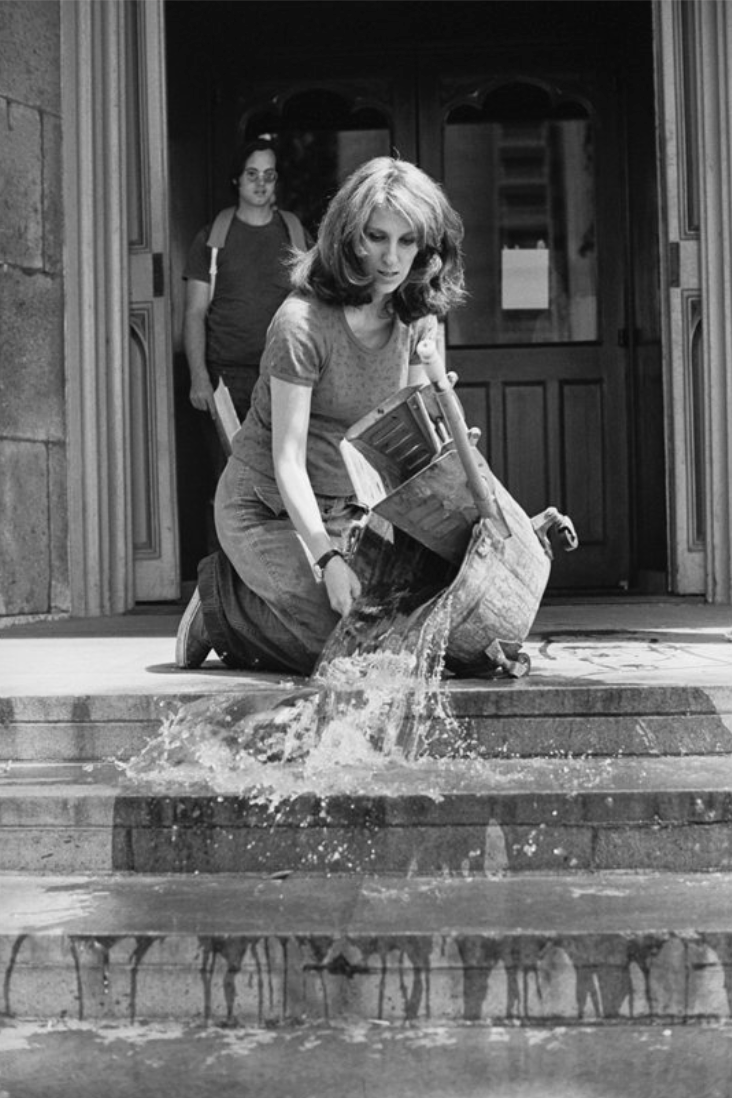
or Hans Haacke brought to light the financial backers of the Guggenheim Museum in ‘Solomon R. Guggenheim Museum Board of Trustees’ (1974).
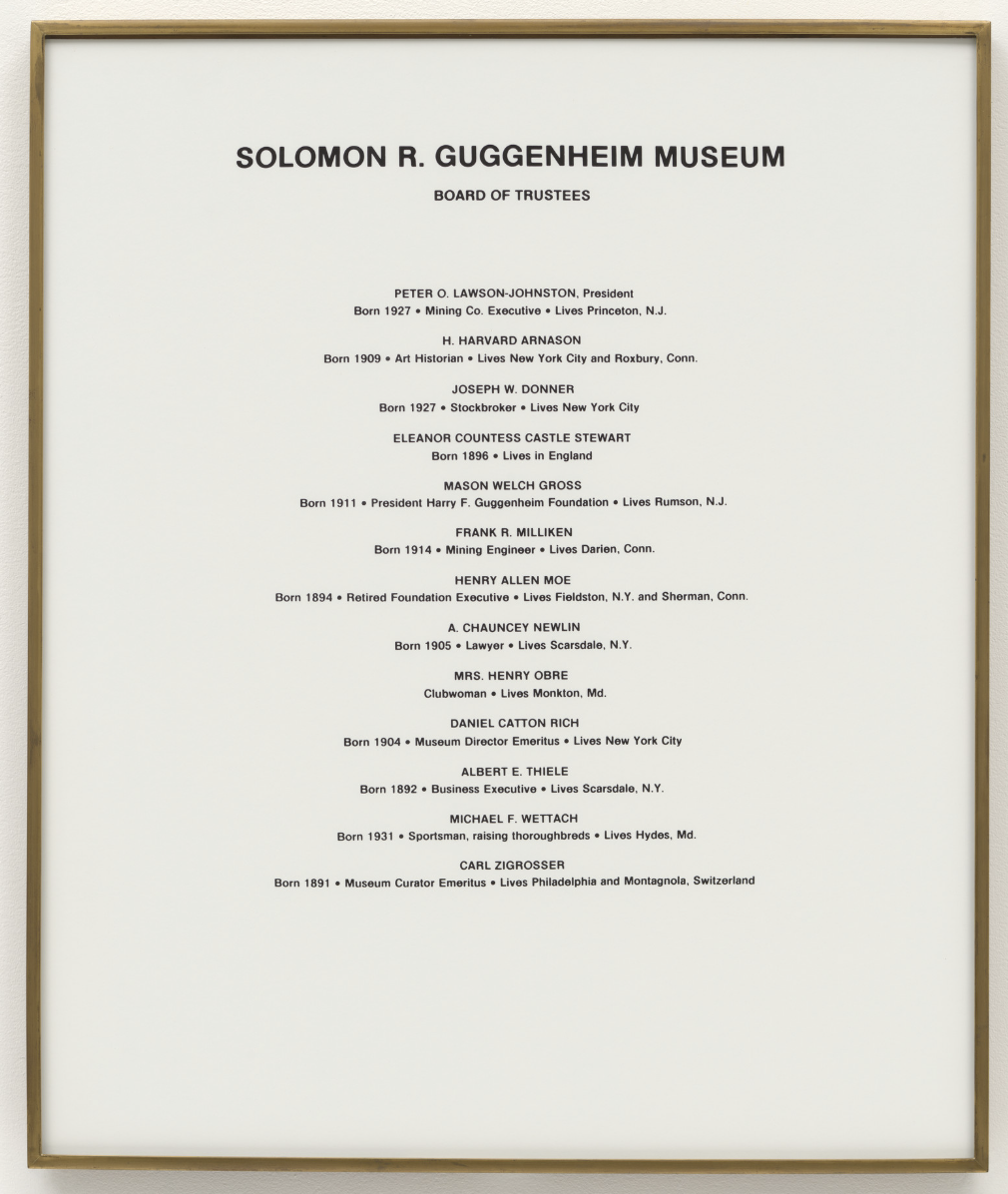
So it’s not simply the routine application of one of the silly bits of contemporary art dogma--‘it’s a work of art if it’s shown in an art gallery or museum’--but rather a combination of institutional setting, manner of presentation, and theme woven together that pragmatically identify the pieces as artworks. Still if someone, including Metahaven, insisted that ‘Latent Spacecraft’ is not a work of art, I cannot imagine how one might convince them otherwise. So shat then does this hypothetical identification of the piece as an artwork amount to? At the very least it motivates the viewer to search and interrogate the piece for aspects symptomatic of art, such as fusion of content and manner of presentation, and and perhaps also what the philosopher Nelson Goodman characterized as the symptoms of the aesthetic, roughly those inducing the viewer to find in a rewarding manner relative density and richness of meaning vis-à-vis ordinary artifacts (see Goodman (1976), pp. 252-5, and Goodman (1978), pp. 67-8).
On the reasonably well-supported hypothesis that with ‘Latent Spacecraft’ we encounter an artwork, what do we see and experience? We see two screens of equal size displayed very roughly at eye-height. A pair of headphones hangs near-by, and a computer mouse is at hand. The screen on the right presents an article written by ‘Latent Spacecraft’’s creators and published earlier this year on-line in something called the ‘antikythera journal’. The article as published and exhibited is interactive through links, including one that provides access to the material from which the contents of the screen on the left are drawn. The text is of some difficulty, as it explains in at best a semi-popular way the kinds of machine-learning (the ‘GANs’) used in the materials on the left and further how and why the creators also drew from James Joyce’s Finnegans Wake). A number of claims are made therein that are seemingly not directly relevant to one’s primary experience of the screen on the left, but the key relevant points seem to me to be these: the screen on the left presents one kind of investigation into and visualization of a ‘black box’ distinctive of machine learning: there is Input —> Transformation —> Output. ‘Input’ and ‘output’ are manifest, but the transformations are (necessarily?) hidden. The article claims that with AI and its use of LLMs (Large Language Models) the transformations are too vast and too complex for human beings to grasp, but that with GANs the transformations are both simpler, and can be shown to strongly correlate with the ways in which human beings actually learn to use language (I have no relevant knowledge and so no competence to evaluate this claim). The screen on the left, together with the white noise and quasi-linguistic sounds heard in the headphones, visualize and make manifest something of these otherwise hidden transformations in GANs.
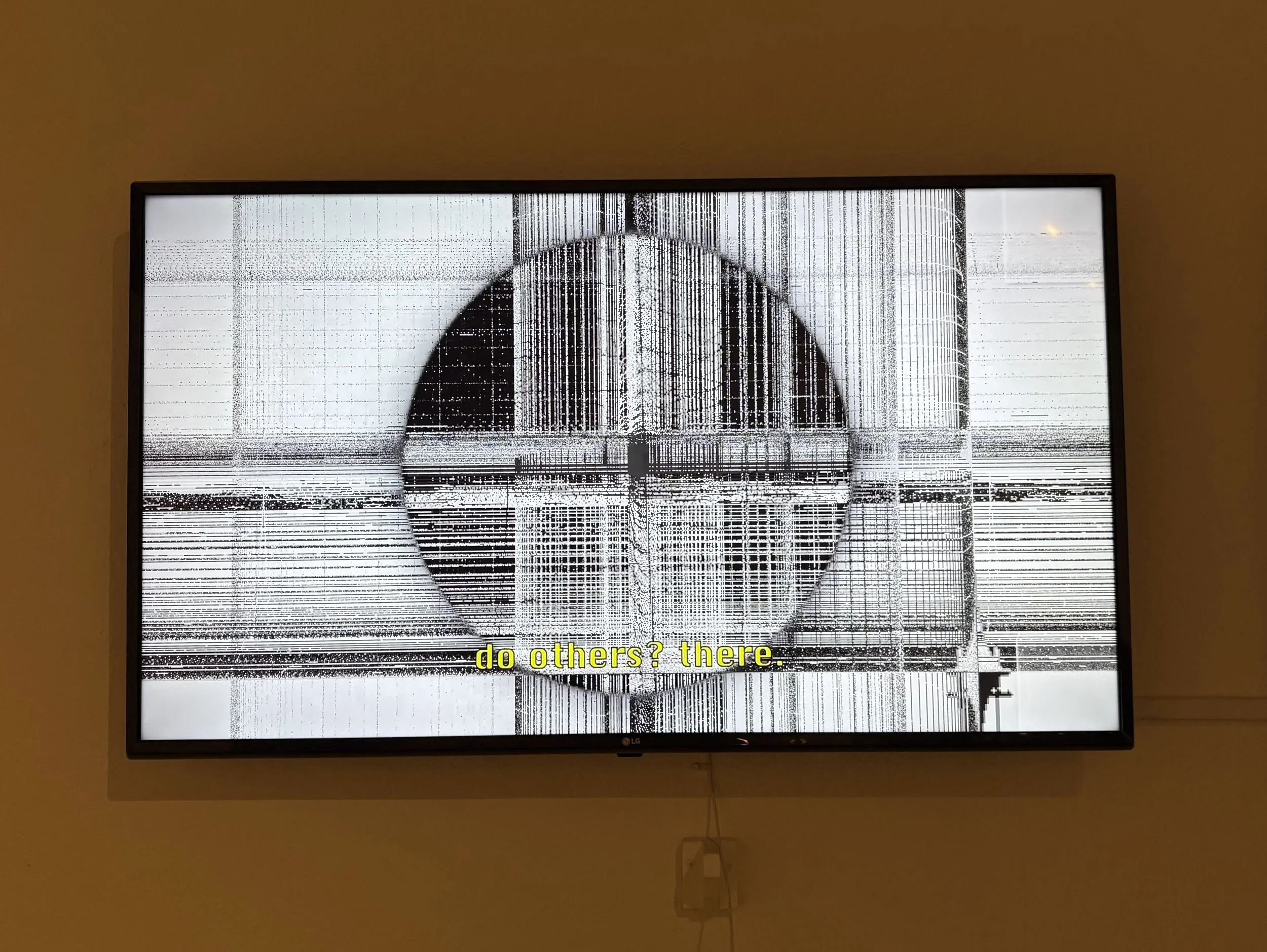
Despite the evenness of treatment of the two screens, the action is surely on the left. While the right is unmoving unless explored, the screen on the left continuously changes. Although in my first two short visits I thought the left screen changed endlessly, a longer third visit showed that it consists of a roughly 13-minute loop. The one invariant feature is the central circle. There is a continuous change of black, grey, and white lines and variegated planes, with the general sense of elements moving from bottom to top. In the thirteen minutes there are several periods where indeterminate, cloud-like shapes appear, alter, and move in what seems a shallow space behind the surface patternings. Occasionally what seem to be lines of computer code in blue together with short strings of words appear and like the other patternings rise vertically. At other times one or a very few words in a slightly greenish yellow appear in a horizontal line near the bottom. The essay indexed on the right screen informs us that part of the text is generated from bits of James Joyce’s Finnegans Wake. While all this is going on the headphones supply the viewer-listener with passages of white noise and seemingly-computer generated sounds--proto-syllables, syllables, quasi-words, and words in short staccato sequences. And that is all.
What if any artistic sense can one make of this? At first glance, and at first visit, the piece struck me as utterly trivial, a kind of screen-saver with a theory attached. By the third visit I found it intriguing, perhaps even a bit gripping, for at least two reasons: The left screen’s presentation of a fixed circle with ever-changing and ungraspably complex visual patternings seemed to invoke the very basic kinds of world-orientation that one finds in many ancient cultures, most prominently in ancient India and ancient China, where the geometry of sacred spaces is derived from a circle crossed or circumscribed by lines (see Wheatley (1971) for a canonical exposition). Also the aural dimension seemingly invoked the quest for extra-terrestrial life, with some listening device picking up cosmic noise and finding something like a communicative utterance in it. So on this interpretation ‘Latent Spacecraft’ takes up and develops the familiar trope in contemporary art of making the hidden manifest with the very ancient attempt to orient oneself and understand the cosmos. The sublime is given an up-dated visual manifestation. This interpretation seems very far from what Metahaven et alia intended, that is, with exploring and giving visual manifestation to the latent space of transformation in GANs—and seemingly without intending that the work be a visual artwork.
In my next blog post (hopefully in 10 days or so) I’ll turn to the consideration of Metahaven’s new book to see what light it might throw on the interpretation of ‘Latent Spacecraft’, and to explore and reflect upon their novel conception of contemporary visual art and their thoughts on its near future in a world of AI and climate change.
References:
Nina Beguš et alia, ‘Latent Spacecraft: Brains, GANs, Finnegans’, in antikythera journal (2026)
Nelson Goodman, Languages of Art: An Approach to a Theory of Symbols (1976)
--Ways of Worldmaking (1978)
James Joyce, Finnegans Wake (1939)
Metahaven, The Hard Question of Art: Cognitive Futures (2026)
Paul Wheatley, The Pivot of the Four Quarters: A Preliminary Enquiry into the Origins and Character of the Ancient Chinese City (1971)