Having in my previous post tried to give an account of the art group Metahaven’s (et alia) piece ‘Latent Spacecraft’, I turn now to a consideration of their recent book The Hard Question of Art: Cognitive Futures. Despite initial skepticism, I’m inclined to say that it’s among the very few interesting books contemporary art I’ve read this century, although nothing in it approaches the achievements of William Kentridge. It’s easy enough to list the book’s topics--there are eleven very largely independent short chapters, each devoted to one or two concerns--but difficult to say what connects the chapters, other than as explorations of a basic conception of art presented in the second chapter. It’s not obvious what the central claims of the book are, if indeed it has any, and many of the discussions end with a suggestion phrased for the most part with the word ‘maybe’, or in one case ‘perhaps’. There is no conclusion. The style is frequently informal: after a quotation from Clarice Lispector, the book opens with the words “Art does not change the world. Sorry. Not in the way we sometimes hope it could. Not in the way we were told it would.” Yet the book also contains a good many brief discussions of academic and/or technical matters such as the history of the concept of empathy and basic features of quantum mechanics. And to top it off, although Metahaven does explicitly raise questions periodically, I’m not sure what the title ‘The Hard Question of Art’ refers to. Nonetheless, it seems reasonably clear that Metahaven’s central concerns revolve around two questions: (a) What sort of arts can we imagine would be ‘appropriate’ for our contemporary ‘globalized’ of climate change and ready, immediate access to the entire world’s suffering; and (b) What sort of arts can we imagine ‘appropriate’ to the broad shifts in research, knowledge-acquisition, and knowledge-dissemination’ arising from the social adoption and embedding of artificial intelligence and LLMs (Large Language Models)? So the book can be thought of as assembling concepts, analyses, and suggestions relevant to, if not answering, then reflecting upon these two questions.
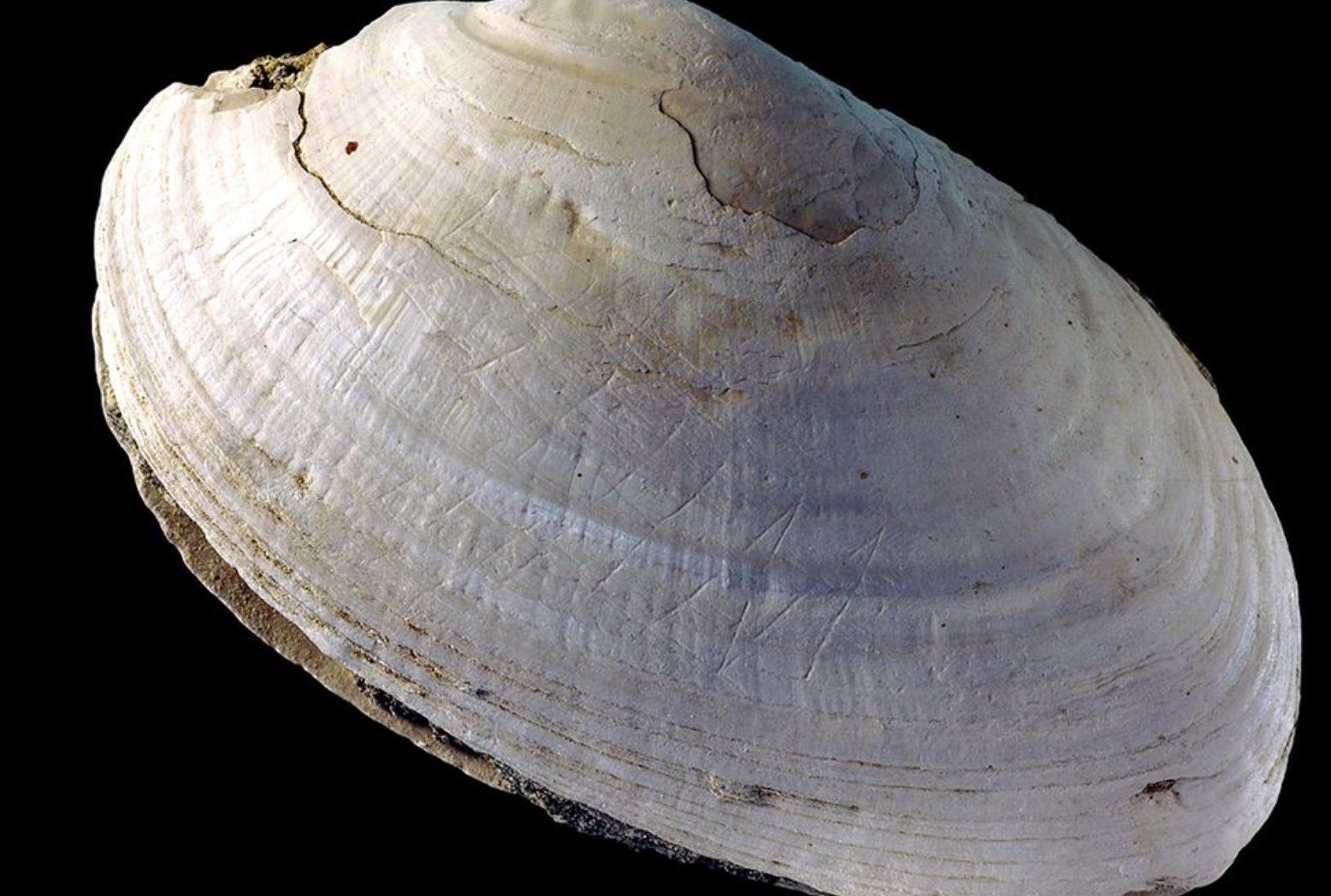
One way into Metahaven’s thoughts begins with asking what they mean by the term ‘art’. Their conception of art is surfaces periodically in the book, and as noted above is most fully presented in the second chapter, ‘Carved Diagonals’, which primarily addresses the earliest art: the proto-artistic geometrical engravings on a shell from Java circa 400K BCE (pp. 32-3);
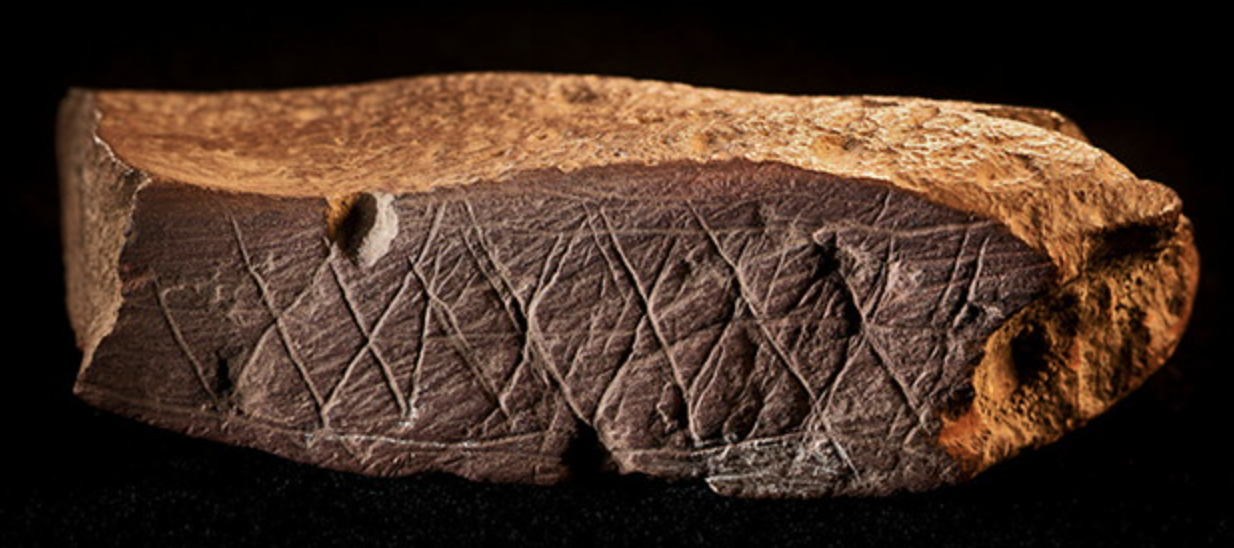
the engraved piece ochre from Blombos Cave in South Africa circa 80K BCE (pp. 30-2);
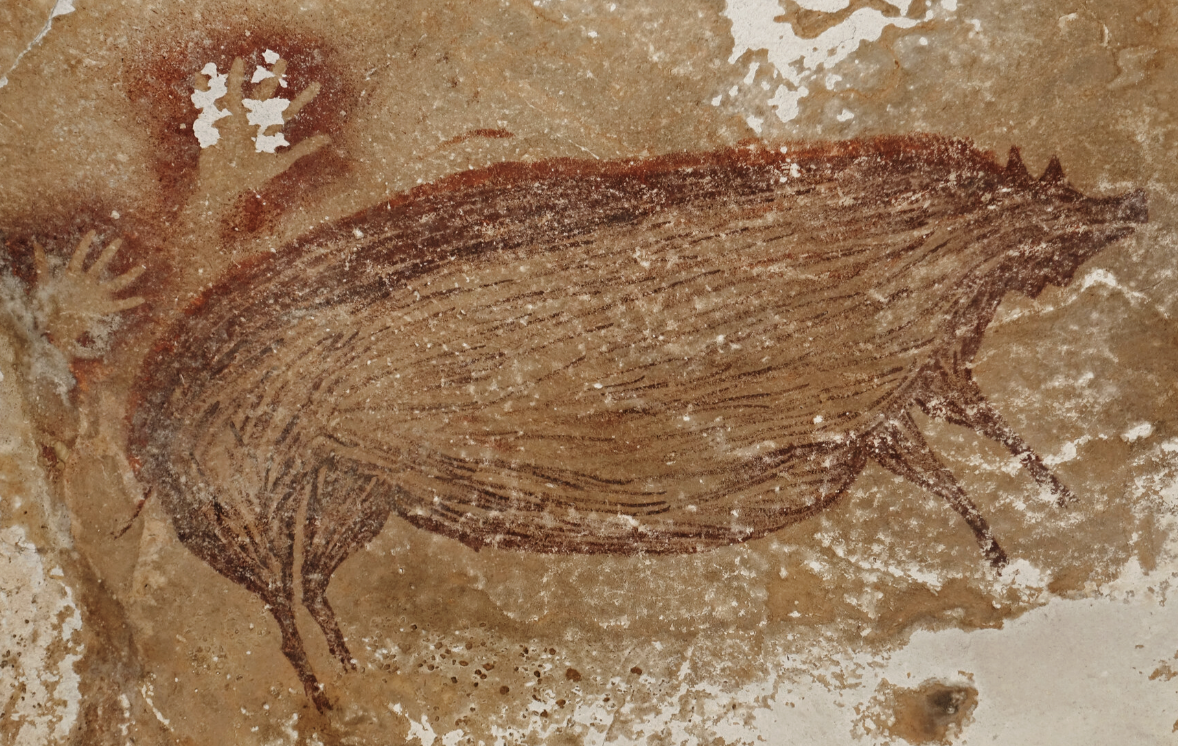
the earliest known instance of figurative art from a cave in Sulawesi circa 44K BCE (p. 34);
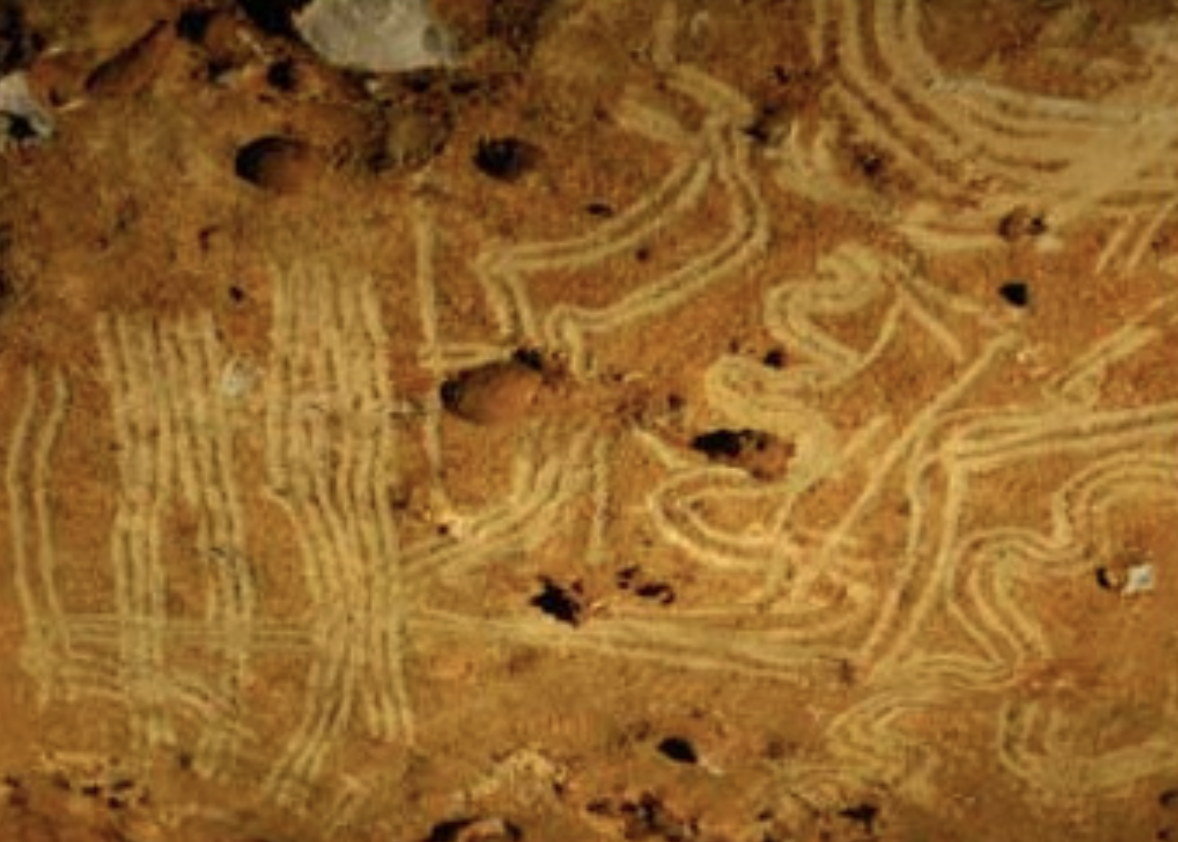
and the so-called ‘macaronis’ of the late Paleolithic, curved doodles in caves made by running fingers through soft clay (p. 35).
Metahaven begin by rejecting what they take to be Ellen Dissanayake’s claim in the book Homo Aestheticus (1992) that art is rightly characterized as a kind of ‘making special’, and counter-claim (a) that appeals to ‘making special’ are either explanatorily empty, or at least insufficient to explain the distinctiveness of art vis-à-vis other artifacts, and (b) that art is something other than special, because “it belongs with things like food and shelter--the basics” (p. 27). They go on by rejecting the findings of neuropsychology as insufficient for explaining art because art is fundamentally social, and it emerges evolutionarily in a manner not well correlated with neurological shifts in the human brain (pp. 27-8). Their core positive conception of art consists of four points: First, art is a species of externalization (as is language) that likely emerges 70-100K BCE along with language and some new (though unknowable) degree of social complexity (p. 28). Second, that art is ‘perceiver-dependent’ in that artworks are addressed to human beings, and only gain actuality in their being encountered and perceived by human beings. They explicate such dependence with reference to E. H. Gombrich’s famous conception of the ‘Beholder’s Share’ (the mechanisms of psychological projection wherewith the viewer of a work of visual representation projects non-manifest content into a marked surface, and which they seem to believe is a major part of Gombrich’s (non-existent) definition of art). Third, not only does art emerge with social changes among early humans (as in point one), but also art changes with major changes in human cognitive capacities via the determining role of cognition in human perception. Metahaven concludes the second chapter with the bald statement of this: “So art, whether we like it or not, is cognitive and subject to cognitive evolution. If cognition changes, perception changes. If perception changes, art changes.” (p. 36) A fourth point is that works of art are always experimental in inducing a probing and open-ended exploration of perception and its cognitive basis. As they put it: “Works of art are strange islands of information that test how perception operates sometimes critically so and always in the full, tangled mess of the world” (ibid), and “art tests not just our perceptions but also our preconceptions” (p. 172; italics in text).
I’m not wholly confident in my understanding of Metahaven’s intentions and aims, but I take it that points (1)-(4) constitute Metahaven’s conception of the perennial features of art in human life, and again that their primary concern is how to articulate the practice and prospects of art in the contemporary world. Their characterization of the contemporary world seems to foreground three features: the globalization of awareness, especially awareness of human suffering (see for example pp. 77-8); the climate crisis wherein sea-level rise inter alia is making a number of the world’s largest cities uninhabitable (see pp. 84-6); the development and increasingly widespread social embedding of Artificial Intelligence systems. Metahaven discusses this last characteristic repeatedly, and (although I’m especially uncertain about their main concerns on this) seem to emphasize two interrelated problems: the malign effects of adopting AI as a model of intelligence generally, and the malign effects of treating the products of AI’s ‘creativity’ as exemplary of creativity generally (they express dismay about a couple instances of AI-generated ‘poetry’).
Now for Metahaven a signal characteristic of these three features, especially the latter two, is their systematic quality, by which they mean that crucial to each feature are so-to-speak holistic phenomena that readily admit neither representation in terms of isolated entities nor a fortiori such entities interacting in intelligible chains of cause-and-effect. This is of particular importance for Metahaven because they immediately derive from the holistic character of our contemporary phenomena two strictures on the kind of art that is and should be ‘adequate’ to the contemporary world: our artworks, to the extent that they are culturally ambitious and aim to address fundamental features of contemporary life, should be neither objects that are free-standing, individual, and/or unchanging; and correlatively our artworks should not have narrative content, as narration inevitably describes a series of individuals and events in well-ordered temporal sequences.
Metahaven seem to believe that the current actualization of AI is sufficiently advanced and widespread to induce a fundamental change in (what we take to be) cognition; this thought, taken together with their evolutionary schema ‘change in cognitionchange in perceptionchange in art’, motivates the demand that we need a new kind of art. Since our new art cannot/should not consist of individual, isolated, unchanging works with narrative content, what sorts of resources and considerations might help in building up new art? Metahaven focus on two fascinating and quite different resources: the so-called ‘transitional object’ conceptualized by the psychiatrist D. W. Winnicott, and kinds of poetry that foreground paradox and nonsense, especially the works of so-called Russian Absurdism of the 1920s and 1930s. First, a transitional object is a soft artifact (such as a blanket or a stuffed animal toy) that the young child adopts as her own and which “may be the first thing in her world for which a subjective and dynamic relationship is possible and plausible, a nascent beholder’s share” (p. 101). They go on to suggest that “[m]aybe (n.b.) the transitional object can be seen as a typology for aspects of art that tend to dissolve with the branching out of objects and practices into the wider cultural field, like a bit of a catchall for affect, objects, and imagining” (p. 106) Because the child uses the transitional object as a vehicle for fantasy and non-finite games of absence and presence, appearance and disappearance, it functions fundamentally as a temporal and spatial bridging of phenomena (p. 116). So although transitional objects are not full-fledged works of art, ‘perhaps’ they can serve as a resource for a new kind of art. Characteristically at the end of a chapter Metahaven put this in the form of a question: “Art is a bit timeless, like pricelessness. Yet the original bond between the child and the transitional object seems much like a bond with art. . . Is art a transitional object?” (p. 118)
The second resource for constructing a new kind of art appropriate to the contemporary world is Absurdist poetry, particularly the recently re-discovered and now-influential works of Alexander Vvedensky (1904-1941) (Vvedensky was also cited as an inspiration by Nadya Tolokonnikova of Pussy Riot at her trial). Dismissing ChatGPT’s attempts at poetry, Metahaven state that “we would like to instead defend here is an often-overlooked strand of poetry involving paradox and contradiction” (p. 148). They briefly consider a number of poets while devoting their most sustained discussion to Vvedensky, who “wrote symbol-rich poetry”, engaged in “a kind of disruption of the potential of meaning-making, sowing chaos in an avant-garde way” (p. 151), and over his short life “increasingly engaged in a radiant poetics” (p. 155) of “research[ing] into the relationship between language and reality” (p. 156). Vvedensky’s ‘The Gray Notebook’ (1931-34) describes, so Metahaven claims, something akin to the sense of reality in quantum mechanics in the lines “The shimmering will begin. The mouse will start to shimmer. Look around you: the world is shimmering (like a mouse)” (Vvedensky, pp. 74-5, quoted at Metahaven, p. 157).
There is a great deal more in this engaging short book, but I guardedly hope that the above account of Metahaven’s central concerns and their conception of an art adequate to the contemporary condition accurate captures their views. It is now not difficult to see how their piece ‘Latent Spacecraft’ fits something like the conceptions proposed in the book: ever-changing, non-narrative, concerned with the uncertain emergence of sense and nonsense, even shimmering. I confine myself to two critical comments on the book, at least as summarized above.
1. In my summary of Metahaven’s views I signaled some skepticism about Metahaven’s understanding of Dissanayake’s and Gombrich’s views. Metahaven is mistaken in thinking that Dissanayake is offering a definition of art as making-special; rather Dissanayake aims to uncover an evolutionarily emergent kind of behavior of which art-making is a central instance. Additionally, they fail to mention that Dissanayake abandoned the term ‘making-special’ a couple of decades ago and has replaced it with ‘artifying/artification’. And as already noted, the phenomenon of the ‘Beholder’s Share’ on Gombrich’s understanding has nothing to do with the definition of art generally nor of the visual arts in particular; it is rather a psychological mechanism, or set of mechanisms, regularly induced in visual representation and outstandingly mobilized and cultivated in some visual art. These critical points are largely pedantic, but Metahaven’s misconstrual of Gombrich’s conception points to a problematic aspect of both Gombrich’s account and Metahaven’s creative misuse of it. The philosopher Patrick Maynard has argued that Gombrich under-describes the phenomena of projection in the Beholder’s Share, and indeed misses its most basic aspect, in that Gombrich failed to include the ways in which the viewer’s projections are mobilized on the basis of the recognition that she is seeing a depiction, and not just a bit of nature or a Rorschach blot (Maynard, p. 112). Likewise, Methaven in treating perceiver-dependence as partly definitive of the concept of art provide an impoverished conception of art, leaving out the tremendous range of meanings, representations, expressions, symbolizations, etc. that arise in even the simplest artworks. Unsurprisingly, then, Metahaven simply and quickly dismiss talk about meaning in art as “com[ing] down to having a (potentially wrong) working hypothesis about the likely contents of a beholder’s share” that is just “a practical way of compensating for the missing data of everybody’s inner experiences” (p. 55). They seem to suggest thereby that artistic meaning cannot be plausibly be understood as a black box containing every art perceivers’ inner feels.
2. A second concern arises about the very idea that there is one or perhaps a small number of ways in which a work of art might be ‘adequate’ to the contemporary world. As noted, this idea presupposes that the contemporary world can be captured in a few leading ideas, practices, and technologies. And in Metahaven’s hands it further suggests that an ‘adequate’ work of art must mimic these leading ideas and practices: since complex systems are holistic and so not subject to adequate description through narrative, so our art must be non-narrative; since the contents of complex systems are not adequately captured in lists of entities, so our artworks must not be independent free-standing entities; etc. Is this not like asserting that the phenomenon of boredom cannot be addressed except by boring artworks?
To my mind, these critical comments do not destroy the interest in Metahaven’s ideas and projects, although they do point to the restricted range of their concerns, and perhaps (‘perhaps’!) indicate points where further explication and elaboration would be welcome. Metahaven with their researches and works must join the small group of artist-thinkers that merit keen interest from anyone interested in the contemporary arts.
References:
Ellen Dissanayake, Homo Aestheticus: Where Art Comes from and Why (1992)
E. H. Gombrich, Art and Illusion (1960)
Patrick Maynard, Drawing Distinctions: the varieties of graphic expression (2005)
Metahaven, The Hard Question of Art: Cognitive Futures (2026)
Alexander Vvedensky, An Invitation for Me to Think (2013)
D. W. Winnicott, Playing and Reality (1971)