To complete the summary of Descola’s book, having summarized his accounts of animism, totemism, and analogism as ontologies of figuration, I turn to his consideration of the fourth ontology, naturalism. Descola’s discussion of naturalism is markedly different in two ways from his previous three accounts, in that naturalism as a visual ontology only emerges quite recently in human history, at the beginning of the fifteenth-century in Europe, and it exhibits a well-documented progressive development that has been the subject of written reflections almost since its inception, in particular in the art history of the past two hundred years.
4. Naturalism: Descola claims that “the two indices that best denote naturalism in images” are the “observable subjectivity of humans and the arrangement of the world’s qualities in a unified space--Descartes’s res cogitans and res extensa”. In naturalism the human subject “must be represented unequivocally as the ground of a distinctive interiority of which the other existents [that is, plants, animals, artifacts, and all of material nature] are deprived” (p. 346). Descola treats naturalism as unfolding in a historical trajectory, one well-known to anyone familiar with any standard history of European painting since the Middle Ages: initially indicated in some of the pages of the Limbourg Brothers’ miniatures from Les Très Riches Heures du Duc de Berry, it effloresces in different ways in the Flemish painting of Roger Campin and Jan van Eyck on the one hand, and in the Florentine Renaissance on the other. The so-called genre painting of everyday life in the Dutch Golden Age of the seventeenth-century marks the next phase, upon which follows the various movements of European painting, with its exemplary culmination for Descola in Mondrian’s transition from landscape to abstract painting. I’ll give a short summary of Descola’s account along with his central images:
The October of the Limbourg Brothers et alia in the first half of the fifteenth century provides an initial instance of the kind of descriptive realism that is characteristic of the naturalist visual ontology.
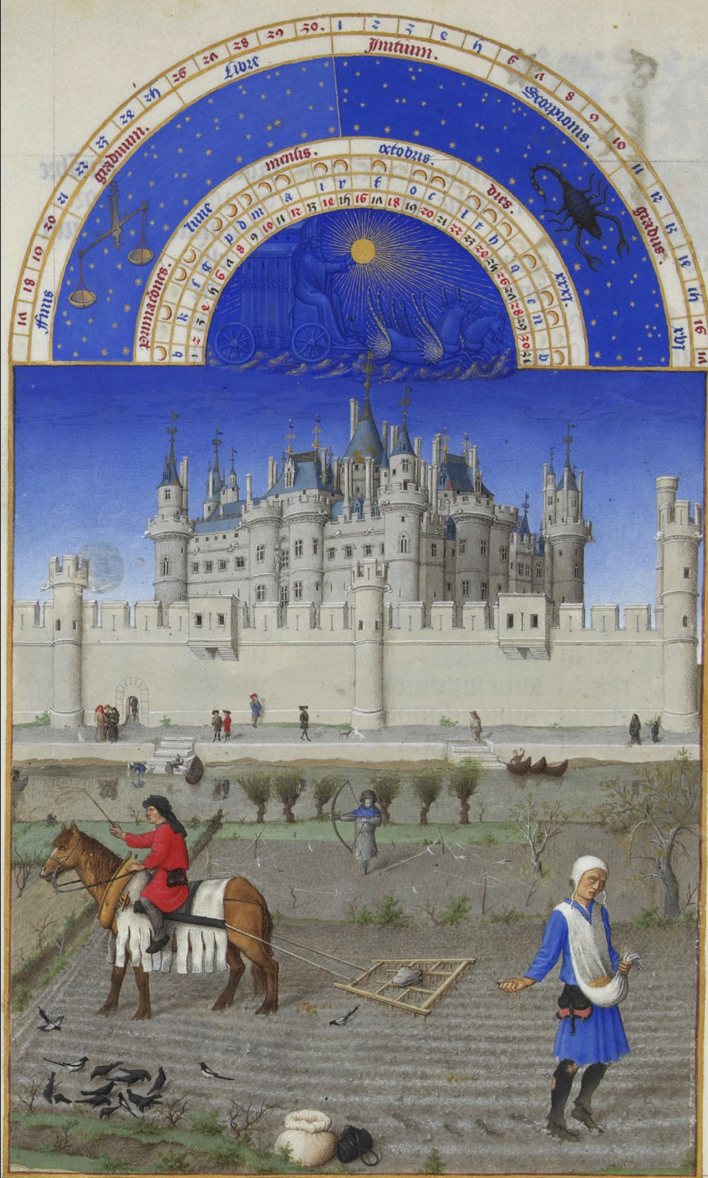
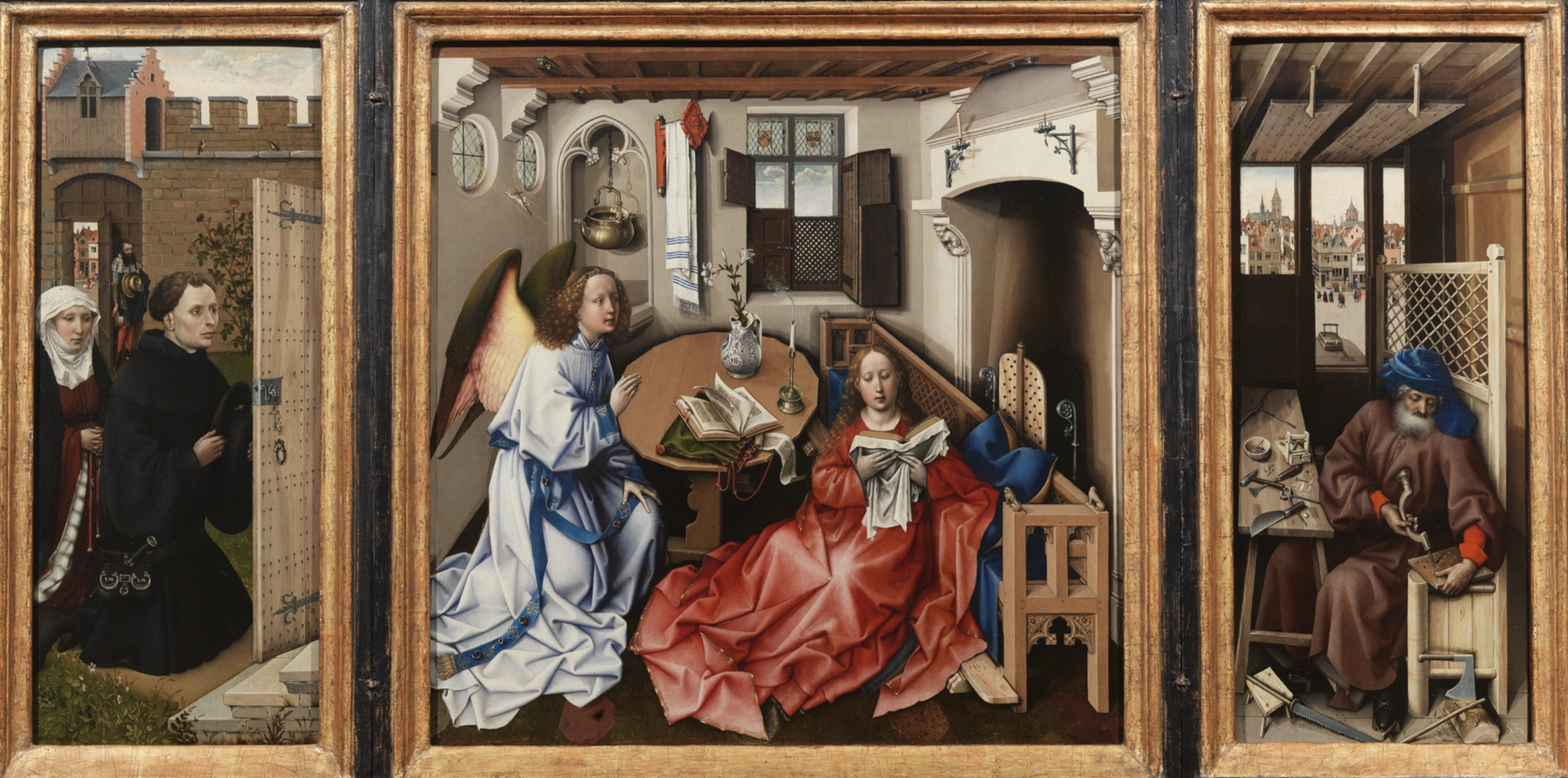
The style of depiction makes it seem that we viewers “are observing a real event, as if we had broken in on it somehow” (p. 355) The sower and the ploughman are engaged in characteristic ordinary activities, with no figure seeming to carry a higher meaning. In comparison with earlier European depictions, which typically gave indications of “what one should know, fear, understand, or hope for”, here and thereafter “painting served simply to show what there was to see” (p. 356). Analogism has given way to naturalism. In the early fifteenth-century Flemish painting of Roger Campin the concern for realistic rendering and precision of the depiction material details enters into religious painting, spectacularly so in the Merode Triptych with the grain of the wood and the folds of the fabrics (p. 375).
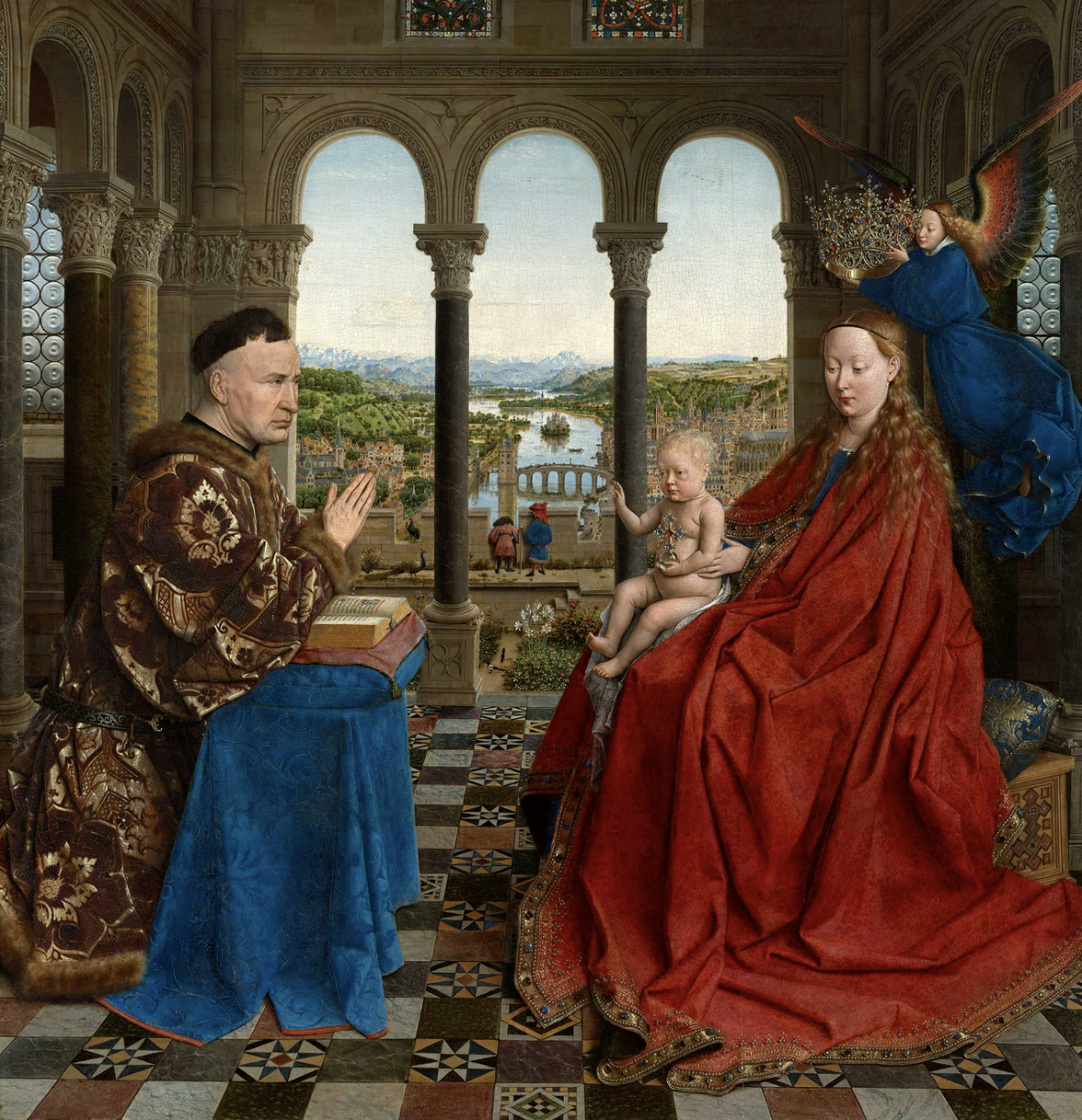
Jan van Eyck’s stupefying rendering of details is in the service of embodying the proto-Cartesian res extensa in the pictorial project of showing “material continuities linked in a cascade of reciprocal determinations” (p. 385)
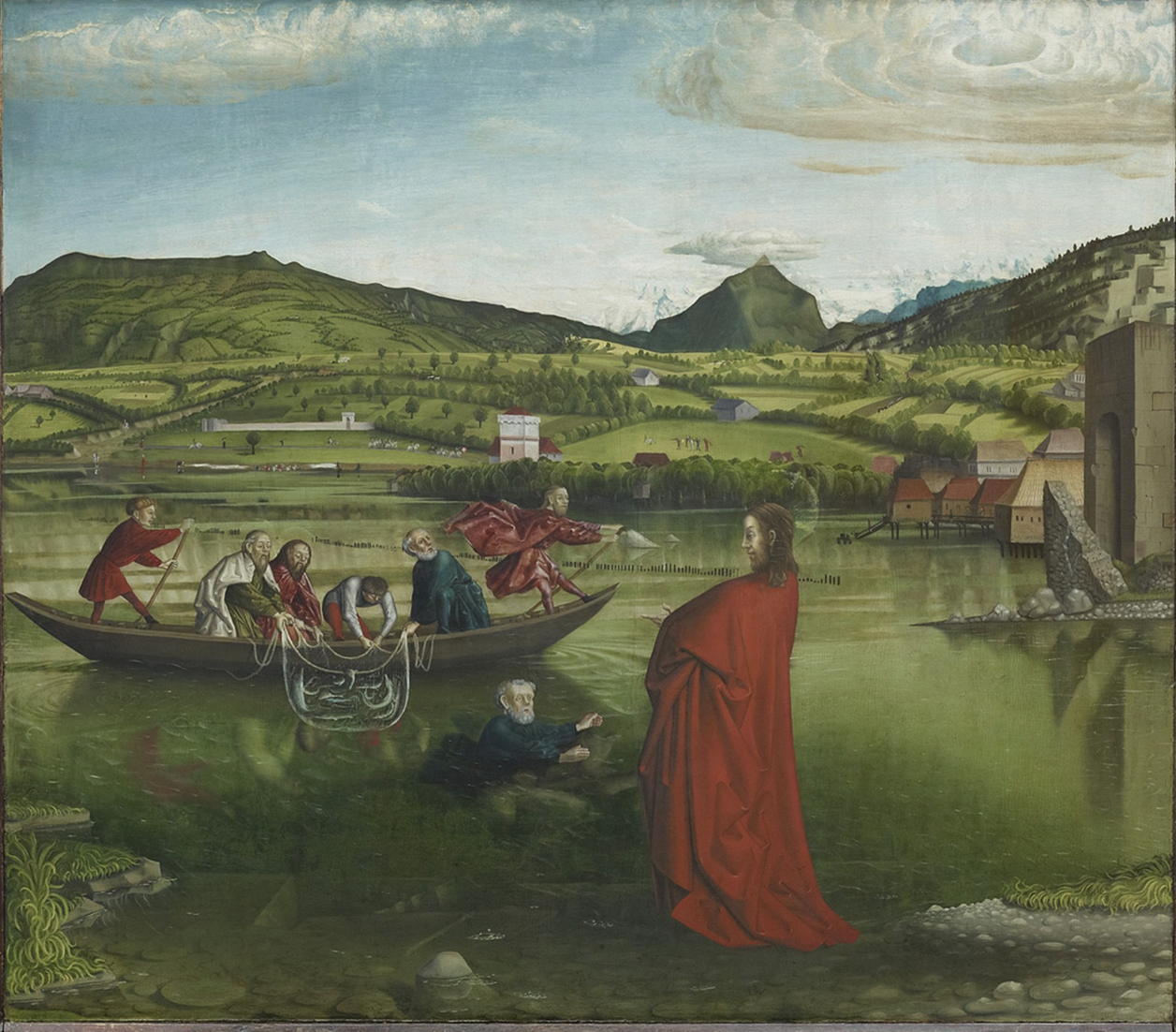
Descola mostly passes over the exceptionally well-known pictorial achievements of linear perspective in the Quattrocento in Italy, pausing to note Konrad Witz’s inaugural depiction of a real site in The Miraculous Draft of Fishes (1444):
Instead, he devotes his attention to the conceptual aspects of the use of linear perspective. In the use of linear perspective objects are made ‘commensurable’, that is, there is a common spatial measure given through scale and placement. Consequently, “[t]his general commensurability meant that the world had become geometrizable, that is, that human subjects had constructed a representation of the world that was true from their own standpoint.” (p. 395) Descola stresses that with linear perspective the viewer of the scene (first of all the implied artist’s view) is external to the scene, arbitrarily placed, but also ultimately the only unifying agent of what is depicted within the homogenous space: linear perspective “isolates a fragment of the world and transforms its nature by changing the parameters of visual flow: first decomposing the visible into discrete points made independent of spatiotemporal determinations, then recomposing these points in a unified geometric space that gives coherence and continuity to the diverse objects placed within it by demiurgical viewers necessarily external to the objective frame instituted by themselves on the basis of the subjective position they occupy.” (p. 407) Linear perspective provides a fixed image which the perceiving subject, constitutively outside the scene, can grasp (p. 428). An image in linear perspective is like a snapshot, one given for a particular subject at a particular time. In that sense such an image is as if a gaze objectified (p. 429).
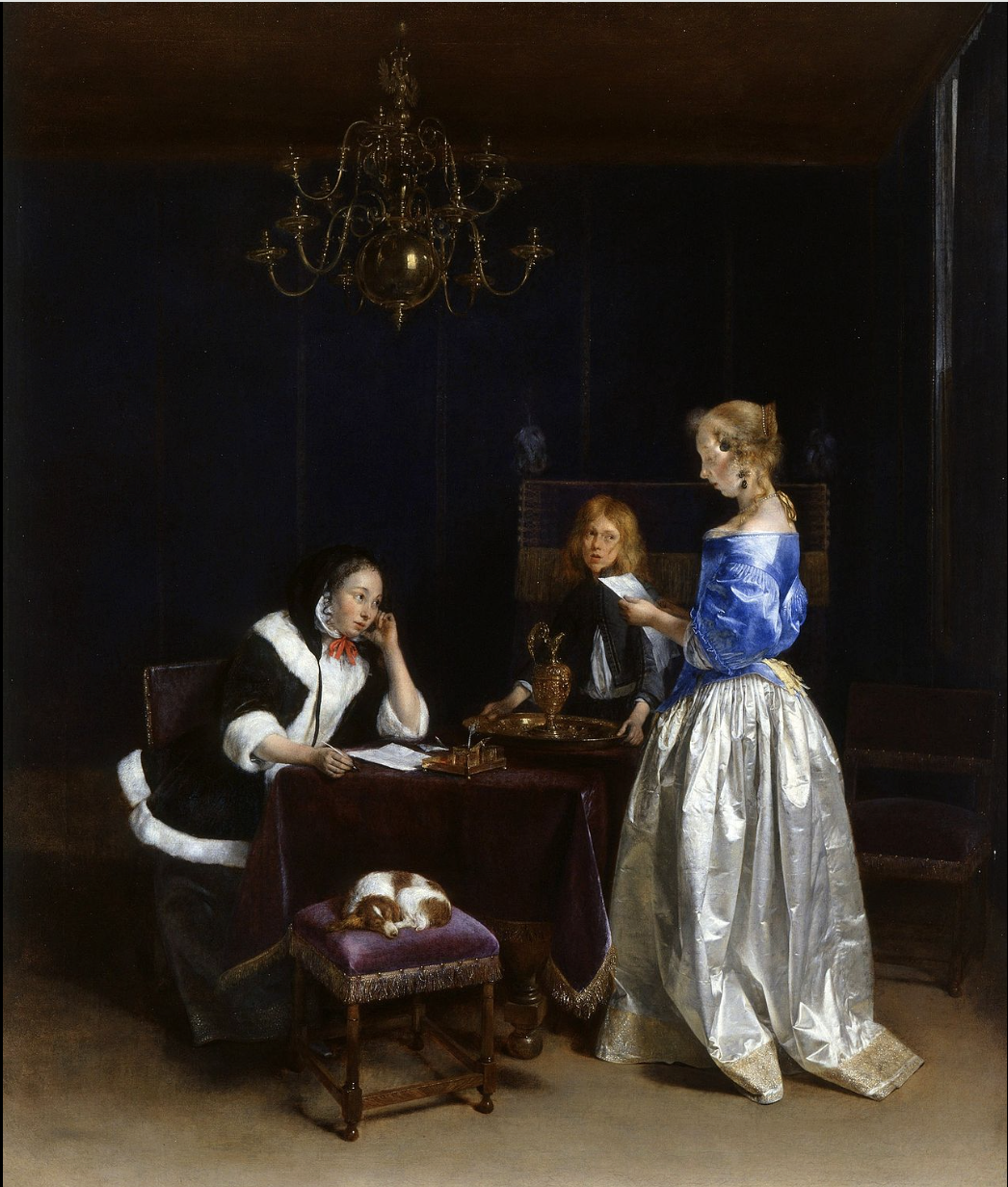
The Dutch painting of the seventeenth-century Golden age largely ignores the Italian manner of conceptualization and instead flows directly from the Flemish achievement: “Just like the painting of the Flemish masters two centuries earlier, that of the Golden Age makes manifest the attention paid to the surface of existents and the desire to represent their diversity through a homogeneous iconic treatment.” (p. 400) The conceptualizations and procedures of Dutch painting involve “the empirical and temporary slicing out of a phenomenon observed from the best angle”. In comparison with the Italians, this ‘dilutes’ “the hold of an organizing agent” in favor of rendering in a manner that seems to provide the very “self-evidence of the visual experience” and with it “a restoration of mystery to everyday life”. (p. 408) One immediately thinks of the mysterious interiorities of the figures in Vermeer, while Descola cites examples from Pieter de Hooch and especially Gerard ter Borch’s The Letter (1660-1665) (pp. 411-12):
The tradition of naturalism culminates for Descola at the end of the 1910, in particular in the work of Piet Mondrian. On this account Mondrian is a naturalist who inherits the project of descriptive realism, and his movement towards abstraction is driven by the ambition to figure “the very experience of description” (p. 429). Mondrian strips depicted objects “of their surface articulations and the false pretenses of linear perspective so as to make tangible on the canvas only the mental operation involved in the representation of a piece of the world” (p. 430). Mondrian’s progression is of course a much-analyzed moment of high modernism (among many, see for example Golding (2000)), which Descola sketches from Polder Landscape with a Train and a Small Windmill on the Horizon (1906-07)
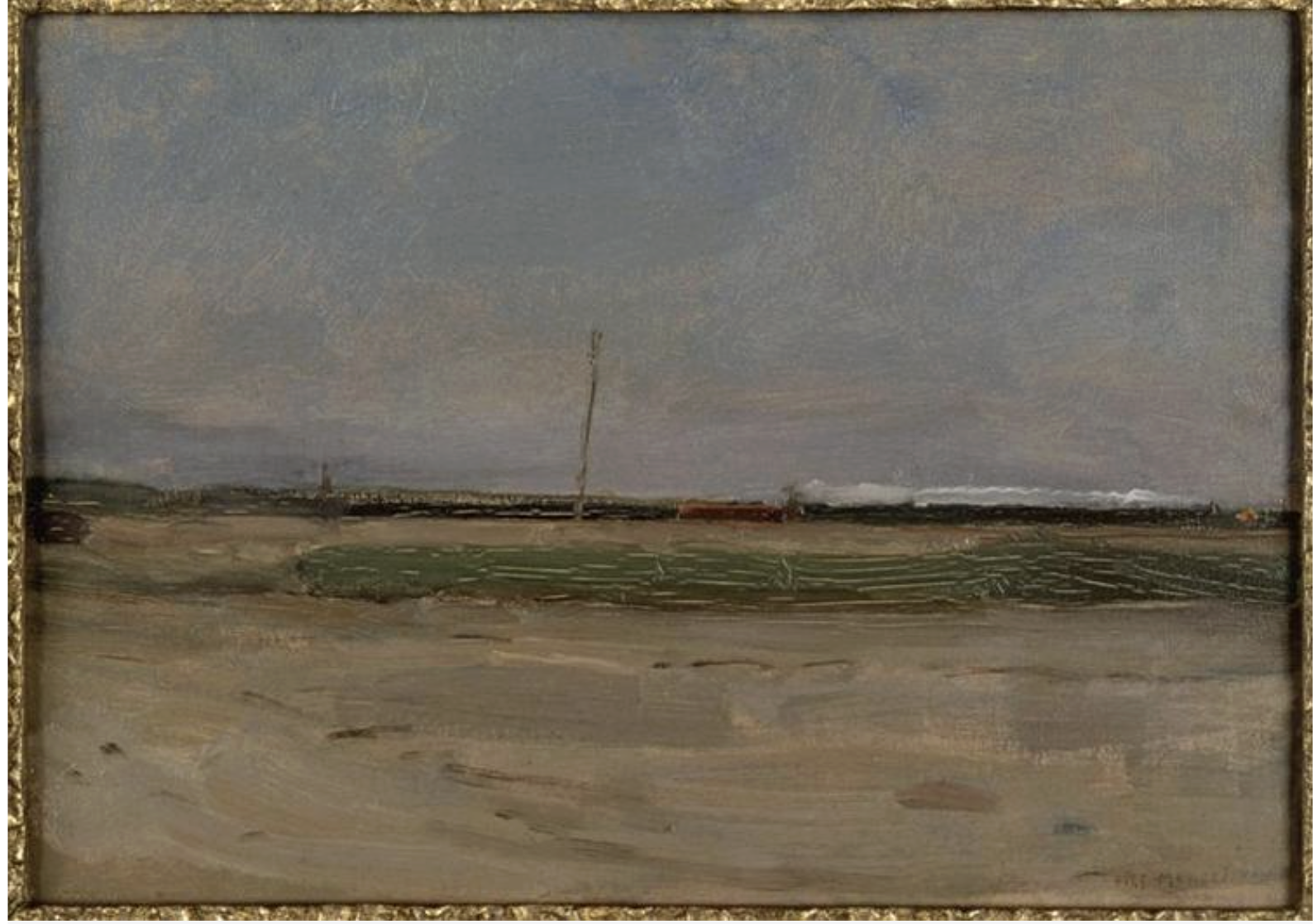
where the spatial depth of the landscape is given by the scale of the depicted train and windmill, through View from the Dunes with Beach and Piers, Domburg (1909)
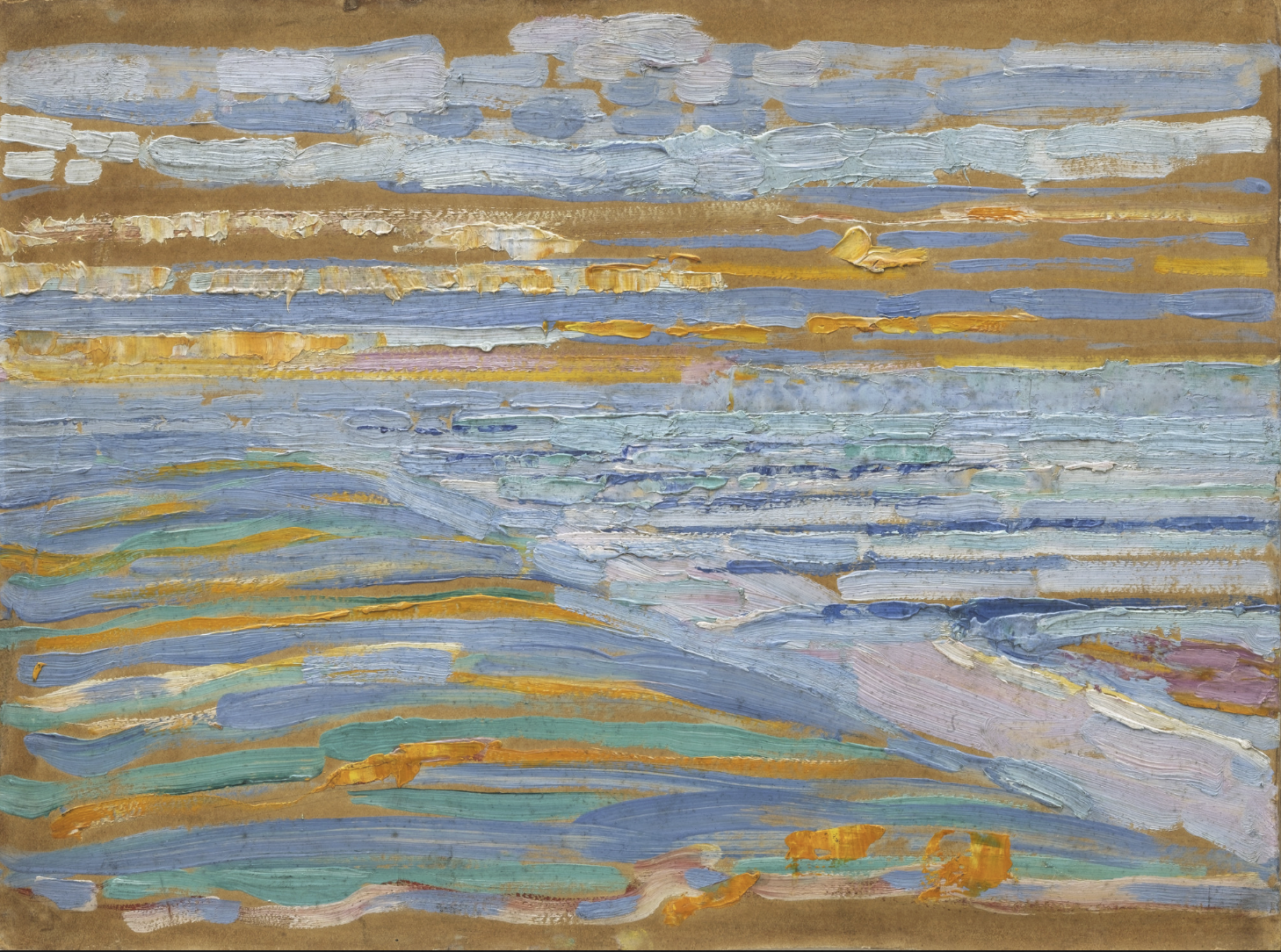
with the effect of mass given through juxtapositions of broad planes and the slightly convex line marking the meeting point of the dunes and the tide-swollen sea, to Pier and Ocean 5 (Sea and Starry Sky) (1915; mis-titled in the text)
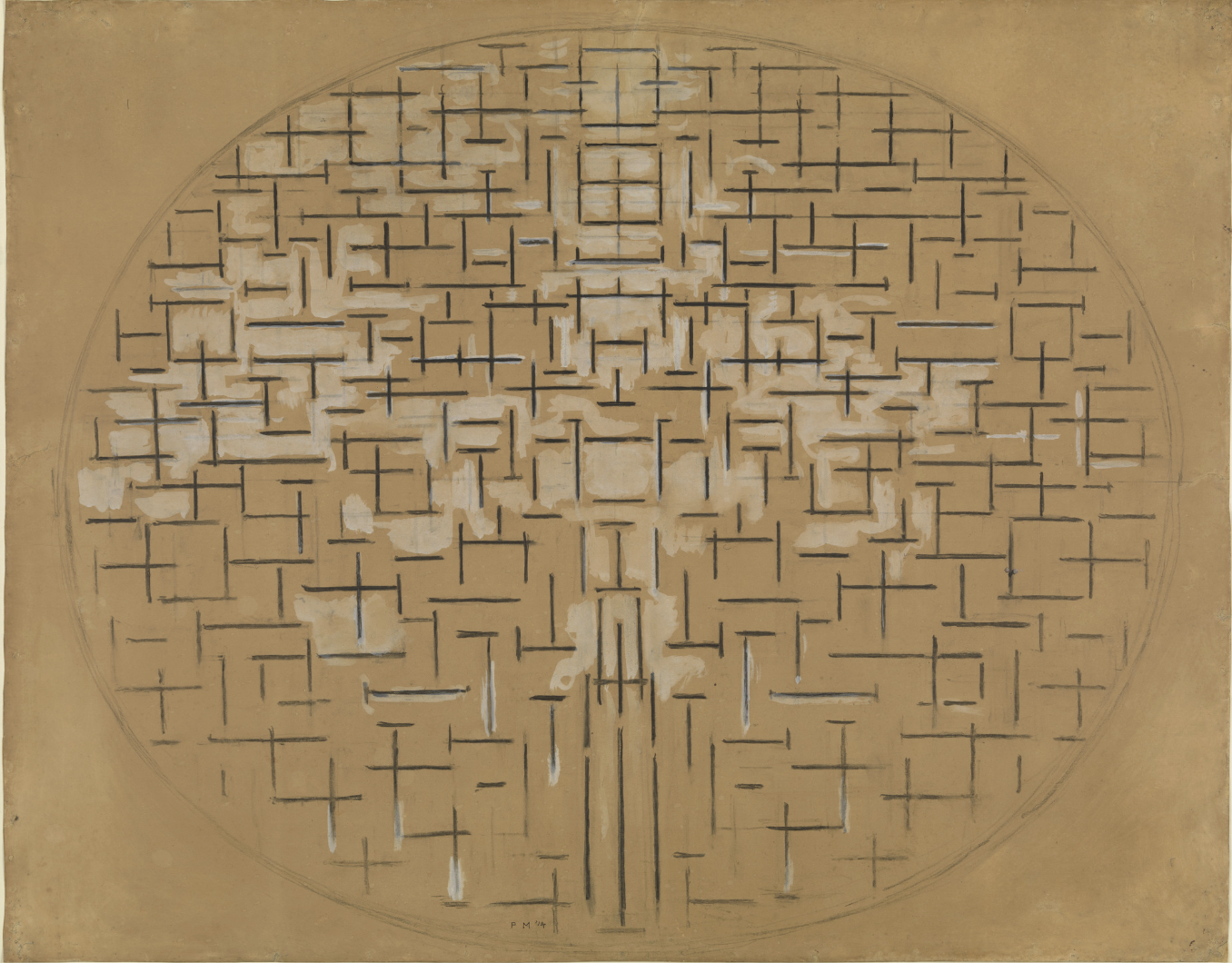
with the depiction reduced to short lines set in an oval, and the sensation of depth, expanse, and swell is given primarily through the play among small-scale crossings, the vertical thrust of the jetty at the bottom, and the oval frame.
This completes Descola’s breath-taking account of the four visual ontologies of animism, totemism, analogism, and naturalism. A key addition is Descola’s qualification that the reign of any ontology in any culture is never total; other ontologies might occur in marginal areas, or the culture itself might use one ontology for a large range of its visual artifacts, but another ontology for a specialized range. Descola devotes a chapter largely to the Tsimshian of northwest Canada whose visual ontology is primarily animist, especially in its shamanistic practices and related artifacts like masks and rattles, but also contains totemic heraldic elements in its decorations of houses. I suspect that for many readers what will be initially the most startling and provocative claim in the book is that contemporary visual art, which seems for Descola to hold sway starting in the immediate post-World War II period with Jackson Pollock’s drip paintings, involves a thoroughly mixed ontology: no one ontology predominates, and various artists use different ontologies in the service of their particular artistic aims. So by way of reflection and conclusion, in my final post I’ll first consider Descola’s account of recent visual art, then indicate a few places where his general account is the basis for attractive accounts of particular visual artifacts, accounts that differ from prominent prevailing accounts, and conclude with a sketch of some reasons for thinking that Descola has provided, contrary perhaps to his own intentions, an general anthropological account not just of visual ontologies, but also of visual artworks.
References and Works Consulted:
Philippe Descola, Forms of the Visible: An Anthropology of Figuration (2025)
John Golding, Paths to the Absolute (2000)